



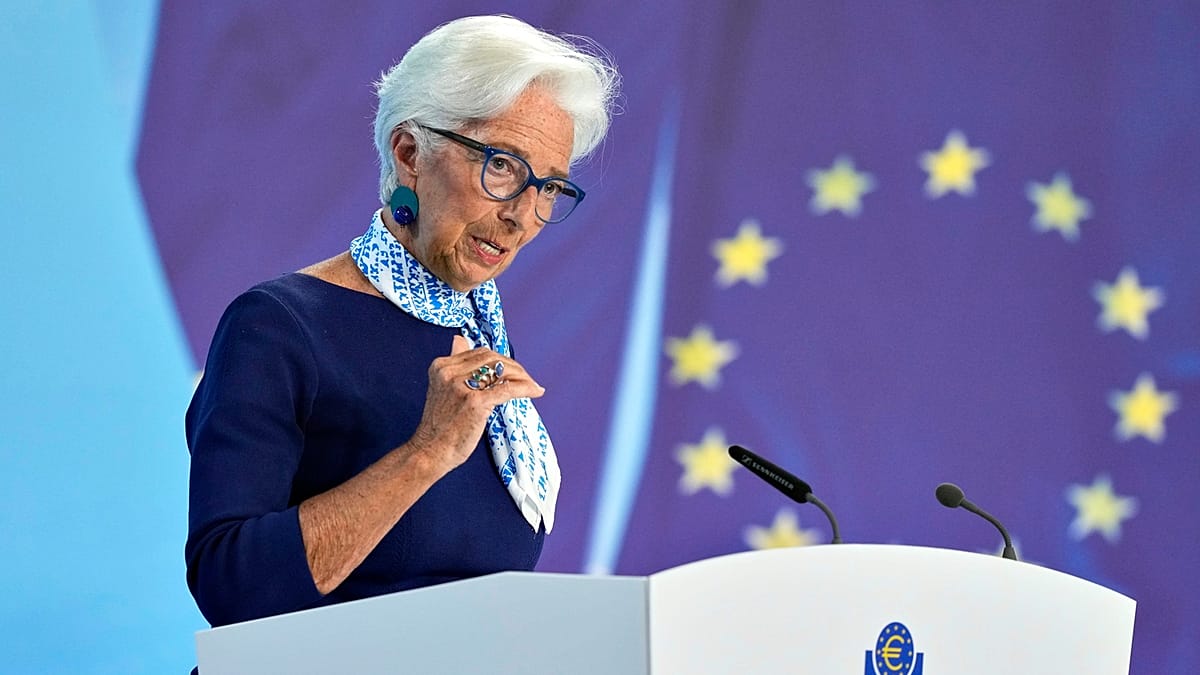
The European Central Bank has declined to provide emergency liquidity to the reparations loan for Ukraine, warning that doing so would breach the European Union’s founding treaties and undermine the bank’s much-prized independence.
The news, first reported by the FT, represents a new setback to the bold plan of using seized Russian assets to support the country it has invaded and destroyed.
“Such a proposal is not under consideration as it would likely violate EU treaty law prohibiting monetary financing,” a spokesperson for the ECB said in a statement.
The reparations loan is one of the three options presented by the European Commission to meet Ukraine’s financial and military needs for the next two years.
Under the scheme, the Commission would channel the immobilised assets of the Russian Central Bank to Ukraine as a zero-interest line of credit.
Kyiv would be asked to repay the loan only if Moscow agreed to compensate for the damages caused by its war of aggression – a virtually unthinkable scenario.
The bulk of the assets, about €185 billion, is held at Euroclear, a central securities depository in Belgium. Member states would have to provide binding guarantees to ensure that Euroclear has enough liquidity to honour its debt with the Russian Central Bank in any given circumstance – for example, if sanctions are lifted prematurely.
To strengthen the proposal, which has no precedent in modern history, the Commission informally asked the ECB whether it would be willing to inject liquidity if the guarantees were suddenly triggered and member states failed to raise the necessary cash.
The bank said such a backstop would amount to subsidising public spending, which is strictly forbidden under EU rules, and declined to commit.
On Tuesday afternoon, the Commission acknowledged having made the request and said it would look for “alternative solutions” to protect Euroclear.
“It is a must that the EU, its member states and private bodies can always fulfil their international obligations,” said Paula Pinho, the Commission’s chief spokesperson.
“We know that this is an absolutely essential part of the discussions.”
Mix and match
The news comes as the Commission prepares to unveil the legal texts to make the reparations loan a reality and provide Kyiv with fresh assistance starting early next year.
The presentation could happen as soon as Wednesday. EU leaders are meant to make a decision on how to support Ukraine when they meet again on 18 December.
Pinho said the reparations loan might be “combined” with one of the other two options pitched by President Ursula von der Leyen: bilateral contributions or joint EU debt. Both have been met with reservations by the vast majority member states.
“From the beginning, we have shown flexibility in terms of addressing how solutions could be found to meet what is the ultimate objective, which is to meet the financial needs of Ukraine for 2026 and 2027,” Pinho told reporters.
The ECB’s statement is likely to galvanise the government of Belgium, the custodian of the Russian assets, which has from the outset fiercely resisted the reparations loan.
Last week, Belgian Prime Minister Bart De Wever sent a scathing letter to von der Leyen, lambasting the proposal as “fundamentally wrong” and ridden with “multifold dangers”.
“I will never commit Belgium to sustain on its own the risks and exposures that would arise from the option of (a) reparations loan,” De Wever wrote.
In the letter, the PM demanded “legally binding, unconditional, irrevocable, on-demand, joint and several guarantees” to cover the €185 billion in Russian assets and all the potential fallout, such as arbitration costs, interests, investment opportunity loss and even the “quantification of financial impact to the Central Bank of Russia’s credit”.
He also asked for total coverage for Euroclear’s holdings in “Russia-friendly jurisdictions”, which he said could be subject to retaliatory measures. It’s unclear how much this would mean in practice, as some of the scenarios are entirely hypothetical.
“Some may hold the belief that this is only a theoretical exposure,” De Wever said. “l am making the point that this danger is, to the contrary, real and likely to happen.”
In previous speeches, the Belgian leader has underlined the importance of securing the European Central Bank’s blessing before moving forward.
ECB President Christine Lagarde has insisted that any proposal should comply with international law, safeguard financial stability and ensure solidarity among G7 allies.
G7 jurisdictions are estimated to hold $300 billion (€258 billion) in immobilised Russian assets. The UK and Canada have expressed interest in mimicking the reparations loan, but the US has put the assets on the table in the highly contentious peace proposal it has been discussing with Russia and Ukraine.