

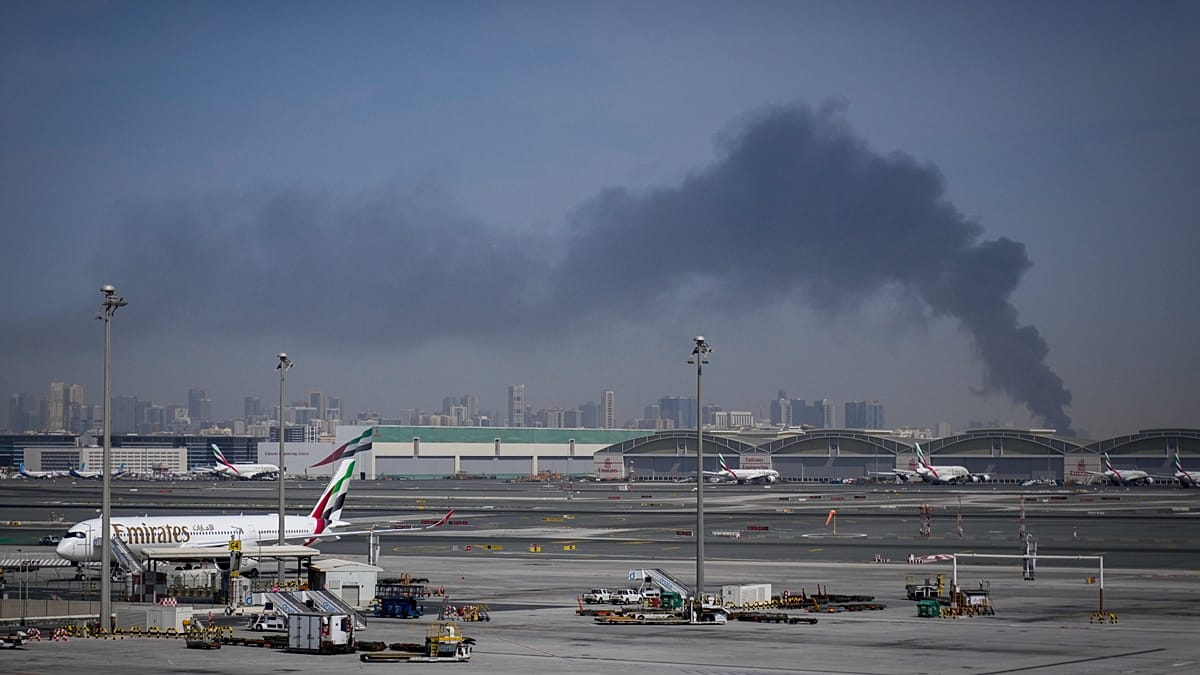
Social media has been awash with footage from influencers and tourists in the Middle East of Iranian retaliatory strikes being intercepted across the region.
ADVERTISEMENT

ADVERTISEMENT
But authorities are warning citizens, residents and visitors that those posting clips and images on social media could face legal consequences.
Rules are in place around sharing these videos and photographs because in doing so you could jeopardise security by revealing the position of defensive military installations. Footage could also be used for improving the aim of future strikes by revealing where exactly was hit.
Such rules are not unique to the region, and there are similar restrictions in Ukraine during the ongoing Russian invasion.
Two arrested in Bahrain for social clips of strikes
On Saturday 28 February, Bahrain’s Ministry of Interior announced that two people had been arrested for live broadcasts and publishing footage on their social media accounts.
“MOI affirms that anyone who films, post or repost videos from the scene of events is subject to legal accountability, as this constitutes a legal violation that could harm security and public order,” the ministry said in a statement posted on X.
Other regional entities have posted comparable statements across social media platforms.
Kuwait’s Ministry of Interior asked people to refrain from filming both the interception of missiles in the airspace and the authorities while they are carrying out their duties as this could “incite anxiety among community members, impact the course of security procedures, and contribute to the dissemination of inaccurate information”. The ministry went on to say that “legal measures” will be taken against those spreading rumours or promoting misleading news.
Qatar’s Ministry of Interior stressed the importance of “refraining from circulating rumours or publishing images or videos of the aftermath to avoid legal liability”, with the Dubai Media Office urging similar restraint.
The importance of official sources
As already mentioned, these rules are twofold and also aim to prevent the spread of fake news.
Authorities in each of the countries affected are regularly sharing updates on X and on their respective news agency websites.
Those in Bahrain can follow @moi_bahrain and @bna_en, while those in the UAE may want to follow @DXBMediaOffice and @ADMediaOffice. In Qatar, @QNAEnglish and @MOI_QatarEn should be your first port of call, while in Kuwait you should follow @kuna_en and @Moi_kuw. Jordan is posting updates on @PetranewsEN and @moi_jor; for Saudi Arabia follow @Spa_Eng and @MOISaudiArabia.
A number of embassies are also providing updates to citizens who register with them.
Euronews, which has bureaux in Doha and Dubai, is also running a live blog with updates that you can follow on our homepage.