


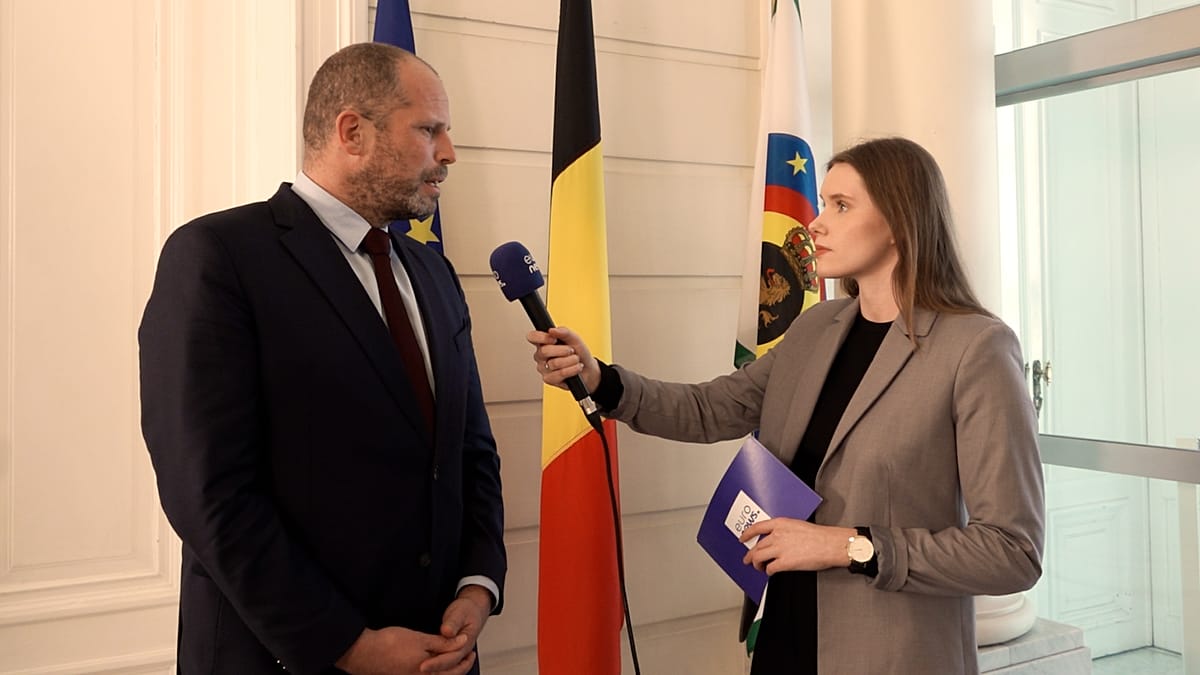
Belgian Defence Minister Theo Francken told Euronews’ flagship morning show Europe Today that while Brussels has concerns regarding the legality of the US-Israeli attacks on Iran, which have triggered a wider conflict in the Middle East, the overall cause can be defended.
ADVERTISEMENT

ADVERTISEMENT
“I think that when you see international law and the interpretation over the last few decades, that [the attacks] can be [seen as] problematic,” the minister said.
He emphasised that he understands the ongoing discussions around concerns over the legality of the US and Iran launching a coordinated joint attack on various sites in Iran on 28 February.
Spain’s Prime Minister Pedro Sánchez initially was the sole EU leader directly challenging the US and Israeli strikes, warning that they could heighten regional tensions and “contribute to a more uncertain and hostile international order”.
He doubled down on his stance on the war on Wednesday after President Trump announced that he would block trade with Spain due to Madrid’s reluctance to back the US offensive against Iran or allow the US use of the Rota and Morón bases.
On Tuesday evening, French President Emmanuel Macron joined Sánchez in challenging the legality of the attacks, saying they were conducted “outside of international law” and that Paris “cannot approve of them”.
However, the Belgian defence minister said the attacks can be defended, and that the end justifies the means.
“It’s a righteous cause to try to decapitate the Ayatollah regime, that’s something totally rightful,” Francken told Euronews.
“I cannot support [this] regime. Not for a second. It is the cruellest regime in the world. They’re supporting Hamas, they’re supporting and financing Hezbollah and Houthis and all those terrorist actors in the Middle East, but also in Europe, also here in Brussels, also in Belgium.”
Offering defence support
Francken also confirmed that the Belgian Defence Ministry is not only preparing for repatriations, but also to provide military support in the conflict region.
“These will be defensive actions,” he explained. “So, for example, a country like Jordan, asking for aid, then we can help them to protect their territory.”
Francken emphasised that Belgium would not get actively involved in the conflict.
“It’s not to start a war […] or to participate with Israel and the United States. It’s more to help people and countries in the Middle East,” he said.
Several European countries have already offered defence support to Cyprus after a UK air base was targeted by Iranian-made drones on Monday. Both Greece and France agreed to send frigates, while France will also send additional land-based, anti-drone and anti-missile systems to the country. Germany also responded positively to a request to send a warship.
Asked whether he believes the EU as a whole should do more, Francken explained that, like with military decisions, up to every individual country to choose how to respond.
“So that’s not easy. I think that Europe needs to be very clear on the support for Cyprus. But [regarding] the Middle East, it’s more like bilateral,” he said.
Ukraine ‘remains number one priority’
Francken also commented on the Belgian navy’s recent interception and seizure of a tanker suspected of forming part of Russia’s shadow fleet, which is used to circumvent EU sanctions.
Belgium received support from the French army during the operation, dubbed “Operation Blue Intruder”.
The boat, named Ethera, has been under judicial seizure in the Belgian port of Zeebrugge since Sunday. The Belgian government has imposed a bond of €10,020,000 on the oil tanker; the ship can only leave the port once this has been paid and an inspection has proven it is legally compliant.
This marked the first time Belgium has carried out such an operation, and Francken told Euronews it signals a step up in European efforts to target Moscow’s fleet of vessels.
“We need to really increase pressure on Putin’s regime to [move forward with] peace negotiations that are true and well-meant. We don’t have that for the moment. And I think that the only way we can increase pressure is to work on their income, to work under oil and gas revenues,” the minister explained.
“That means that we also need to tackle the logistics lines, which means tackling the shadow fleet. So, we will continue on that pathway.”
Asked whether the conflict in the Middle East may now draw Brussels’ attention away from the Russian war on Ukraine, Francken said this would not be the case.
“I think that the eastern part of our continent will continue being the number one priority.”