


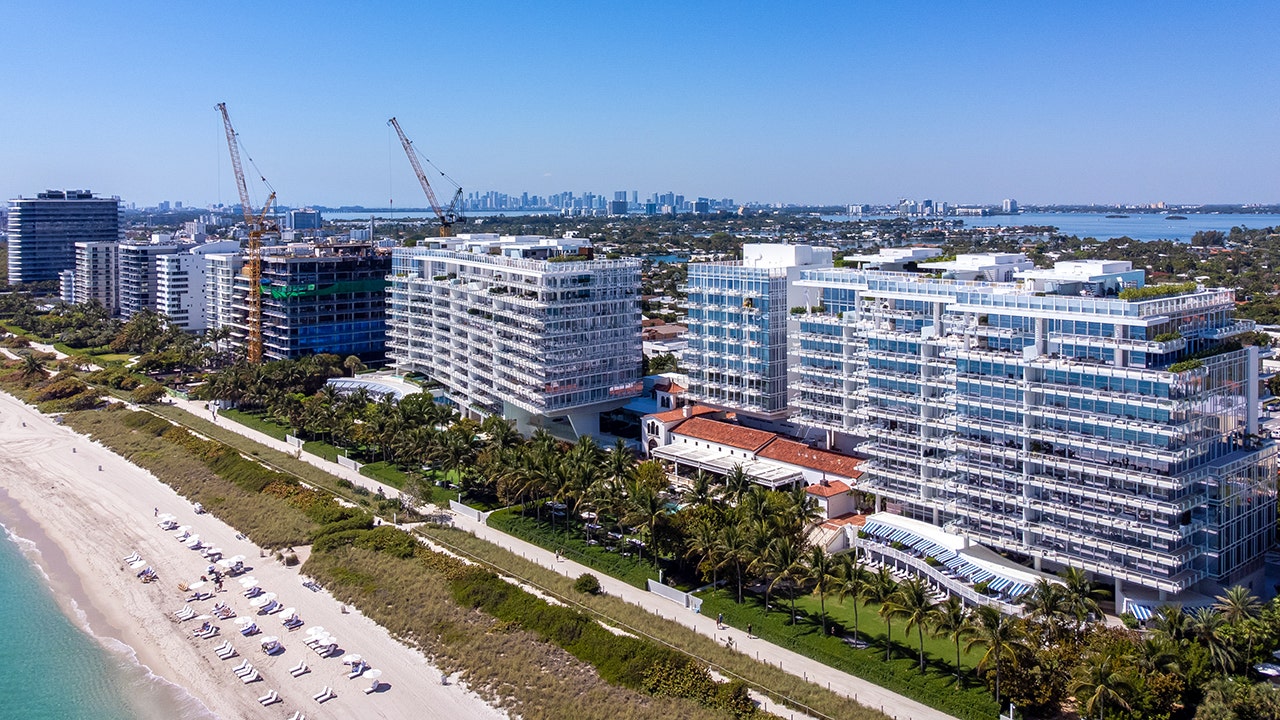
From the moment you step through a private foyer and into the sun-washed living area, it’s clear that $44 million buys more than just a view; it buys a masterpiece.
At the legendary Four Seasons Surf Club in Surfside, Florida, the modern coastal aesthetic is defined by striking architecture and a warm glow all around, illuminating custom millwork and slatted wood feature walls. Outside, rows of crisp white umbrellas line tranquil pool decks that reflect resort-style luxury.
For titans like former Starbucks Chairman and CEO Howard Schultz, this is the new “Wall Street South” — a place where floor-to-ceiling glass erases the line between a high-stakes boardroom and the turquoise horizon of the Atlantic.
“It seems like the frequent thread that we discuss is, if they can facilitate business here, why would they do it in a place that is freezing cold? They may as well do it sitting next to the ocean,” The Corcoran Group’s Mick Duchon told Fox News Digital during a showing of a $21.95 million unit in the same residential building Schultz just moved into.
INSIDE AMERICA’S MOST GUARDED ENCLAVE: A RARE LOOK AT FLORIDA’S ‘NO BUDGET’ BILLIONAIRE BUNKER
“What I find with a lot of the buyers that are looking in this space in the market, they never really retire,” he continued. “So they’re looking for the next step in their adventure, like [Schultz], and it’s an exciting place to take that step.”
Last month, Schultz and his wife announced they had relocated to Florida for their “retirement phase,” leaving Washington state after nearly half a century. Schultz shared the news in a post on LinkedIn, recounting how he, his wife Sheri, and their golden retriever, Jonas, made the move from New York City to Seattle 44 years ago.
“We were starting a new life,” Schultz wrote, recalling how Sheri would be their primary income earner as he started a new job “at a place called Starbucks” in September 1982.
“The spirit of continuing forward has long underpinned our approach to life—in business, in philanthropy and most importantly, as a family,” Schultz further wrote. “We will be forever grateful for the memories made in Seattle and the relationships built along the way… To the family, friends and partners who made Seattle our home for so many years, thank you.”
He and his wife purchased a $44 million penthouse at the Four Seasons Surf Club Residences, The Wall Street Journal first reported, down from an initial listing price of $55 million. It features five bedrooms, a rooftop terrace, central courtyard, private garage and oceanfront cabana.
Schultz’s announcement came as Washington state has been working to pass what has been dubbed the “millionaires tax,” which would impose a 9.9% income tax on households earning more than $1 million annually. The Washington State House of Representatives passed the controversial bill in a 51-46 vote, and it was signed into law by Democratic Gov. Bob Ferguson on Monday.
“The wealth tax as a threat in the states that potentially may implement… is a major catalyst for these high-net-worth people moving here, and where we are right now at the Four Seasons Surf Club is a perfect landing for them because of everything that it offers,” Duchon said.
NEW YORK INVESTMENT GIANT APOLLO JOINS HEADQUARTERS MIGRATION TO ‘FREEDOM’ STATES
Living at the Four Seasons Surfside means buying into a history where Winston Churchill used to paint and the Rat Pack hung out. In 2026, it has been updated for the modern business leader with dining by three-Michelin-starred Thomas Keller and a state-of-the-art hammam and spa.
“The 1930s history… creates this historical importance, and it just adds character to the property, which is meaningful. It has a story built into the property that these people really appreciate,” Duchon noted. “It creates a place that these people are comfortable in.”
“The lifestyle here is extraordinary, the climate’s extraordinary, and the landscape is unbelievable and there’s a few properties — the Surf Club being one of them — that really fits the criteria that they’re looking for from a service perspective, an exclusivity perspective, security, architecture, design and location,” he added.
The billionaire landing pad that Duchon has as a pending sale is a turnkey four-bedroom, multiple-bathroom sanctuary spanning just over 5,000 square feet. Upon entering, guests are greeted by fine art, remarkable light fixtures and calming, comfortable white and beige furniture. In the dining area, a bespoke travertine wine cellar towers to the ceiling. The primary lounging space feels vast and grand, all while overlooking the Atlantic Ocean.
When it comes to greater Miami, some might see a cooling market. However, insiders argue that in the ultra-luxury tier, the rules of traditional real estate don’t apply.
“The market dictates the price, and sellers are entitled to ask whatever they want,” he continued. “The price points are open oftentimes, there isn’t a ceiling… They’re oftentimes willing to spend more than any other transactions in order to achieve what they want.”
“That market is separate from the rest of the market,” he expanded, “and there’s only specific properties that those high-net-worth people would consider, including Indian Creek, the Four Seasons… It’s a specific demographic that we’re focusing on, and it’s only really a specific type of product that they’re going to be interested in.”
As the sun sets over the emerald green lawns and white cabanas at the Surf Club, the message to the rest of the country is clear: Miami is the new destination for American capital and culture. The multimillion-dollar sales aren’t just isolated events; they are the catalysts for a “trickle-down” economy that is “really growing culturally” at a record pace.
“The transactions that are occurring now in this price point, they create a lot of momentum for the rest of the market, and it does have a trickle-down effect,” Duchon said. “It’s across the other markets on the islands and single-family homes and other condos… It has created more demand and appreciation comes from that. But it is a market within itself. So there are other spaces within the Miami market that are pretty stable and steady and approachable.”
READ MORE FROM FOX BUSINESS
FOX Business’ Stephen Sorace contributed to this report.