

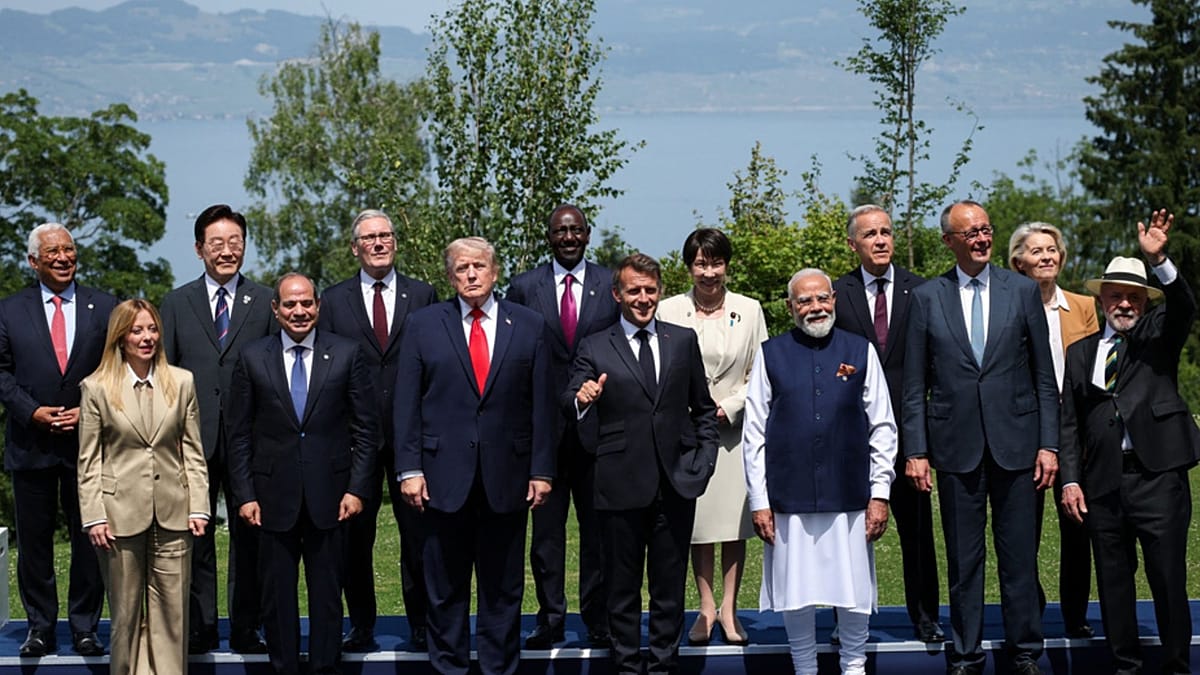
A series of misleading statements and videos has spread on social media in the wake of the G7 summit in Evian, France. Leaders from the Group of 7 countries, in addition to the EU and other invitee states, gathered there to discuss global geopolitical challenges such as the conflicts in Ukraine and the Middle East, as well as the world economy.
ADVERTISEMENT

ADVERTISEMENT
Many of the claims centre on US President Donald Trump’s interactions with European leaders, and what they’ve said about him. The Cube, Euronews’ fact-checking team, took a look at some of the more viral claims doing the rounds.
According to one post, Trump allegedly said at the summit that “Europe has gone woke” and that it’s not recognisable in many places, although Hungary, Poland, the Czech Republic and Slovakia have gone the opposite way.
The post shares a clip of the president indeed saying those things, but you can tell that he did not say them at the G7 because of the White House signage in the background.
The clip actually comes from a press conference he gave in February, in which the US president criticised the continent’s energy and immigration policies.
“I want Europe to strengthen up, Europe has gone woke,” he told reporters on 20 February.”Europe is not recognisable when you go into so many places. Not all countries. When you look at Hungary, you look at Poland, [the] Czech [Republic], Slovakia… There are some countries which have gone very much the opposite.”
“Europe’s getting killed on two things,” Trump later said in the speech. “Energy and immigration.” The Cube has already debunked many of his claims related to the continent’s energy and migration policies.
Other social media users mocked Ukraine’s President Volodymyr Zelenskyy, sharing clips which they say show Trump snubbing and turning his back to him.
While one video does seemingly show Trump turning around to greet European Commission President Ursula von der Leyen as Zelenskyy approaches, there’s little evidence to suggest that he deliberately ignored him.
The pair met at least once on the sidelines of the summit earlier this week, with Trump labelling it a “good meeting” and calling for Russia to make a deal with Ukraine to end its invasion of the country.
Zelenskyy, meanwhile, said that he had raised the prospect of building interceptors for Patriot anti-ballistic missile systems in Ukraine during talks with Trump.
Yet another claim circulating online alleges that French President Emmanuel Macron said that “it’s not the Americans or Trump who decide France’s future, nor do they decide French or European law”. This is somewhat true, but strips the statement of context.
Macron gave an interview to TF1 at the G7 summit, with the French news outlet asking him whether he would give in to Trump’s demands to scrap a digital services tax on global tech giants. The US president had otherwise threatened 100% tariffs on French wine and champagne.
Digital services taxes are interim levies on large multinational tech companies such as Google and Meta that generate revenue from digital services in countries where they lack a physical presence. Some European countries have introduced such measures, with the exact rates and rules varying by country.
For example, France levies a 3% tax on digital interfaces, online advertising, and user data, as well as a 1.2% tax on streaming services. Austria, meanwhile, imposes a 5% tax on online advertising revenues, and Hungary applies the highest rate in Europe at 7.5% on digital advertising.
Other countries with similar digital services taxes include Italy, Poland, Portugal, Spain and the UK.
In the TF1 interview, Macron said that he would not give in to Trump’s threats because “it didn’t work like that”. He explained that the digital tax was a law decided and implemented by several European countries.
He did indeed say that the US does not decide French or European law, but did not single out Trump specifically.
“This is normal, and this will not happen any differently as long as I’m here,” Macron said. “So we will have a respectful but firm discussion.”