
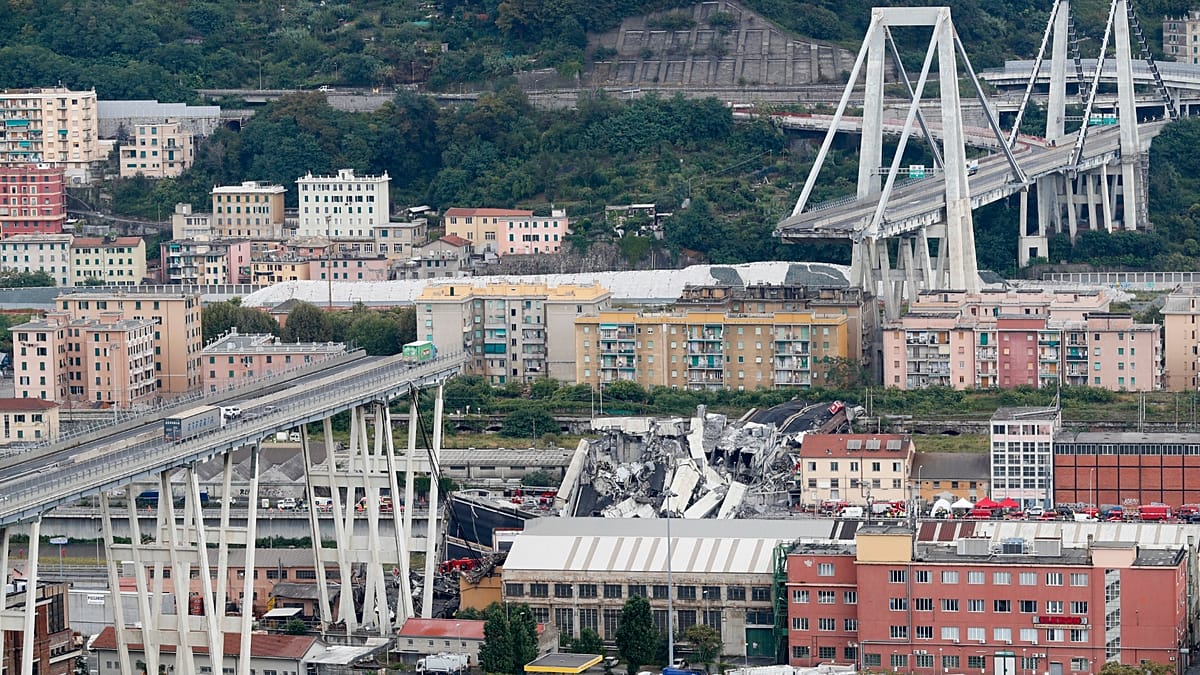
A court in Italy on Thursday sentenced Giovanni Castellucci, the former chief executive of Autostrade per l’Italia (Aspi), Italy’s largest motorway operator, to 12 years in prison over the 2018 collapse of Genoa’s Morandi Bridge.
ADVERTISEMENT

ADVERTISEMENT
The disaster was one of Italy’s deadliest infrastructure failures, claiming 43 lives.
Prosecutors had sought an 18-year-and-six-month sentence for Castellucci. He is already serving a final six-year prison sentence over the Avellino coach crash.
In all, 32 people were convicted and handed sentences ranging from 1 year and 11 months to 12 years. Others were either found not guilty, or lesser charges had expired under the statute of limitations.
Also convicted were Autostrade’s former head of maintenance, Michele Donferri Mitelli, who was sentenced to 11 years in prison. The former CEO of the SPEA engineering company, Antonino Galatà, received five years and six months.
Defendants faced charges including negligence resulting in the collapse and manslaughter stemming from failures to maintain the bridge, which was part of a main route linking northern Italy with the French Riviera.
Families of victims welcome the ruling
“I lost my sister, her two children, my brother-in-law and even their little dog. That’s where my determination comes from — to make sure they receive justice and that their deaths were not in vain,” Egle Possetti, who heads a committee to preserve the memory of the bridge victims, told reporters outside the courthouse.
“I think it is important that responsibility extends beyond those at the top. Autostrade, SPEA and the Transport Ministry all had roles to play. I hope the state’s responsibility also emerges clearly.”
However, Guido Carlo Alleva, lawyer for Aspi’s former chief executive Giovanni Castellucci, described the ruling as “wrong.”
“They have sought a culprit rather than establishing responsibility. Castellucci has been convicted despite having done nothing wrong. His only ‘fault’ is that he is innocent,” he said.
“I believe this is a profoundly wrong ruling. We will appeal,” Alleva added. “I always respect judges’ decisions and will carefully read the court’s reasoning for a ruling with which I do not agree in the slightest.”
The ruling comes eight years after the Morandi Bridge collapse
The Morandi Bridge, also known as the Polcevera viaduct, was designed by engineer Riccardo Morandi and opened in 1967.
It collapsed at 11:36 a.m. on 14 August 2018 during a violent storm, sending cars and lorries plunging to the ground. Forty-three people were killed and 566 residents were displaced.
According to prosecutors, the collapse resulted from a strategy by Aspi’s top management to cut maintenance costs and boost profits, while the Ministry of Infrastructure failed to carry out adequate oversight.
The defence argued that the collapse was caused by a structural defect in the viaduct — a hidden flaw in the stay cables, which connect the bridge deck to its supports — that could not have been detected in advance and which led to corrosion and the failure of pier 9.
The trial, which began on 7 July 2022, involved hundreds of witnesses and a vast amount of evidence.
Over four years of proceedings, the court heard 282 witnesses across the same number of hearings. The case also produced more than 24,000 pages of transcripts, 10,000 pages of records and a 5,000-page closing brief from prosecutors.
The current Autostrade chief executive, Arrigo Giana, issued a public apology Thursday in an open letter published in major Italian dailies.
“The actions and decisions of some people left indelible scars,’’ said Giana, who joined Autostrade as CEO last year. “Offering today the apology that was not made then is, for us, a moral imperative that goes beyond establishing legal responsibility and the course of justice toward the truth.”
