


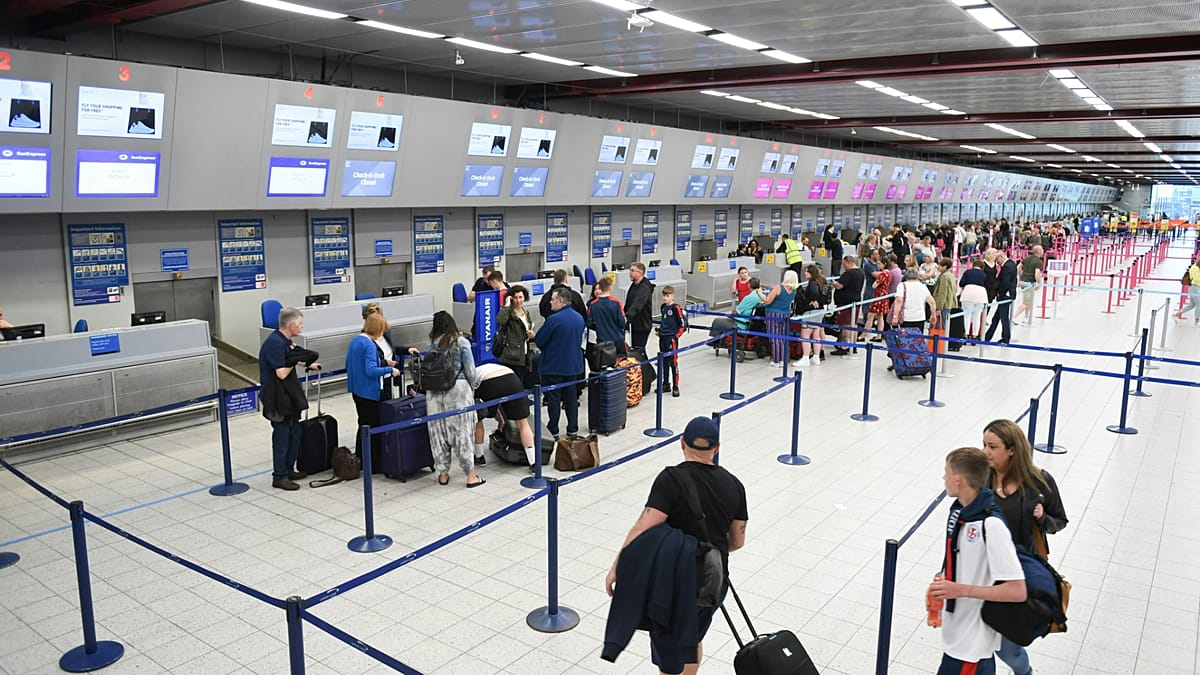
For the first time since Europe’s air transport recovery after the Covid-19 pandemic, passenger traffic has fallen year-on-year.
ADVERTISEMENT


ADVERTISEMENT
The number of flyers across the European airport network dropped by -0.7% in April 2026 compared to the same month last year, according to European airport trade body ACI EUROPE.
The group says that while marginal, the decline “marks a significant milestone”.
Why are fewer people flying in Europe?
ACI EUROPE says April’s performance reflects a combination of factors, including the conflict in the Middle East, the partial shift of the Easter holidays into March this year, and industrial action heavily affecting the German market.
Some airports are continuing to expand. The best EU+ performances came from airports in Slovakia (+125.2%), Slovenia (+14.6%), Estonia (+12.1%), Malta (+13.5%) and Poland (+8.3%).
Among the largest EU+ markets, Spain (+3.7%) and Italy (+2.2%) posted the best results.
However, airports in Germany (-8.5%), the UK (-2.1%), and France (-0.9%) saw passenger volumes receding. Cyprus (-16.1%) and Iceland (-11.7%) registered the steepest decreases, followed by those in Austria (-7.4%) and Switzerland (-6.1%).
Europe’s biggest and smallest airports were most impacted
Overall, ‘major’ airports (-3.5%), along with ‘mega’ airports (-1%) and ‘large’ airports (+0.1%), were the segments most impacted by the conflict in the Middle East, as they concentrate most of Europe’s connectivity to the region.
Amongst the majors, Barcelona (+4.1%), Madrid (+3.3%) and Amsterdam-Schiphol (+2.7%) were the only ones seeing passenger traffic increase in April.
Munich (-16.4%) and Frankfurt (-11%) posted the sharpest decrease, largely due to no less than seven days of industrial action during the month.
Istanbul Airport (-6.8%) and Istanbul Sabiha Gökçen (-3.4%) – usually top performers – both contracted in April, with volumes also declining at London Gatwick (-8.8%) and London Heathrow (-5.34%). Meanwhile, Rome-Fiumicino (-0.6%) and Paris-CDG (0.0%) were essentially flat.
Conversely, ‘medium’ airports (+2.1%) and ‘small’ airports (+5.5%), whose route network is predominantly intra-European, remained largely insulated, on the back of low-cost carriers not reducing capacity and some demand shifting from long-haul to medium/short-haul travel.
Small airports, however, kept faring the worst when compared to pre‑pandemic (2019) levels at -27.7%, reflecting structurally changed market conditions and significant financial viability challenges.
EES system remains an ‘immediate concern’
Olivier Jankovec, Director General of ACI EUROPE, says April marks a clear inflexion point for European air traffic.
“While we were already seeing a normalisation of passenger traffic growth after the strong post-pandemic bounce-back, geopolitical instability – most notably the war in the Middle East – is now further weighing on growth and exposing significant differences in performance across markets,” he says.
“The encouraging news is that demand generally remains strong, airlines capacity adjustments limited, and fears over potential jet fuel shortages have eased.”
Jankovec adds, however, that the most immediate concern remains “the severe disruptions and hardship imposed upon passengers by border control processes linked to the Schengen Entry/Exit System”.
“Unless authorities are allowed to introduce greater flexibility, including fully suspending the system where operationally necessary, disruptions for passengers will intensify over the coming weeks and months,” he says.