

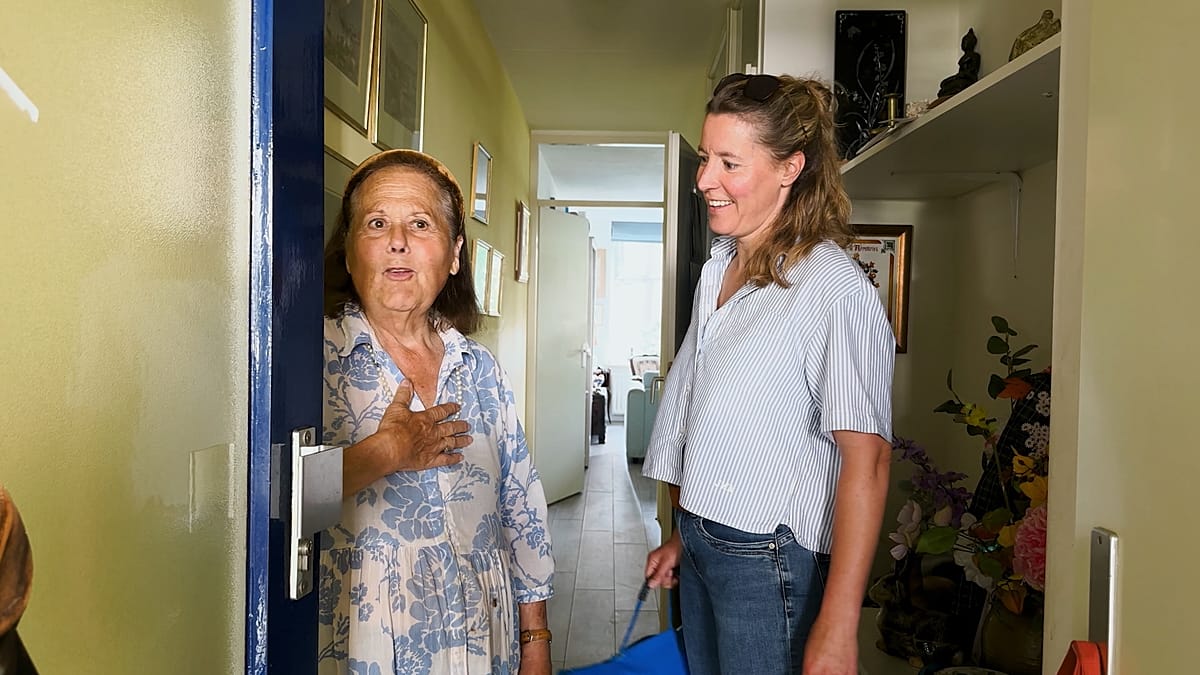
“What a lovely day! Blue sky, a shining sun. It’s a gift!”, exclaims Anne-Marie, as she greets Deborah Warta, a community nurse, starting her daily visits to patients, in the Dutch city of Amersfoort.
ADVERTISEMENT


ADVERTISEMENT
At 88, and despite living with dementia, Anne-Marie Wildbergh delights in the simple pleasures of life.
After watering the flowers she cares for on her balcony, she walks back gleefully into her flat, as Deborah reminds her it’s time to take her medicine. “Oh yes! Here’s the day’s candy”, Anne-Marie says jokingly, picking up the pills that were just spilled out from a small automatic dispenser.
Anne-Marie is intent on remaining positive, helped by happy memories of her beloved husband, the warmth of children, and the daily care provide by Deborah and her team.
“It’s good that people in my situation can have carers looking after us at home. And I’m never alone. It really helps”, she says. “And you also take care of yourself very well”, adds Deborah. ”You cook, you shower, you dress well, and you’re enjoying your life in your neighbourhood.”
Home care: more than medical treatment
For Deborah, care is about more than medical treatment.
She works for Buurtzorg, the Netherlands’ largest home-care organization. Its name literally means “neighbourhood care”.
It became an international reference for its unusual approach: small teams of self-managing nurses, and a strong focus on helping people remain independent at home.
Something that Bert de Bruin, another of Deborah’s patients, suffering from Parkinson disease, plans doing for as long as possible.
“The way Deborah and her colleagues take care of me is extraordinary” says Burt. A brief experience in a rehabilitation centre after an accident has not left good memories. “I felt somehow like a number. Now I can really feel the difference.”
“Bert has a lot of professionals around him, And we have very close contacts with each other. If anything happens, we can react very quickly” says Deborah.
After her morning visits, the energetic nurse bikes to another neighbourhood to join her colleagues for a team meeting.
There is no manager leading the discussion. Decisions are taken collectively by the nurses themselves: a hallmark of the Buurtzorg model.
“I started it all because I felt that the community care system in the Netherlands was getting worse and worse.”, says Jos de Blok, a former nurse who founded Buurtzorg in 2006. “Nurses were frustrated as they couldn’t provide the best possible care to their patients anymore, because there were so many people telling them what or what not to do. And they couldn’t solve problems for patients that could easily be prevented through a direct relationship with them”.
No managers, better care, at a lesser cost
Team autonomy, says Jos de Blok, has proved efficient in many ways.
“The carers feel ownership, they feel accountable for what they’re doing and they try day by day to do the best possible things for their patients. And if you don’t interfere, it all goes well!” he explains. “And when you develop a good relationship with patients who trust you, you can not only prevent problems, but also gain a lot of time”, he adds.
Buurtzorg now employs around 15,000 people across the Netherlands and has inspired similar initiatives with partners in more than twenty countries, in Europe, Asia or South America.
“We’ve shown that by doing the right thing at the right time, you can do it faster, and with less money”, smiles the CEO.
“We have almost no overhead. My idea is that if we use these principles throughout the healthcare system, costs would go down by 25%.
You should only focus on what’s really needed. Good healthcare is putting a skilled person with a patient that needs something. And doing the right thing at the right time, while involving the people around so that they can participate in the best possible way.”
The philosophy extends beyond physical care.
In Amsterdam, Marjolijn Onvlee, a Buurtzorg district nurse, and Anke Sprakel, a reporter specialized in the judiciary, co-produce Radio Steunkous, which means “support stocking”.
Armed with a mobile recording studio, they’re on the lookout for stories from older residents for their weekly podcast.
“What do you do to stay healthy?”, asks Anke to an elderly man wearing a cycling helmet. “I go swimming he says. But I also read and write a lot, to keep my mind active. Because I have Alzheimer’s disease”, he confides.
“Mental care is just as important as physical care”, insists Anke. “That’s why we decided to create a programme for older people who are at home, about health care, getting older, and life experience.”
Everyone can help others stay healthy
“And we believe that telling stories to each other is good for your health”, adds Marjolijn. Everyone can contribute, and everybody can be a “support stocking” for somebody else” she smiles.
We end the day in a café set up in what used to be the pharmacy of a public medical center.
The most recent of Marjolijn’s initiatives, also supported by Buurtzorg.
“People come here for a nice cup of coffee, to have a chat and meet one another, but we’d also like to share health knowledge.”, she explains.
With the center’s healthcare professionals, the nurse wants to create a hub offering not only social interaction but also comfort and advice to the nieghbourhood’s elderly inhabitants.
“We believe that we need each other”, says Marjolijn. Everyone is important, to help each other stay okay.”

