




It’s a digital gold rush as data-center development sweeps through small-town America.
As demand for artificial intelligence, cloud computing and digital storage surges, developers are racing to secure land, power and water.
That growth is becoming increasingly concentrated: nearly 1% of U.S. counties, roughly 33, now account for 72% of all data-center activity as of July 2025, according to a recent Goldman Sachs analysis. But the map is changing almost daily.
One Georgia community is experiencing that shift in real time.
GOOGLE TO INVEST $40B IN TEXAS DATA CENTERS IN MAJOR AI PUSH
Newton County, about an hour east of Atlanta, is one of four counties that host Meta’s Stanton Springs campus.
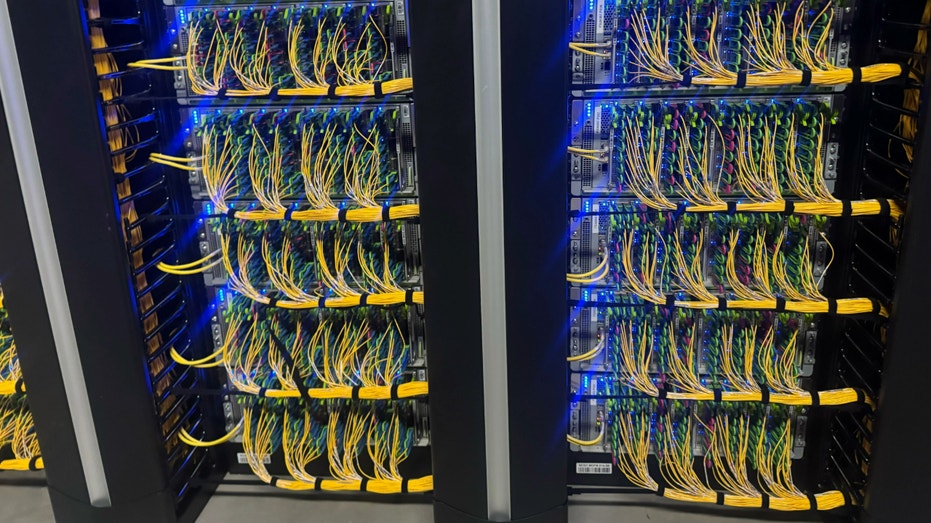
FOX Business was granted an exclusive look inside the facility, which opened in 2018 and has continued to expand, with a second campus now under construction. The 1,000-acre site houses eight massive buildings, each roughly the length of four football fields, packed with rows of high-speed servers humming 24/7. The cable network is long enough to reach the moon and back. And it’s where data for Facebook, Instagram, WhatsApp and Meta’s other platforms is processed and pushed at record speeds.
It’s just one of 26 data centers currently under construction or already in production in the U.S., with even more growth on the horizon.
“I’ve been in the industry for over 20 years, and I’ve never seen this level of focus on data centers,” KC Timmons, director of SiteOps Global Operations at Meta, told FOX Business. “It’s innovative. There’s so much good that we can do.”
Meta’s arrival was largely welcomed, and its investment has become a major economic anchor for the region, creating hundreds of jobs, supporting local contractors and generating long-term tax revenue for schools and public services. The company now employs roughly 400 people in HVAC, electrical, operations and technical roles, most of them hired from the surrounding community.
| Ticker | Security | Last | Change | Change % |
|---|---|---|---|---|
| META | META PLATFORMS INC. | 673.42 | +11.89 | +1.80% |
But Meta’s presence now sits alongside the explosive growth the county has experienced just this year. And not everyone is thrilled about it.
“It’s all pie in the sky,” Newton County Commissioner LeAnne Long told FOX Business. “It’s not what they say it is. These big developers come in with lucrative promises like zoning, water, electricity. It is the biggest smoke-and-mirror thing you’ve ever seen.”
NORTH CAROLINA RESIDENTS FIGHT BACK AGAINST MASSIVE TECH PROJECT POTENTIALLY COMING TO THEIR TOWN
Long, who is also a real estate broker in the region, questions what happens years from now if the industry’s footprint shifts and the massive buildings are no longer needed.
“What happens to the communities that we’ve lost?” Long asked.
Newton County has become one of the most aggressive data center build-out zones in Georgia. Since January alone, local officials say 11 additional data centers are in various stages of planning or construction. Amazon has already begun building on a $25 million acreage purchase – about $50,000 per acre – powered by Georgia Power. And in nearby Social Circle, where Meta is located and which spans both Newton and Walton counties, officials have zoned seven more data-center projects with no long-term land-use plan in place.

“Some would say we’re building the plane while flying it,” Serra Hall, executive director of the Newton County Industrial Development Authority, told FOX Business.
Serra said Meta’s success has drawn a wave of new interest to the region, making strategy and coordination more important than ever. Since the beginning of the year, she says her phone has been ringing off the hook with inquiries from companies looking to build nearby.
MYSTERY COMPANY’S $1.6B DATA CENTER PROPOSED FOR WISCONSIN FARMLAND DRAWS RESIDENTS’ IRE
Part of the reason the growth is accelerating so rapidly is the county’s access to power, proximity to I-20 and the extensive fiber infrastructure established by Meta. Through the Open Compute Project that Meta co-founded, the initiative to create open-source hardware for scalable and efficient data centers has helped drive down costs. The OCP initiative actively encourages and facilitates more companies to build and adopt high-efficiency data center infrastructure.
“We’re trying to bring everyone to the table and slow things down,” Hall said. “It’s about working on the path together. It takes good planning.”

The influx of data centers brings benefits beyond jobs. Since 2022, when Meta’s first taxable buildings came online, the company has contributed $12 million in cumulative tax revenue – a number expected to rise as construction continues. Before Meta arrived, the same land had been off the tax digest for nearly two decades under government ownership.
Meta has also launched initiatives to support small businesses, such as workshops teaching local owners how to grow through Instagram Reels. Amazon, meanwhile, has partnered with Newton County Schools and Goodr to open a no-cost grocery store providing students with fresh produce and shelf-stable food.
| Ticker | Security | Last | Change | Change % |
|---|---|---|---|---|
| AMZN | AMAZON.COM INC. | 229.53 | +0.42 | +0.18% |
Still, residents say the promises don’t always match their lived experience. Several major manufacturers – including Meta, Rivian and Takeda – have partnered to recycle water back into the community, but concerns persist as the development footprint grows.
“This all has just become so popular since Jan. 1,” Long said. “I didn’t even know what a data center was a year and a half ago. We’ve just been bombarded.”
Long stressed that Meta itself isn’t the issue – its campus sits in a designated business zone and hasn’t disrupted residential life. Her concern is the wave of newcomers, the risk of future vacant megastructures, and the effect speculative development could have on home values.
For longtime residents, the pace of construction is becoming harder to ignore.
Lisa Miller, 64, lives near land that once held a lumber mill and is now Amazon’s active construction site.

“We’re not a big place,” Miller told FOX Business. “People out here are into cattle, horses.” The area has shifted among rural, suburban and industrial uses for decades, but never at this speed.
Blasting and heavy construction have also raised safety concerns. Miller described one neighbor’s experience: “She heard the blast – and then her whole living room ceiling fell in.”
Amazon told FOX Business its $11 billion investment will enable AI innovation and create thousands of jobs, from network engineers to construction workers, and also give back to the community.
“As we build these facilities over the next several years, we remain committed to being good neighbors,” a spokesperson said.
Energy demand is another growing concern. Data centers will use roughly 8% of all U.S. power by 2030, and U.S. utilities will need to invest around $50 billion in new generation capacity to support the facilities, according to Goldman Sachs.
Despite the anxieties, local leaders and residents agree that the solution isn’t to reject the industry – it’s to slow the pace, coordinate and plan for long-term consequences.
Meta, as the region’s earliest anchor, has committed to supplying more renewable energy than it consumes and becoming water-positive by 2030, aiming to model responsible development.
“If I could say something to the whole nation, it would be: think it through,” Miller said. “Plan it. Don’t just stick ’em in every cow pasture that goes up for sale.”


