



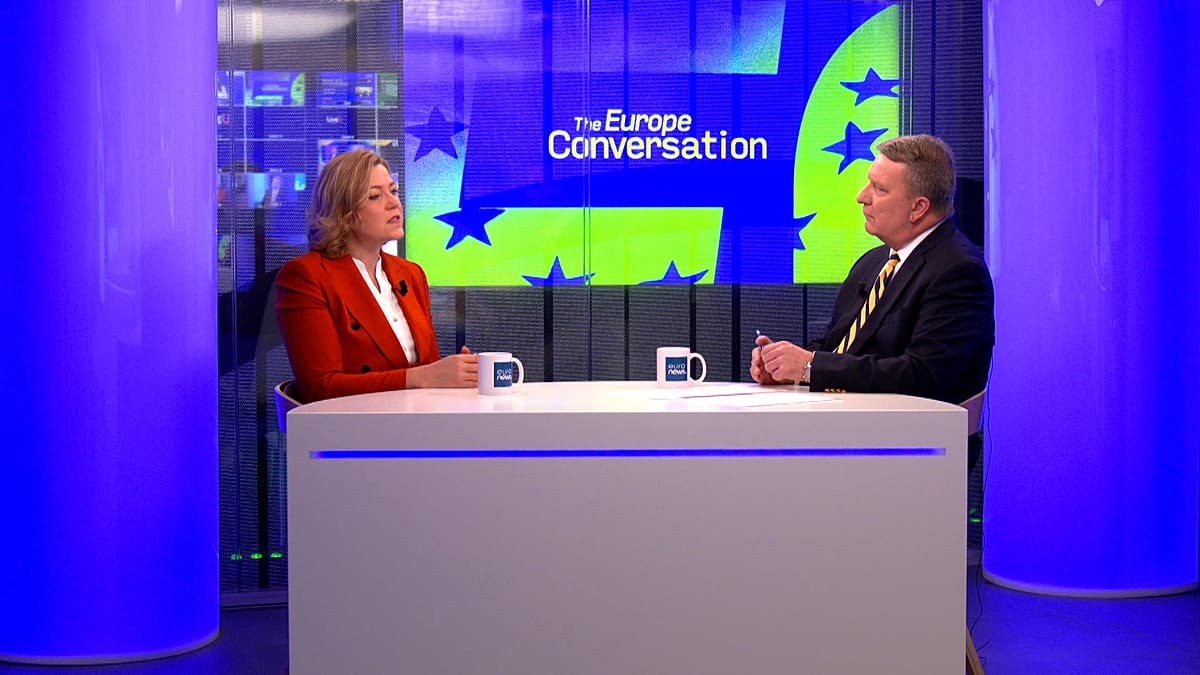
Existing differences of opinion about digital rules in the European Union and the United States should not be a source of confrontation, but should be treated in a respectful way, the Executive Vice President of the EU Commission, Henna Virkkunen, said on Euronews’ flagship programme The Europe Conversation.
“When we speak about democracies like the European Union and the USA, I think democratic countries and friends, we can handle those kinds of differences in our rules with respect,” urged Virkkunen, whose portfolio in the Commission includes Tech Sovereignty, Security and Democracy.
“Europeans are very committed to our rules because we want to make sure that we have a fair and safe democratic environment, also when it comes to the digital environment,” Virkkunen added.
Her comments came as the row over the controversial AI chatbot Grok between Brussels and Elon Musk’s social media platform X escalated.
On Monday, the European Commission launched a formal investigation into Grok, after the outcry at the platform’s failure to prevent the creation of sexually explicit images of real people, including children, without their consent.
If X is found to have breached EU online platform rules under the bloc’s Digital Services Act (DSA), the Commission could fine the company up to 6% of its global annual turnover.
“We are now collecting evidence from the X and Grok side,” Virkkunen said.
The US government has repeatedly cast EU action to rein in US tech giants as “discriminatory” and “unjustified” attempts to censor American viewpoints.
In December, the Trump administration denied visas to a former EU Commissioner, Thierry Breton and to other Europeans who were instrumental in EU efforts to counter hate speech and disinformation online.
When US tech companies are doing business in Europe, they have to follow the rules – but so do Asian or European companies, Virkkunen noted.
France’s under-15s social media ban
Asked whether she supports a social media ban for young teenagers as promoted in France, she avoided taking sides.
Instead, she stressed the necessity of having appropriate age verification tools in place to enforce such bans.
“Some very small kids, they already have their own social media accounts. And now the member states are discussing what the right age really is for that,” Virkkunen said.
“We are focusing our investigations now so that online platforms are really taking the responsibility that a high level of safety, security, and privacy is ensured for our minors, because it’s our obligation,” she added.
On Monday, France’s National Assembly backed a bill that would ban children and teenagers under the age of 15 from social media.
The law could come into force by next September if approved by the Senate.
“Our children and teens’ brains are not for sale,” the French President said. “Our children and teens’ emotions are not for sale, or to be manipulated – not by American platforms nor Chinese algorithms.”
The French legislation is part of a wave of measures being discussed across Europe, following Australia’s enforcement of the world’s strictest social media rules for children under 16 last year.
Denmark also wants to block access to social media for anyone under-15s, with potential, parental-approved, exceptions for 13- to 14-year-olds – a move that could potentially become law by mid-2026.


