

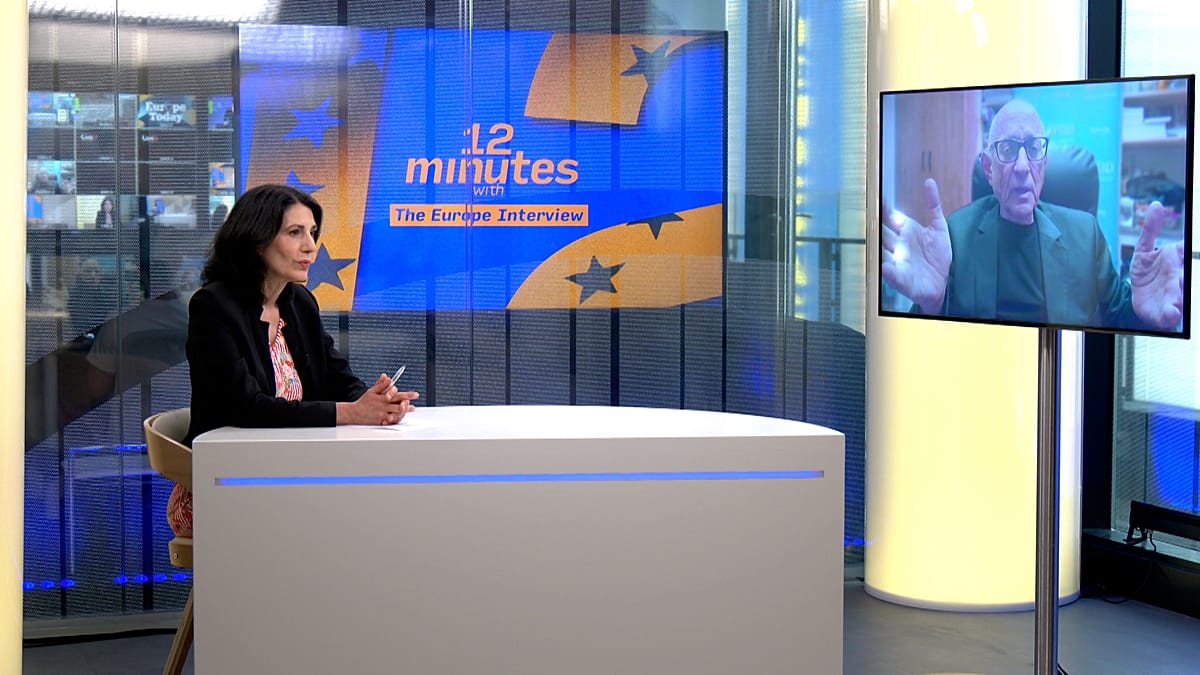
European Union leaders must recognise that the most pressing challenge they face is an internal one — not possible disagreements with Israel, Prime Minister Benjamin Netanyahu’s former national security advisor, Jacob Nagel, told Euronews.
ADVERTISEMENT


ADVERTISEMENT
His comments come as EU-Israel ties are coming under strain. Earlier this month, Israel’s Foreign Minister, Gideon Sa’ar, severed all contact with the bloc’s foreign policy chief, Kaja Kallas, due to alleged comparisons of Israel to apartheid-era South Africa.
Meanwhile, the European Commission is under pressure from some of its member states to propose a range of options to restrict EU trade with illegal Israeli settlements in the occupied Palestinian territories.
“At the end, I think that also the EU countries will come to their senses and will realise who are the good guys and who are the bad guys,” Nagel, who served for more than 40 years in Israel’s Defence Ministry and the Prime Minister’s Office and is now a Senior Fellow at the Foundation for Defence of Democracies (FDD), said onEuronews’ interview programme 12 Minutes With.
He argued that the EU “is not relevant” — even though the bloc remains Israel’s largest trading partner — echoing a statement made to Euronews by Netanyahu last year.
Nagel went on to state that the EU and its leaders should focus on different, more pressing issues.
“See some of the countries inside Europe, and I don’t want to say names, you go in the streets, there is terror,” he said.
“There are some European countries that understood it, and they took their fate into their hands, but some have already lost the war against the immigrants. I think Europe is facing a big problem that it has to solve, and its problem is not Israel.”
US ‘remains our best friend’
Asked if US-Israel relations had recently come under strain over the latter’s military operation in Lebanon, Nagel acknowledged there may have been some tension but insisted that “Israel and the US are the best allies. They are our best friends.”
On the Israeli side, while Netanyahu avoided direct public criticism, some government and opposition figures denounced Washington’s apparent sidelining of Israel in the US ceasefire memorandum of understanding (MoU) with Iran, signed on 17 June, and for dragging the Jewish state out of the conflict before it achieved its goals.
On the US side, Trump reportedly angrily berated Netanyahu at the start of June over Israel’s threats to resume airstrikes on Beirut and its southern suburbs, jeopardising talks with Iran, which were ongoing at the time.
Later, Vice-President J.D. Vance told Israel it was isolated on the international stage, saying Trump is Israel’s only ally left in the world.
While stressing he understood Trump’s reasons for engaging with Iran, Nagel said the US president was nonetheless “making a mistake” by prioritising domestic interests, particularly the economy — the biggest concern for US voters — over securing a more favourable deal to end the Iran conflict and preventing the Islamic Republic from eventually acquiring a nuclear bomb.
“Iran is now getting exactly what it wants and needs,” he said, pointing to the reopening of the Strait of Hormuz and the temporary waivers for Iranian oil exports, which means that Iran will, at least during the 60-day negotiation period provided by the MoU, receive direct, conventional hard-currency payments.
Experts estimate that selling oil legally could generate roughly $8 billion (around €7 billion) during this initial 60-day window alone.
“Trump is now listening to his close allies like Vice-President J.D. Vance, [Steve] Witkoff and [Jared] Kushner, and not listening to [Defence Secretary Pete] Hegseth and [State Secretary Marco] Rubio and others, and he decided to prioritise the American interests; he wants to bring down the price of oil.”
Both Hegseth and Rubio have been advocating a more hawkish line on Iran to limit its power and guarantee US security and that of its allies, including Israel.
However, Nagel recognised that Trump’s ‘America first’ drive and focus on bringing down the price of oil is “legitimate” given November’s mid-term elections and rising fears among Republicans over a Democratic takeover of Congress.
“The people in the US, they don’t know where Iran is, where Israel is, what enriched uranium is. They just know how much they are paying for a gallon of oil when they go to the gas station,” he said.
“We would very much like the US to be with us, but sometimes they have their own interests,” Nagel also said, adding that this is merely a temporary shift in attitude.
“The US will come to its senses very soon. We work together with them. At the end, they will understand who the Iranians are, and they will go back to make sure that the work is finished.”

