


The European Union’s flagship initiative to cut pollution from heavy industry has hit its first birthday, but a new watchdog study claims the bloc’s ambition has caved in to the biggest polluters with more than 750 meetings between lobbyists and EU officials registered in just 12 months.
ADVERTISEMENT

ADVERTISEMENT
The investigation by the Corporate Europe Observatory (CEO), covering the period from 26 February 2025 until 3 February 2026, shows that the EU’s Clean Industrial Deal has been captured by heavy industry lobbying and reshaped into a subsidy machine for Europe’s biggest polluters.
The research couldn’t be more timely, as corporate intervention in EU policymaking has already achieved tangible results. CO2 emissions requirements for cars and vans have been watered down and a ban on combustion engines has been delayed.
Environmental obligations have also been softened, and the EU’s carbon border tax has been simplified and diluted, with further changes likely. The same goes for the bloc’s headline climate policy, the EU carbon market, which is slated for review by the summer and already under attack by the industry.
“A year later, it is clearer than ever that in reality it is more of a Dirty Industrial Deal,” reads the CEO’s research. “It is championing the weakening of regulations (known as ‘simplification’) that protect the public and the environment, while creating a myriad of less than ‘simple’ mechanisms to throw money at some of the EU’s most polluting companies.”
Séjourné and Hoekstra held most meetings
More than three lobbying meetings a day took place across 16 European Commission departments, the research reveals, with 90% involving corporate interests and only 8% involving civil society.
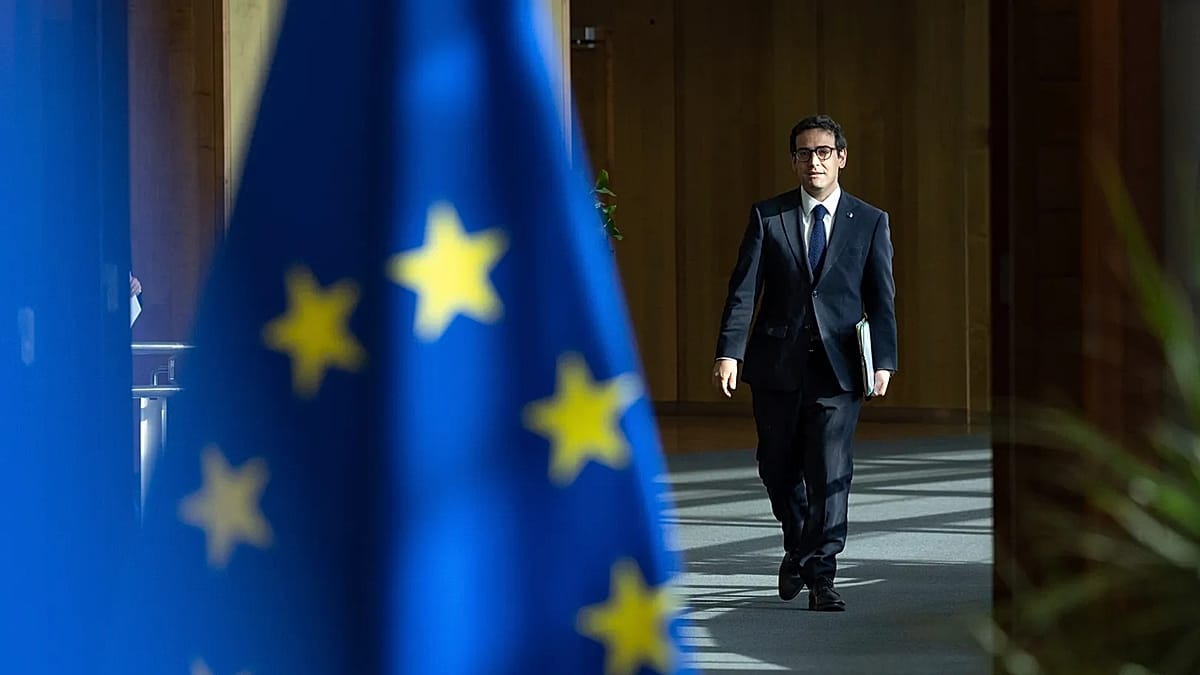
The most lobbied power centre was the office of Industrial Market Commissioner Stéphane Séjourné, with 131 meetings in a year, followed by the office of Climate Action Commissioner Wopke Hoekstra, with 60 meetings.
By contrast, the Commissioner for a Clean and Competitive Transition, Teresa Ribera, barely features, with only 20 meetings – a stark contrast with Séjourné, who, together with her, is responsible for delivering the bloc’s effort to restore Europe’s industry to the global forefront in the face of fierce competition from China and the United States.
The CEO’s investigation is based on public records, yet the Brussels-based watchdog noted that these figures are “merely the tip of the iceberg,” as lower-level staff, who are often the target of lobbying operations, are not obliged to disclose their meetings.
“That’s particularly worrying, given how aggressively business has been lobbying to weaken protections for workers and the environment, and is sidelining those who are supposed to defend those interests,” CEO writes, adding the findings reflect the broader “pro-business bias that has been baked” into this Commission.
Brussels-based trade associations representing the metals and mining sector, the steel industry, nuclear energy and car giants dominate the meetings with EU officials, CEO research reveals.
Leading the charge is the steel lobby, on behalf of Europe’s industrial giants ThyssenKrupp and ArcelorMittal, with trade association EUROFER topping the list with 39 meetings. Next in the ranking is the French multinational electric utility and nuclear giant Électricité de France (EDF).
And despite ranking only third, organisations from the automotive sector had the biggest lobbying firepower, employing 190 lobbyists and declaring a combined yearly lobbying budget of almost €15 million.
National politics shaping EU policies
The findings reveal that corporate influence in Brussels goes beyond corporate capture and instead amounts to strategic national industrial power politics, with France winning the race.
“The Clean Industrial Deal, and in particular its crowning jewel, the Industrial Accelerator Act, has mirrored a distinctly French economic doctrine,” CEO researcher and campaigner Pascoe Sabido told Euronews: “state-backed heavy industry, deregulation in the name of “competitiveness”, and public finance used as an industrial weapon. Séjourné, with substantial industry support, has succeeded in scaling this up to the European level.”
The French nuclear giant EDF has been one of the most active lobbyists shaping the bloc’s industrial deal, with 12 meetings.
Marcin Korolec, Director at the Green Economy Institute and former Polish climate Minister, said industrial policy is “clearly top-tier” in the EU.
“Leaders are actively courting business and positioning themselves as part of the solution. Strong focus on ultra-short-term instruments in order to step up the pace,” Krolec said, noting the “clear differences” at national level.
“France is pushing the EU debt as an investment booster, and Germany is focusing on red tape and the Emissions Trading System (the EU’s carbon market). A clear absence of Poland and the entire Central and Eastern Europe region could make the choice prevailing or at least add a new perspective,” said Korolec.
“This matters for shaping the narrative ahead of the EU’s multi-annual budget for 2028–2034 and public procurement framework revision,” the Polish national added.