



Cruises have long been established in the mainstream travel market. Many holidaymakers like the fact that they can visit several destinations without constantly changing hotels; the room travels with them, costs are predictable, and the organisational effort remains manageable. Demand has risen in recent years, both on the high seas and on inland waterways, and this trend is likely to continue in 2026.
ADVERTISEMENT


ADVERTISEMENT
River cruising in particular is on the rise. According to the German Travel Association (DRV), cruises were among the most dynamic areas of the German travel market in 2025. German holidaymakers spent around 6.7 billion euros on ocean and river cruises, an increase of 8 percent from the previous year.
River cruises on a growth trajectory
A recent study by IG RiverCruise indicates that in 2024, the European river cruise market recorded 1.39 million passengers, 3.537 billion euros in gross ticket revenue, and almost 10 million overnight stays. The survey covers data on 358 ships on Europe’s rivers.
The DRV sees the main focus on the Rhine and its tributaries, followed by the Danube, French waterways and the Nile. Guests from North America are becoming increasingly important, and markets in Australia and various Asian countries are also developing positively.
Benjamin Krumpen, chair of the DRV’s cruise committee, told Euronews: “River cruising continues to show very positive development and, together with ocean cruising, remains an important growth driver for the travel industry.”
The shipping company A-ROSA Flussschiff specialises in cruises along European rivers. The company told Euronews that the combination of a relaxed pace, comfort and variety appeals not only to classic cruise guests but also to a younger clientele. River cruises have therefore long since moved beyond a niche product.
The Rhine as a key route
In Germany, the Rhine remains the main stage for river cruises. Few other rivers link so many well-known cities, landscapes and cultural regions along a single route. Between Amsterdam, Cologne, Mainz, Speyer, Strasbourg, and Basel, historic old towns and striking landscapes line up one after another.
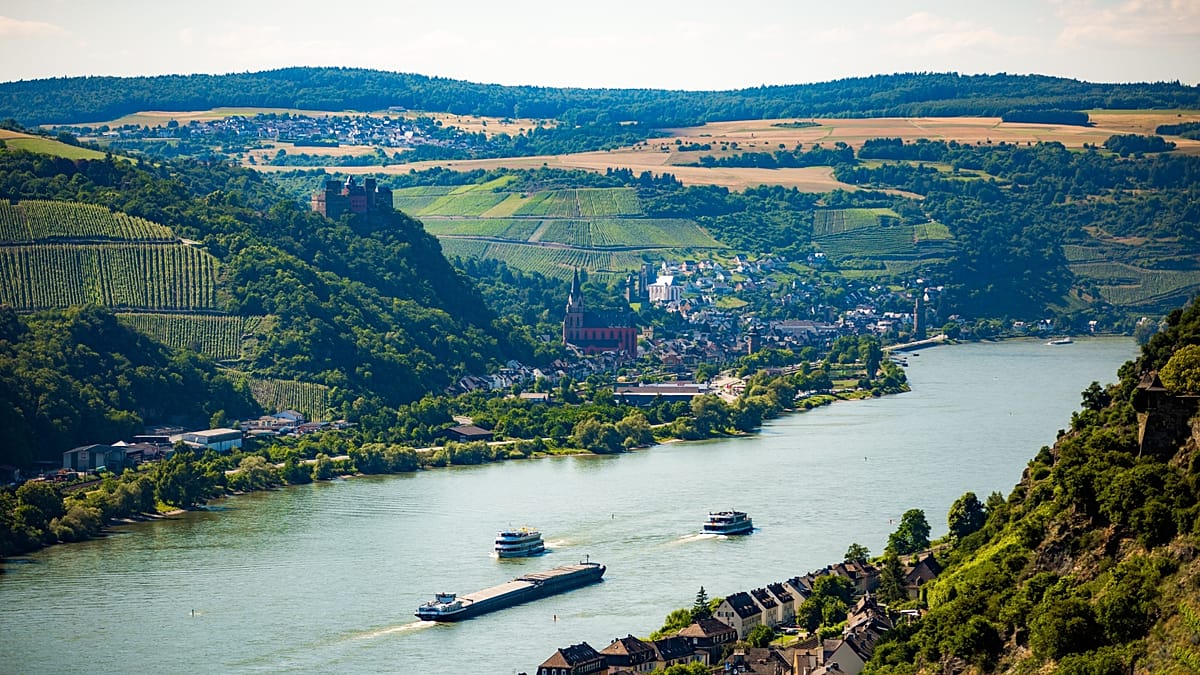
Trips through the Middle Rhine Valley with its castles, vineyards and the Lorelei rock are particularly in demand. The combination of UNESCO World Heritage, legendary scenery and wine-growing areas makes this stretch one of Europe’s best-known river cruise destinations. For international visitors, it often corresponds to an image of Germany that brings together culture, landscape and history.
Tributaries such as the Moselle, Main, Neckar, Saar and Danube further broaden the range on offer. They lead to smaller towns, wine villages, and culturally distinct regions that are often less visible on classic travel routes.
New tourism opportunities
One example of the market’s dynamism is Weil am Rhein. There, the Rheinhafengesellschaft port authority wants to expand its remit and in future also allow passenger vessels to dock. Two new berths are planned. Once completed, an estimated 15 ships a week could dock there.
The project opens up new tourism opportunities for the town and the wider region. From there, passengers could take excursions to Weil am Rhein, the Black Forest or Switzerland. At the same time, the project shows that river cruises are increasingly also seen as an infrastructure issue.
Many regions could benefit from investment in berths, port facilities and tourism connections. According to the DRV, river cruises create added value for ports, hotels, restaurants, retailers and excursion providers.
Infrastructure as a bottleneck
According to the DRV, however, there is considerable need for modernisation along inland waterways. Key challenges include a lack of shore power connections, moorings in need of renovation, insufficient berthing capacity, and restrictions affecting locks and other hydraulic structures.
Benjamin Krumpen told Euronews: “Infrastructure development in many places cannot keep pace with the growth of the sector and its requirements.” Technical failures or renovation work repeatedly lead to delays and make planning more difficult for shipping companies and guests.
The association also warns of competitive disadvantages. If investment fails to materialise, operators could shift more capacity to other European cruising regions.
From the operator’s perspective, however, the crucial point is not expansion at any price, but sensible integration into existing structures, as the A-ROSA company explains.
TUI expands river cruise business
Tourism groups are also aware that the river cruise market is growing. TUI River Cruises (part of the TUI Group) announced two further river cruise ships for spring 2026 and plans to expand its fleet to ten ships by 2028. The new vessels are to operate in Europe, including on the Rhine, Danube and Main, and are designed to run on alternative fuels such as methanol.
IG RiverCruise, Europe’s leading industry association for the river cruise sector, points to technological advances on the market. It says 61 percent of passenger vessels in Europe can already run on synthetic fuels, and 96 percent can connect to shore power. Shore power is seen as one of the key levers for greater sustainability in port operations, as ships can switch off their engines while alongside. The technology is therefore available, but its use depends heavily on infrastructure on land.
Environmental issues along the rivers
The environmental footprint remains a central bone of contention. Environmental organisations have for years criticised the fact that ships, depending on their propulsion system and operating mode, emit pollutants such as sulphur oxides, nitrogen oxides, particulate matter, and CO2. Especially in ports and sensitive waters, this can affect air quality, noise levels and ecosystems.
In river cruising, the debate is particularly tangible because ships travel directly past towns and riverbanks, in the immediate vicinity of residential areas and protected sites. Issues such as cleaner propulsion systems, wastewater treatment, waste disposal and time spent at berth therefore concern not only the climate but also local acceptance.
Routes beyond Europe
In Europe, the Danube, Douro, Seine and Rhône, alongside the Rhine, are among the most popular river cruise routes. Each has its own profile: the Danube stands for major cities and wide cultural landscapes, the Douro for wine regions, the Seine for a blend of metropolis and countryside, and the Rhône for Mediterranean-style scenery.
Outside Europe, the Nile, Amazon, and China’s Yangtze River also have a firm place in the portfolio. For operators, the point is not just to market individual rivers, but to combine routes, culture and excursions into a complete travel product.
How sustainable is the boom?
The market is growing, routes are becoming more diverse, and infrastructure is also catching up. This is precisely where the key question for the coming years lies: how can further growth be managed without increasing environmental impacts, traffic problems and conflicts over public acceptance?
The future of river cruising will therefore not be measured by booking figures alone. What will also count is how well ports, operators and regions handle emissions, noise, traffic, and residents’ expectations. If Germany wants to remain competitive in Europe, the underlying conditions will have to keep pace with growth.