



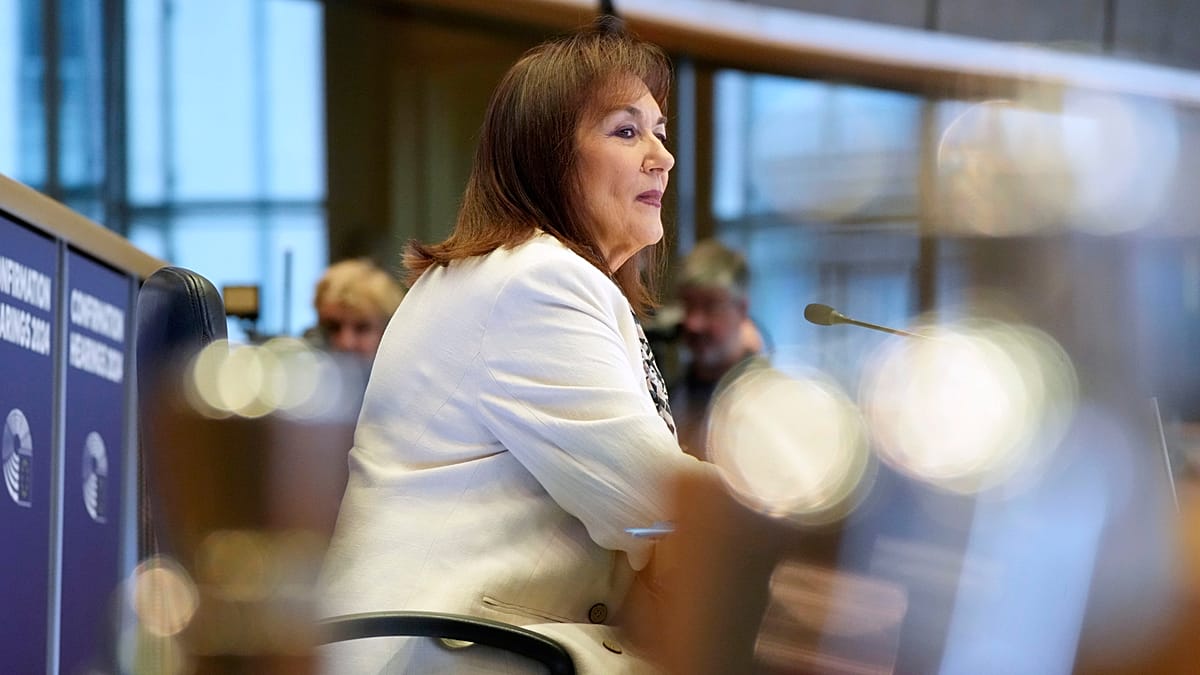
Paris is demanding an explanation from the European Commission for its decision to send the Commissioner for the Mediterranean, Dubravka Šuica, as an observer to the first formal gathering of United States President Donald Trump’s Board of Peace on Thursday, saying she doesn’t have a “mandate”.
ADVERTISEMENT


ADVERTISEMENT
“We are surprised because she doesn’t have a mandate from the Council to go and participate in this meeting of the Board of Peace,” spokesperson Pascal Confavreux told reporters in Paris on Thursday. “She will have to explain it when she returns.”
France, Belgium, Spain, Ireland, Slovenia, Sweden and Portugal were among a handful of EU countries who raised objections to Šuica’s attendance of the gathering in Washington during a closed-door meeting of ambassadors on Wednesday, warning that her presence risked being interpreted as a collective endorsement of the controversial body.
The board’s charter, which makes no reference to Gaza, has been widely criticised for its global mandate that seemingly aims to supplant the United Nations, and for entrusting sweeping powers to Trump as lifelong chairman.
A non-paper drafted by the EU’s diplomatic arm and seen by Euronews raises a series of legal concerns surrounding the Board’s charter, including the way the “autonomy of the EU legal order militates against a concentration of powers in the hands of the Chairman”.
“The Board of Peace needs to re-focus on the situation in Gaza,” Confavreux added, saying that “as long as there is an ambiguity on (the Board’s) parameters, France cannot participate.”
Slovenia’s Foreign Minister Tanja Fajon also said on Thursday that her government had “reservations” about Šuica’s participation, suggesting that the Commissioner lacks authority over EU foreign policy, which is conducted based on unanimous positions agreed by member states.
Meanwhile the EU executive remained defiant on Thursday, defending Šuica’s participation as central to the EU’s efforts to contribute to Gaza’s post-war recovery and reconstruction.
“Our participation is really to be seen in the context of our long-standing commitment to the implementation of the ceasefire in Gaza, as well as our commitment to take part in international efforts when it comes to the recovery and reconstruction of Gaza,” a spokesperson for the EU executive said.
“We do believe that we need to be at the table, otherwise we will simply be a payer and not a player” in Gaza’s future recovery, the spokesperson added.
The EU is the biggest donor of humanitarian aid to the Palestinian people, with a total contribution of €1.65 billion to the territories since the outbreak of the war between Israel and Hamas on 7 October 2023.
The Commission’s spokesperson also underlined that as many as 14 of the EU’s 27 member states have sent a diplomatic representative to the Thursday meeting, in a clear signal that governments do not want to be sidelined from the talks on Gaza’s post-war future.
Backlash grows
Yet most countries are opting to send a diplomat or civil servant, while the Commission is dispatching a political representative, something that diplomats say has left several capitals uncomfortable.
An EU official, speaking on condition of anonymity, confirmed that Šuica did not plan to intervene during the meeting later on Thursday to express the Commission’s positions.
The official added that her presence was a way to avoid being excluded completely from the board’s plans for Gaza’s recovery.
The Commission itself continues to maintain it will not join the board as a member, citing doubts over its scope, governance and “compatibility” with the United Nations charter.
Hungary and Bulgaria are the only EU countries to have expressed the wish to sit on the board as permanent members. But 14 countries, including Germany, Italy, the Netherlands and Poland, have since sent a diplomatic representative to observe Thursday’s meeting.
Šuica’s participation has also sparked anger among MEPs. Nathalie Loiseau, a French MEP who sits on the European Parliament’s foreign affairs committee, questioned the “mandate” that allows Šuica to join the meeting in Washington.
“Since when does the Commission decide on this kind of issue behind the backs of the member states? She will have to explain herself quickly,” Loiseau wrote on X.
The centre-left Socialists and centrist Renew Europe have also issued statements calling for the Commission to explain the decision.
“Legitimising a body that sidelines UN & invites autocratic influence is against EU principles,” the Renew Europe group said.
The Left, meanwhile, has described the move as a “pathetic act of bending the knee to Trump.”