

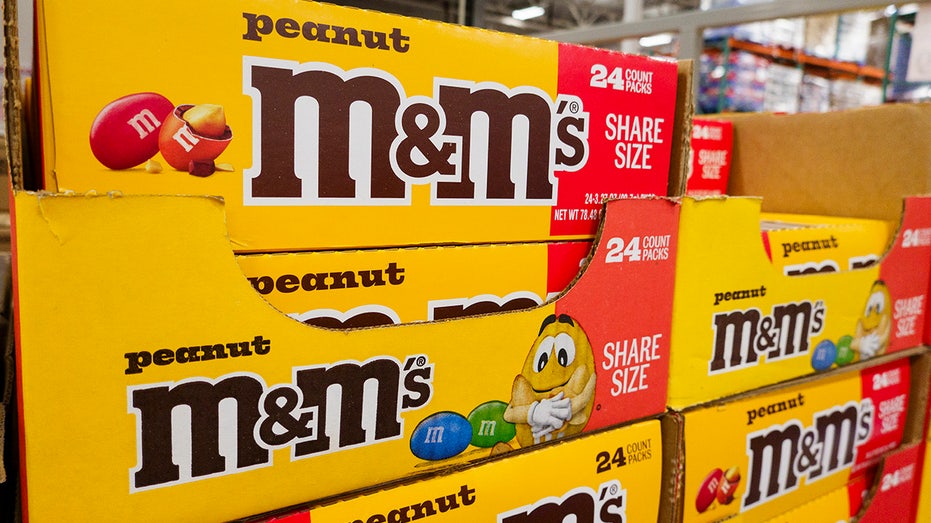
M&M’s makers Mars will debut artificial dye-free candies in August in a Make America Healthy Again (MAHA)-compliant move after facing pressure from Health and Human Services (HHS) Secretary Robert F. Kennedy Jr.
But while the classic candy-maker was able to use natural sources like beets or turmeric to replicate colors like red and yellow, shades of blue have proven considerably more difficult and expensive to recreate naturally.
Mars has been replicating blue and brown’s artificial coloring using spirulina extract, a concentrated blue-green algae powder, but the substance is prohibitively expensive.
Turmeric, for example, is available in bulk from most wholesalers for prices in the $9-$11 per lb. range. Spirulina, by contrast, can be significantly more expensive. The raw supplement can cost up to $20 per lb. at similar wholesalers, while the concentrated form most often used for food dyes is often priced at over $100 per lb.
THESE POPULAR FOODS ARE AFFECTED AS COMPANIES ALIGN WITH TRUMP ADMIN’S ‘MAHA’ INITIATIVE
Furthermore, spirulina’s viscous nature has caused clogging in M&M’s factory spray nozzles and created film build-ups in manufacturing equipment, creating a potential safety and health hazard, The Wall Street Journal reported.
The high costs associated with MAHA-ifying its products have driven Mars into a colorful dilemma, according to the Journal. Wanting to debut its altered product ahead of the company’s 85-year anniversary in August, Mars has spent millions in an effort to find alternatives.
Given the high costs of reproducing blue, Mars considered just rolling out a three-color mix of red, orange and yellow, but executives felt “the sunset vibes were too strong,” the Journal reported.

Anton Vincent, the leader of the company’s North American snacks division, told the Journal the replacement effort “was a daunting situation,” adding, “you’re messing with an 85-year-old icon.”
WALMART ELIMINATING SYNTHETIC DYES FROM ITS PRIVATE-LABEL FOOD BRANDS
Mars had originally announced a plan to offer artificial dye-free products in 2016, but reversed the decision after announcing customers didn’t seem to care.
But, thanks to a Kennedy-led push to pressure companies to ditch artificial materials, Mars again announced in 2025 they would be pivoting to natural dye options.
Kennedy Jr. has frequently criticized the use of artificial dyes in U.S. food products, calling them a key driver in numerous American health epidemics.
“When we look at these nine specific food dyes, the science shows a clear, undeniable link to behavioral disruptions in our kids and long-term cancer risks. We are systematically clearing them out,” he said in a 2025 press conference with West Virginia’s Republican Gov. Patrick Morrisey.
West Virginia became the first to sign into law a total ban on statewide sales of major artificial dyes in 2025.
Kennedy Jr.’s HHS added Mars to a list of 27 corporations that have pledged to remove artificial food dyes from certain products in his office’s effort to eliminate petroleum-based food dyes from the U.S. food supply.
Federally, his office has formally banned four petroleum-based artificial food dyes, revoking Food and Drug Administration (FDA) authorization for brominated vegetable oil (BVO), Red Dye no. 3, Citrus Red No. 2 and Orange B.
Kennedy Jr. has also pushed hard to get companies to phase out six other specific dyes — Red 40, Yellow 5, Yellow 6, Blue 1, Blue 2, and Green 3.
His office has cited animal studies that linked consumption of specific artifical dyes to cancer risks and long-term behavioral dysfunctions.
The FDA cited the Delaney Clause, a provision requiring the institution to prohibit a chemical if it’s found to cause cancer in humans or animals, after banning Red Dye No. 3 in 2025. Numerous long-term animal studies found the chemical linked to cancer development in rats.
FOX Business contacted Mars and HHS for further comment.