Good morning, I’m Mared Gwyn writing from Brussels. Welcome to Tuesday.
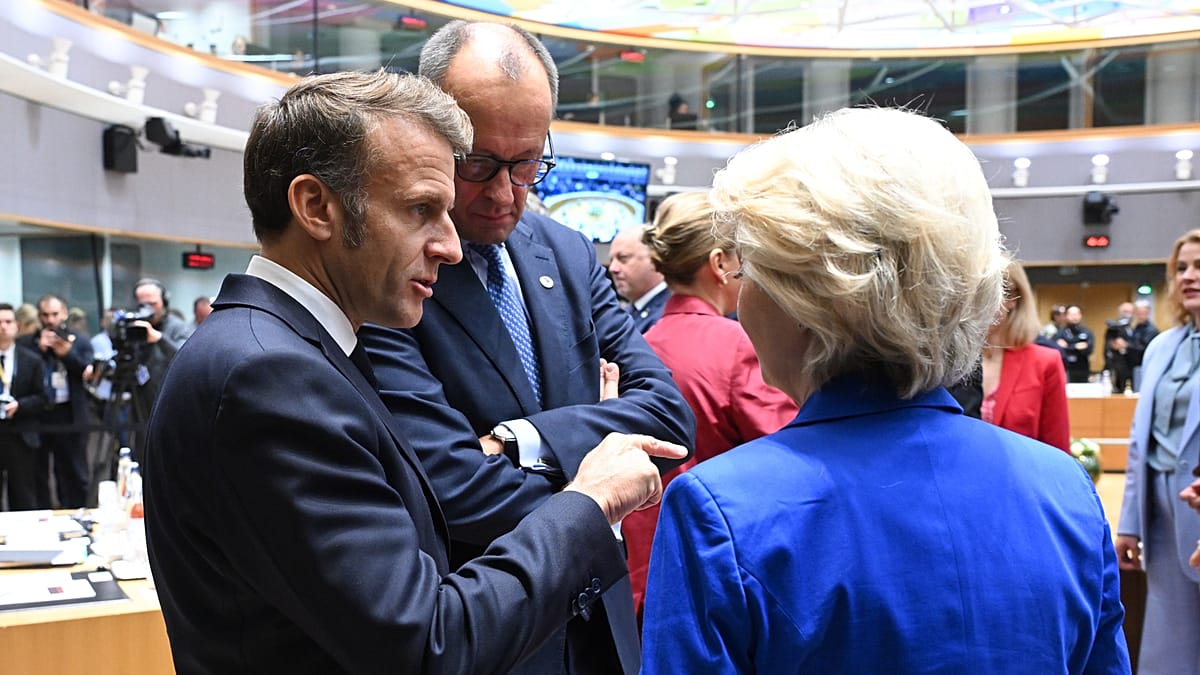
EU leaders are raising the stakes ahead of their informal gathering on Thursday, with both European Commission chief Ursula von der Leyen and French President Emmanuel Macron unveiling separate pitches for a major overhaul of Europe’s economic doctrine over the past 24 hours.
In an interview with seven media outlets published earlier today, Macron repeated his call for the EU to issue common debt to fund strategic investments, saying the move is needed to “challenge the hegemony of the dollar” and avoid Europe becoming a spectator of its own decline.
The French President also said Europe faces an “openly anti-European” US administration that wishes “the dismemberment” of the EU, according to the Financial Times’ report of the interview.
France has confirmed it will join a meeting convened by the German, Italian and Belgian leaders at the margins of the retreat on Thursday – in a signal of increasing appetite for cooperation between the bloc’s largest economies. Rome and Berlin had issued a joint paper on Europe’s competitiveness last month, sidelining Paris.
Von der Leyen has meanwhile framed the bloc’s economic revival as a fight for the “freedom to choose our own destiny” – while acknowledging that a two-speed Europe might be inevitable.
In a letter addressed to leaders on Monday, the Commission chief set out her vision for a massive push to further integrate the EU’s economies and shore up the bloc’s global competitiveness in a world she describes as “shaped by raw power, strategic rivalry and the weaponisation of dependencies.”
Her recommendations include slashing red tape, striking further major free trade deals with global nations, better enforcing the rules of the EU’s single market, and introducing a “European preference” in public procurement to counter the weaponisation of economic dependencies, a move championed by France’s Macron.
Crucially, and in a major departure from the principle of consensus that guides her institution, the Commission chief echoes Mario Draghi’s recent call to allow member states willing to further integrate their economies to do so without the need for the bloc to move as a whole, in what the former Italian premier and central banker described as “pragmatic federalism.”
“Our ambition should always be to reach agreement among all 27 Member States,” von der Leyen writes, adding that “where a lack of progress or ambition risks undermining Europe’s competitiveness or capacity to act, we should not shy away” from using a provision in the EU Treaties that allows nine or more member states to pursue deeper integration, known as Enhanced Cooperation.
Draghi and Enrico Letta, both authors of crucial 2024 blueprints on European competitiveness and the single market, will participate in Thursday’s informal retreat at Belgium’s Alden Biesen castle. The talks are now being framed as a pivotal moment if the bloc is to turn around its stagnating economies and live up to the geopolitical moment.
Meanwhile, EU lawmakers will meet later this afternoon to decide whether to pencil in a vote in their agendas on the implementation of the EU-US trade deal. Lawmakers decided to unfreeze the deal last week amid President Trump’s climbdown on his Greenland threats – but some voices from the centre and left of the hemicycle are calling for specific measures to Trump-proof the deal.
Exclusive: EU Commission balks at Sánchez’s regularisation of undocumented migrants
Three EU officials, speaking to my colleagues Eleonora Vasques and Vincenzo Genovese on condition of anonymity, have expressed reservations about Spain’s decision to grant legal status to about half a million irregular migrants, citing concerns over a potential conflict with the EU’s current policy.
“It is not in line with the European Union’s spirit on migration,” one of the EU officials said. Another pointed out that a massive regularisation risks clashing with the EU’s message to the rest of the world on deterring irregular migration.
EU Commissioner for Internal Affairs and Migration Magnus Brunner is also expected to raise the issue in a speech before the European Parliament this afternoon, when the plenary debates the Spanish decision.
Asked about Spain’s decision in January, Brunner made no judgment, saying that it is a national responsibility. Eleonora and Vincenzo have more.
The European Parliament will meanwhile vote on the final approval of two key migration files later today – including changes that would facilitate the fast-tracking of asylum claims and the deportation of asylum seekers to distant third countries to which they may have no link. The centre-right European People’s Party (EPP) is expected to vote along with hard-right factions to push through the changes.
Why the EU wants to end the price cap on Russian oil
The price cap on Russian oil, one of the hallmark initiatives by Western allies to squeeze Moscow’s war chest, might have its days numbered.
As we previously reported, the European Commission has proposed, as part of a new package of sanctions, a complete ban on the provision of maritime services to tankers carrying Russian crude, regardless of how much clients pay for the supplies.
Until now, the EU has exceptionally allowed its companies to service Russia’s oil vessels that complied with the G7 price cap, recently adjusted to $44.10 per barrel. The tankers that exceeded the limit were denied access to high-quality insurance, banking and shipping, forcing the Kremlin to set up a “shadow fleet” of obscure ownership.
But with the war in Ukraine nearing its grim fourth milestone and the negotiations led by the United States bearing limited progress, the thinking in Brussels rapidly morphed. The stability in energy prices and weaker global demand have opened a window of opportunity to complete the work that started back in 2022.
Jorge Liboreiro explainshow the EU plans to move to the next stage.
More from our newsrooms
European Parliament to ‘test’ support for digital euro. The European Parliament will vote on a report on the annual work of the European Central Bank, which includes a passage in support of the digital euro, later today, Eleonora Vasques reports.
Hungarian election campaign enters hot phase with Ukraine, the EU and Trump in focus. With two months until Hungary’s April election, Prime Minister Viktor Orbán has intensified his anti-Ukraine rhetoric, while leading challenger Péter Magyar promises to curb corruption and tax relief for low earners. Sándor Zsiros has the story.
Ukraine to open battlefield-tested arms export centres across Europe, Zelenskyy says. The decision is set to transform Ukraine’s defence industry and allow Kyiv’s partners to access the rarest type of weapons – those tested on the battlefield. Sasha Vakulina has more.
We’re also keeping an eye on
- The European Parliament’s plenary session continues in Strasbourg.
- European Commission to unveil drone strategy and plan to protect against cyberbullying.
That’s it for today. Jorge Liboreiro, Vincenzo Genovese, Maria Tadeo and Eleonora Vasques contributed to this newsletter. Remember to sign up to receive Europe Today in your inbox every weekday morning at 08.30.