





Good morning. I’m Mared Gwyn with your Tuesday morning newsletter.
ADVERTISEMENT


ADVERTISEMENT
The European Commission is sending a representative to attend the first meeting of Trump’s Board of Peace in Washington on Thursday – but is not becoming a member due to persisting concerns over the Board’s scope, governance, and overlap with the United Nations.
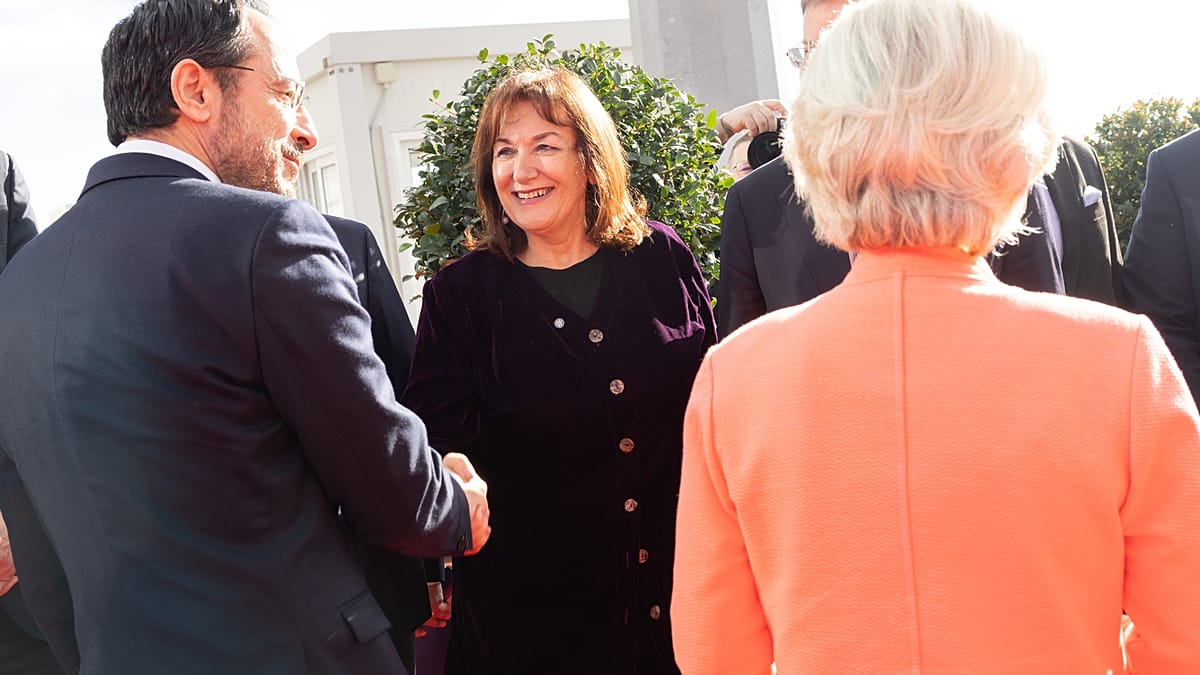
As we reported on Monday, the European Commissioner for the Mediterranean, Dubravka Šuica, will join only the “specific part” of the meeting that deals with Gaza, as the EU executive aims to avoid getting completely sidelined from the implementation of the US-brokered 20-point peace plan without getting entangled in controversy surrounding the Board.
Reminder: The Board of Peace was initially conceived to cement the ceasefire in Gaza, and has been endorsed in an United Nations Security Council resolution. But most European leaders have raised concerns that Trump has since expanded its mandate to create a parallel United Nations which he would chair indefinitely, even after his presidency ends.
Only two EU member states have joined as sitting members: Hungary and Bulgaria. But Cyprus, Greece, Italy and Romania have since accepted so-called observer status on the Board – a status EU officials have tried to distance themselves from.
A spokesperson confirmed on Monday that the EU’s foreign policy chief, Kaja Kallas, is in touch with governments on the issue and that the Board of Peace will be discussed when EU foreign ministers gather in Brussels next week.
They will be joined by Bulgarian diplomat Nickolay Mladenov, appointed by Trump as High Representative for Gaza and tasked with linking up the Board of Peace with a technocratic Palestinian committee responsible for running its day-to-day business.
In other news, my colleague Jorge Liboreiro reports that work continues in Brussels to approve a new package of sanctions against Russia by the time the war in Ukraine marks its fourth-year milestone next week. Yesterday, ambassadors heard from David O’Sullivan, the special envoy for sanctions, who briefed them on the latest efforts to crack down on circumvention.
The discussion couldn’t be more timely: the proposed package foresees the first-ever activation of the Anti-Circumvention Tool to prohibit the sales of computer machines and radios to countries “where there is a high risk that these products are re-exported to Russia”.
The prime target would be Kyrgyzstan, a mountainous country of 7 million that shares a customs union with Russia. Bilateral trade between the EU and Kyrgyzstan has exploded since the start of the full-scale invasion, raising serious concerns among officials in Brussels that the country is acting as a backdoor for the Kremlin to obtain blacklisted items. To put things in perspective: in 2021, EU exports of goods to Kyrgyzstan were worth about €263 million. In 2024, they were worth €2,500 million.
Yet, the most critical element of the proposal remains the full ban on maritime services to Russian oil tankers which, if approved, would terminate the price cap on Russian oil as we know it. The European Commission is keen to secure the endorsement of other G7 countries before moving forward with the plan. Greece, a country with a powerful maritime industry, has raised concerns about the ban, warning it could increase competition from India and China, empower Russia’s “shadow fleet” and further promote the removal of vessels from their national registry, a deceptive practice known as “deflagging”.
Our trade reporter Peggy Corlin also reports this morning that the fight to ban Russian steel is stepping up, four years since the start of the invasion and as the commodity continues to enter the EU market. Negotiations between EU lawmakers and EU countries start next week on whether to ban the metal outright. What began as a sanctions debate has morphed into a high-stakes political fight.
Swedish lawmaker Karin Karlsbro is preparing to take on Belgium, Italy, the Czech Republic and Denmark, which argue they still need imports of unfinished steel for their industries.
“It is a big provocation that we haven’t done everything possible to limit Putin’s war chest,” Karlsbro told Euronews, adding “because the Russian steel industry is a backbone of Russian war, it is the Russian war machinery.”
Meanwhile, a new elite club of the EU’s economies dubbed “the E6” – which hosts Germany, France, Italy, Spain, Netherlands and Poland – met again yesterday, this time to discuss how to speed up plans to integrate the bloc’s capital markets.
The President of the Eurogroup, Greece’s Kyriakos Pierrakakis, said he doesn’t think the E6 can pose a threat to his group, where all countries that use the euro as their currency are represented. “We’re quite positive that any initiative that can catalyse convergence given elements of transparency can be a positive force,” Pierrakakis said.
Yet smaller member states are cautious, amid fears they could be sidelined from decision-making by the heavyweights. Ireland’s finance minister Simon Harris, whose country has one of the highest GDP per capita in the bloc, told reporters after the meeting: “I would much rather see a structure where countries come together on issues where they share a common view, rather than the entry to the club being based on your size exclusively.”
Trilateral Ukraine peace talks enter round three
As Ukraine, the US and Russia are set to hold another round of talks in Geneva, President Volodymyr Zelenskyy said Moscow is preparing another massive strike, while the Kremlin states the territories are on the agenda in Geneva, our Ukraine correspondent Sasha Vakulina reports.
The meeting takes place just days before the fourth anniversary of Russia’s full-scale invasion. The delegations are meeting as fighting continues along the roughly 1,250-kilometer frontline and amid relentless Russia’s bombardment of civilian areas and energy infrastructure, which left millions of Ukrainians without electricity, water and heating in the freezing February temperatures.
On Monday, as Ukraine’s delegation departed from Kyiv, Volodymyr Zelenskyy warned that Russia was preparing for another “massive strike”. The Ukrainian president says he has instructed Ukraine’s air force chief, defence minister and the head of state-owned electricity company Ukrenergo to “prepare additional protective measures” throughout the day ahead of the possible attack.
Sasha has more.
EU mutual defence should be defined for ‘below Article 5’, top officer says
Work to operationalise the European Union’s mutual defence clause should concentrate on circumstances that fall “below the threshold” of NATO’s Article 5, the bloc’s top military official has told Euronews’ Alice Tidey.
General Seán Clancy, Chair of the EU’s Military Committee, told Alice over the weekend that his services “stand ready” to help with redefining what European mutual defence means.
On Saturday, European Commission President Ursula von der Leyen used her speech at the Munich Security Conference to call for the EU to become independent in its defence, adding that the time had come for the bloc to bring its mutual defence clause “to life” as part of this effort. She added that the commitment laid out in the clause, known as Article 42.7 of the Treaties, “only carries weight if it is built on trust and capability”.
The clause states that “if an EU country is the victim of armed aggression on its territory, the other EU countries have an obligation to aid and assist it by all means in their power”.
Asked why the EU needs to further operationalise its mutual defence clause if the 23 member states that are also in the military alliance are convinced of Washington’s long-term commitment to their security, General Clancy said that the roles of the two organisations are very clearly defined.
Alice has the full story.
Irish data watchdog launches EU probe into X’s Grok over sexual AI images
Ireland’s Data Protection Commission (DPC) is probing Elon Musk’s AI chatbot Grok over its recent creation of sexual AI imagery, to identify possible breaches of the EU’s data regulation, the GDPR. The Commission said in a statement released Tuesday that the “large-scale enquiry” would probe “the alleged creation and publication on X of potentially harmful, non-consensual intimate or sexualized images involving Europeans, including children,” generated by Grok.
As X has its European headquarters in Dublin, the Irish Commission can lead on such probes. The Commission said that it notified X of the probe on Monday.
If it is found in breach with the EU rules, the platform could face hefty fines.
The European Commission opened a separate probe in January to determine whether Grok is complying with risks management obligations in relation to the recent spread of non-consensual sexual deepfake images.
More from our newsrooms
Delaying digital euro harms Europe, German vice-chancellor says. Those who fail to recognise that it is now essential to move forward with the digital euro are harming Europe itself, Vice-Chancellor Lars Klingbeil told journalists, amid delays in the European Parliament over approval of the legislation. Eleonora Vasques has the story.
The silent wealth drain hitting European savers: Is your money at risk? The Director General of the European Fund and Asset Management Association tells Euronews how European savers are missing their biggest opportunity to build wealth. Read.
Alexei Navalny dart frog toxin poisoning: What we know. Epibatidine, found in the Ecuadoran dart frog, causes muscle paralysis and eventual asphyxiation. Experts have said the toxin can also be produced synthetically, instead of extracting it directly from the frog itself. Emma De Ruiter and Aleksandar Brezar explain.
We’re also keeping an eye on
- EU economy and finance ministers gather in Brussels
That’s it for today. Jorge Liboreiro, Eleonora Vasques, Peggy Corlin, Sasha Vakulina, Alice Tidey and Maria Tadeo contributed to this newsletter.


