

As investigators worked to identify the cause of a deadly train crash in Spain, unfounded theories about the origins of the tragedy have surfaced online.
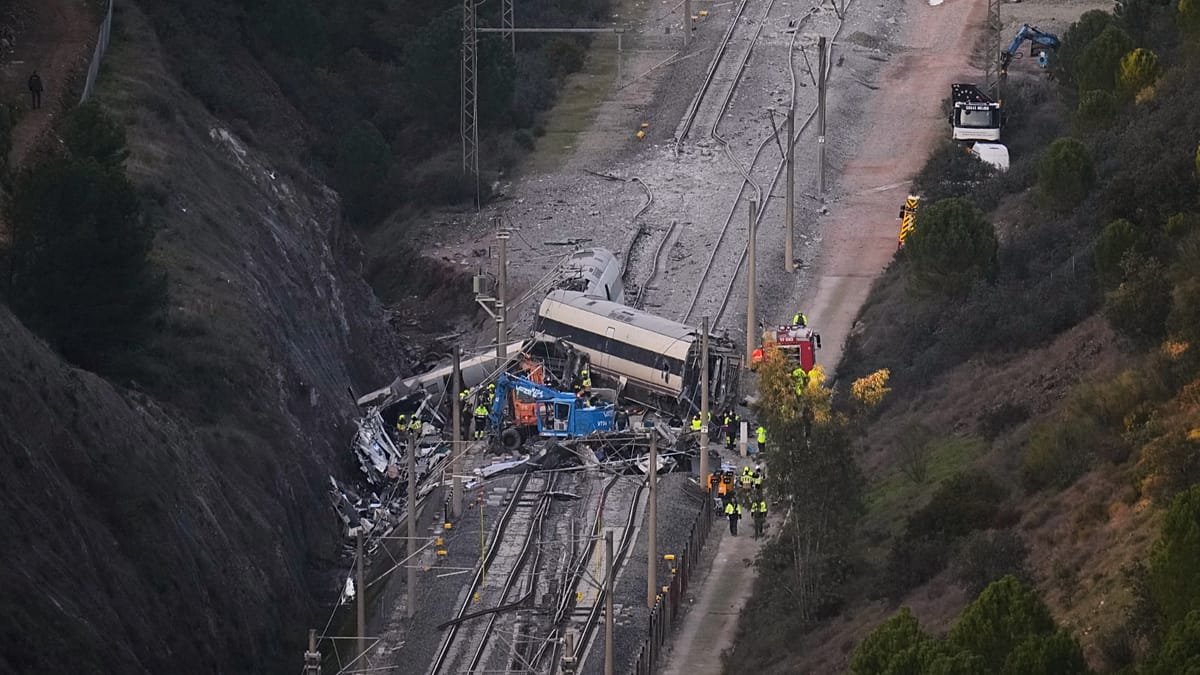
On 18 January in Adamuz, southern Spain, three carriages on a train operated by the private company Iryo derailed and crossed onto a separate track before colliding with another train operated by Spain’s state-owned Renfe rail operator, which crashed into an embankment.
At least 45 people died in one of the worst train crashes in the country’s history. Days later, a train driver was killed in a separate derailment near Barcelona, and another train crashed into a crane in the Murcia region, injuring several.
The back-to-back accidents have prompted a wave of ultimately misleading theories as to what exactly caused the Adamuz crash.
Sabotage unlikely
One of the primary unfounded theories for the crash is that it was an act of sabotage — a claim that emerged in the hours following the Amaduz incident and spread widely across social media in several languages.
Fact-checkers at independent non-profit Maltida reported that one of the most widely shared posts claiming this theory was a Polish-language post on X that claimed the crash resembled an incident in Poland in November 2025, when a blast damaged a section of a railway line used for deliveries to Ukraine.
Polish prosecutors later arrested three Ukrainian men whom they accused of working for Russia.
The theory that Spain’s crash was caused by sabotage spread in multiple posts, which attached a photo of the alleged damaged tracks in Poland alongside a picture of emergency responders at the Amaduz crash in Spain.
The perpetrators of the sabotage were claimed to be Russiaand Israel.
After a second train crashed near Barcelona, users asked X’s generative AI chatbot, Grok, about the reasons for the first crash.
Although Grok correctly responded that investigators had ruled out human error and sabotage, in one instance, it also incorrectly claimed Spanish Transport Minister Óscar Puente speculated that it was caused by sabotage.
What caused the Amaduz crash?
Most of the speculation around the crash was caused by an information vacuum in the wake of the Adamuz disaster.
Although Puente did not allude to sabotage, he called the crash “truly strange” since it occurred on a flat stretch of track that, according to authorities, was recently renovated. Both trains were driving under the speed limit.
He later clarified in the aftermath of the incident that he “wasn’t referring to sabotage” when calling the incident strange, adding that sabotage was not the most “plausible” cause of the tragedy.
Investigators have turned their focus to a fracture in a straight section of the track, which early findings suggest may have been damaged before derailment occurred.
The preliminary probe found that similar notches were found on the wheel threads of the train that moved to the other track.
Explaining why rail fractures can be particularly dangerous, Mark Young, professor of human factors in transport at the University of Southampton, told Euronews’ fact-checking team, The Cube, that rails are designed to guide and constrain train wheels.
“If the rail is broken, then this function will be compromised,” he said, adding that in some scenarios a wheel can “climb” over the rail, causing the opposite wheel on the axle to drop onto the track.
“This is a derailment and is particularly hazardous when it happens near a facing switch, where the derailed wheels can be further diverted by the pointwork,” he said.
Investigators working on the preliminary probe have taken the damage to the rail as a “working hypothesis” to look into further, but, unlike the Polish incident, possible Russian sabotage is not the focus.
Interior Minister Fernando Grande-Marlaska has ruled out sabotage as a possible cause. Human error has also been dismissed due to neither train travelling over the speed limit.
Money to Morocco?
Another misleading theory about the crash, which circulated in various social media posts, particularly on X, is that the Spanish government provided funds to Morocco and Uzbekistan to help improve their rail systems at the expense of their domestic railways.
One post claims that the Spanish government donated “€247 million to Morocco and Uzbekistan for rail and road improvements”. Additional crashes, such as the one in Barcelona, saw the claim circulate further.
Multiple Spanish outlets reported that the Spanish government approved two loans that were used to finance two tram lines in the Moroccan city of Casablanca. These loans, according to a press release, were repayable.
In the case of Morocco, the money was given via a Spanish company that would be awarded the contract through an open tender.
The loan given to Uzbekistan commissioned “two Talgo-250 high-speed electric train sets”. It was also repayable.
These loans were charged to the Fund for the Internationalisation of Companies, a body managed by the Spanish Ministry of Industry, Tourism and Trade, to promote the presence of Spanish companies and goods internationally.