

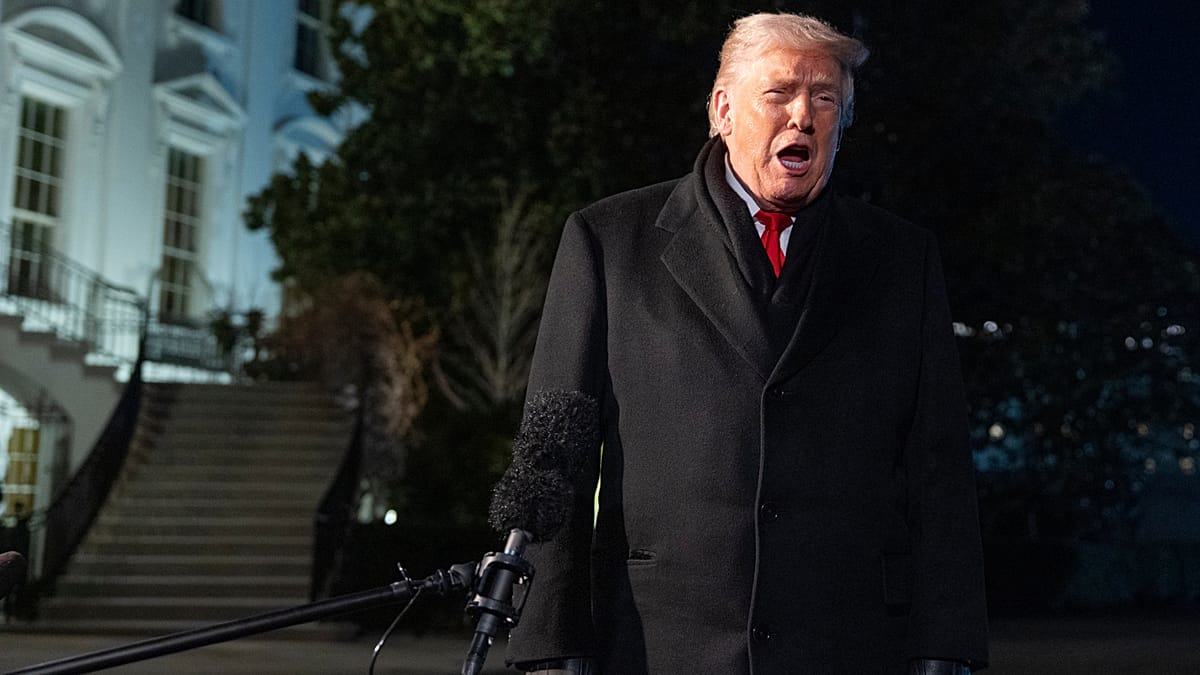
All eyes will be on Davos on Wednesday afternoon as US President Donald Trump is set to deliver a speech, hours after doubling down on his bid to acquire Greenland saying that there is “no going back”.
Denmark’s Prime Minister Mette Freredirksen, and her counterpart in Greenland, Jens-Frederik Nielsen, are taking the threat seriously, with both saying on Tuesday that they “cannot rule out” a US military intervention.
Europe is trying to close ranks and those who took to the stage already in Davos have said the European Union stands ready to respond and meet the changing geopolitical times.
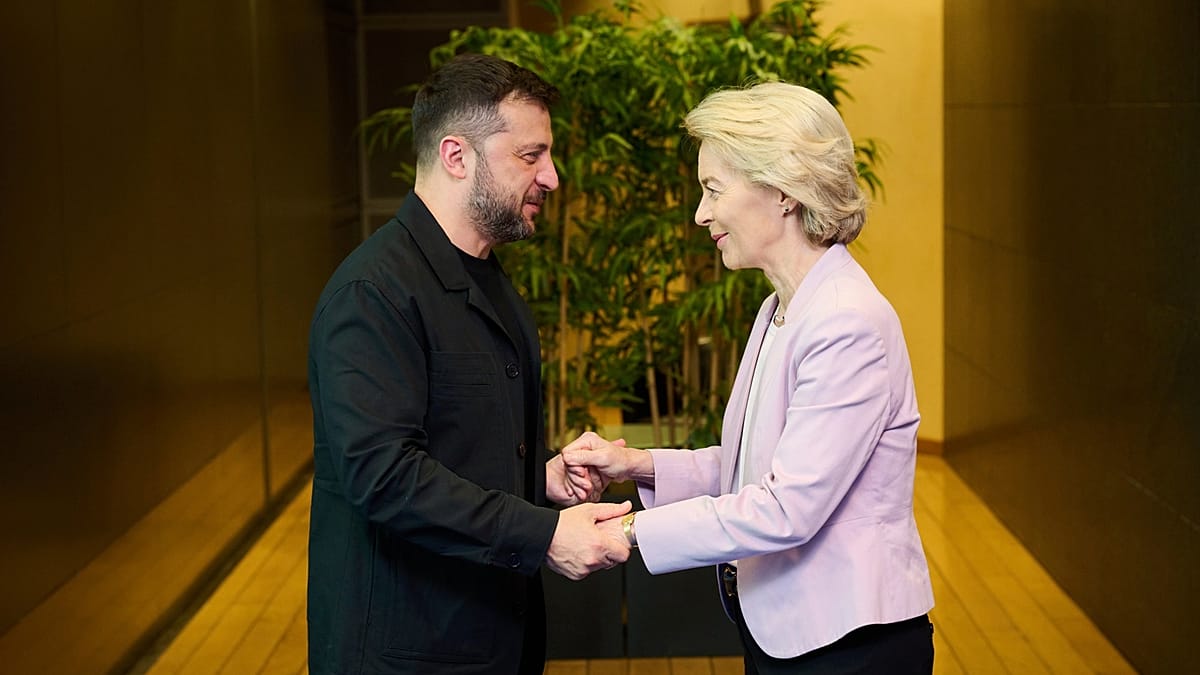
European Commission chief Ursula von der Leyen vowed for instance that the EU’s response should Trump proceed with his tariff threat would be “unfliching”, while French President Emmanuel Macron called on the blow to “not be shy” or divided and to not “passively accept the law of the strongest“.
Bart de Wever, the Belgian prime minister, had a similar message, warning that “80 years of Atlanticism are drawing to a close” and that “either we stand together or we stand divided, and if we are divided, it marks the end of an era”.
But a lot of the action today will actually take place behind closed doors with Trump set to meet with some European leaders as well as NATO Secretary-General Mark Rutte. Von der Leyen, who travelled to Strasbourg on Tuesday evening, is set to return to Davos in the hope of some face time with the US leader, Euronews understands.
Follow our live blog below for all the latest:


${title}
${body}
EU needs its own ‘strategic approach’ to the Arctic, says von der Leyen
The European Union needs its “own strategic approach” to the Arctic region, Ursula von der Leyen says as she continues her speech.
“The first pillar will be a massive European investment surge in Greenland. In particular, to further support the local economy and infrastructure,” she says.
“We will work with the US and all partners on wider Arctic security. In particular, I believe we should use our defence spending surge on Arctic-ready equipment. And strengthen our security arrangements with partners such as the UK, Canada, Norway, Iceland and others,” she adds.
“I believe Europe itself needs to reassess its wider security strategy. This should look at what is needed to adjust to today’s new realities. Many of you have worked on various national and European security strategies. Some of them in the recent past. But the world has changed so fast, and Europe now has to change with it.”
It’s unclear, however, when this new security strategy will be presented.
EU will respond to Trump’s tariffs with ‘urgency and determination’, says von der Leyen
Ursula von der Leyen vows to hit back if Donald Trump goes ahead with his proposed 10% tariffs to force the sale of Greenland.
“Greenland is not just a territory in a key region of the world map, a land rich in critical raw materials, a strategic outpost on emerging global sea routes. It is all of those things. But above all, Greenland is home to a free and sovereign people. It is a nation with its sovereignty and its right to territorial integrity. And the future of Greenland is only for Greenlanders to decide,” she tells lawmakers in Strasbourg.
“We do agree with our American friends on the need to ensure the security of the Arctic region,” she goes on.
“We share the same strategic assessment on Arctic Security. And this is why the threat of additional tariffs for security reasons is simply wrong. If we are now plunging into a dangerous downward spiral between allies, this would only embolden the very adversaries we are both so committed to keeping out of this strategic landscape.”
“We are at a crossroads. Europe prefers dialogue and solutions – but we are fully prepared to act, if necessary, with unity, urgency and determination.”
France calls for Greenland NATO exercise
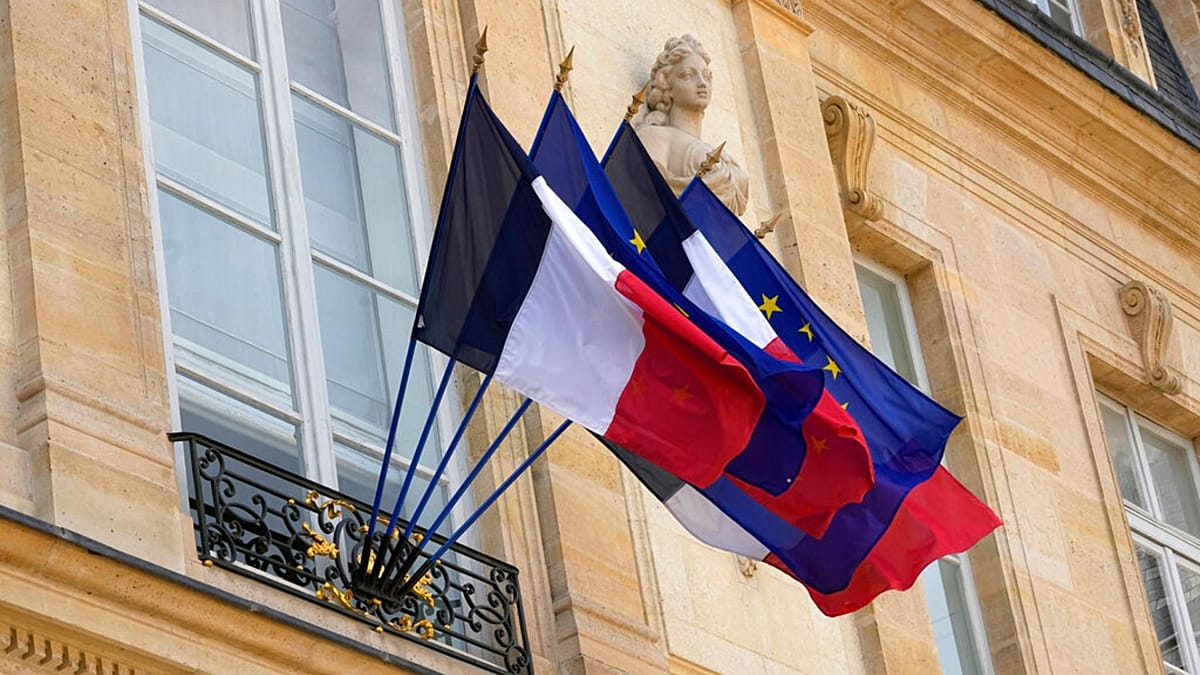
The French presidential palace this morning announced that Paris “is requesting a NATO exercise in Greenland and is prepared to contribute to it”.
Ursula von der Leyen: ‘We will need a departure from Europe’s traditional caution’
Ursula von der Leyen, the president of the European Commission, has now taken the floor in the European Parliament. Her speech echoes her message a day prior in Davos, where she made a strong plea in favour of “European independence”, calling it an “imperative” to survive in the 21st century.
“The shift in the international order is not only seismic, but it is permanent. And the sheer speed of change far outstrips anything we have seen in decades. We now live in a world defined by raw power – whether economic or military, technological or geopolitical. And while many of us may not like it, we must deal with the world as it is now,” von der Leyen tells MEPs.
“We have to be strong in shaping ourselves if we want to shape the world around us. In this increasingly lawless world, Europe needs its own levers of power.”
Von der Leyen then hails the collective action taken by EU countries in recent years to face the COVID-19 pandemic, support Ukraine, manage the energy crisis and ramp up defence spending.
“We are already moving in this direction, but the speed of change requires a new approach from Europe. We will need a departure from Europe’s traditional caution,” she says. “The world is changing faster, so does our mindset. So our institutions, governments and societies – all of us – must transform the ways in which we think and act.”
Costa: ‘Alliances cannot just boil down to a sequence of transactions’
After discussing the crisis over Greenland, António Costa shares a reflection about the turbulent state of the international order.
“The first way for Europe to become stronger and more sovereign is to remain a firm champion of the international rules-based order, international law and multilateralism. We will always uphold the principles enshrined in the United Nations Charter and defend human dignity and individual freedoms,” he says.
“We cannot accept that the law of the strongest prevails over the rights of the weakest. Because international rules are not optional. And alliances cannot just boil down to a sequence of transactions,” he adds, referring to Trump’s notoriously transactional approach to foreign policy, which has unnerved Europeans.
“We cannot accept violations of international law. Anywhere. Whether in Ukraine, Greenland, Latin America, Africa, or in Gaza,” Costa goes on.
“In times like these, principles matter more than ever. Because reliability is strength, and consistency is key.”
Trump’s tariffs are ‘incompatible’ with EU-US trade deal, says Costa
António Costa continues his speech addressing the crisis over Greenland, which will be discussed by leaders during an extraordinary summit on Thursday evening.
He says member states are “united around the principles of international law, territorial integrity and national sovereignty” and “in full support and solidarity with the Kingdom of Denmark and with Greenland.”
“Only they, Denmark and Greenland, can decide on their future,” he says.
Costa adds that both sides of the Atlantic have a “shared interest in peace and security” in the Arctic region, which climate change is making increasingly strategic. He then warns that the 10% tariffs threatened by Donald Trump against eight European countries, aimed at forcing the sale of Greenland, “undermine transatlantic relations and are incompatible with the EU-US (trade) agreement.”
“We stand ready to defend ourselves, our member states, our citizens, our companies, against any form of coercion. And the European Union has the power and the tools to do so,” he says, in what reads as a reference to the Anti-Coercion Instrument, the so-called “trade bazooka”.
“We want to continue engaging constructively with the United States on all issues of common interest – and there are many, since we are partners and allies and share a transatlantic community.”
State of transatlantic relation is testing European principles, António Costa tells MEPs
António Costa, the president of the European Council, has begun his speech at the European Parliament in Strasbourg.
“Let’s face it: taken together, the geopolitical challenges Europe is facing sometimes seem daunting,” Costa says, referring to Russia’s war on Ukraine, transatlantic tensions over Greenland and the erosion of the rules-based global order.
“But the European Union will come out of this stronger, more resilient and more sovereign. For this to happen, our response must have three components: A Europe of principles. A Europe of protection. And a Europe of prosperity.”
“All these three dimensions are being tested in the current moment of transatlantic relations,” he adds.
Here’s what to expect today
Good morning and welcome to our third day of live coverage on the Greenland crisis dividing the US and the European Union.
We will, once again, seek to bring you the very latest on developments in Brussels, other European capitals, Washington, and Davos.
The two main events we’ll be avidly watching from the Swiss mountains are as follows:
- 10.15-11.00: Panel on “Can Europe defend itself?” with NATO chief Mark Rutte, Finnish President Alexander Stubb, Polish President Karol Nawrocki, and the head of the European Investment Bank Nadia Calvino;
- 14.30-15.15: the speech by US President Donald Trump.
Time to buckle up!