


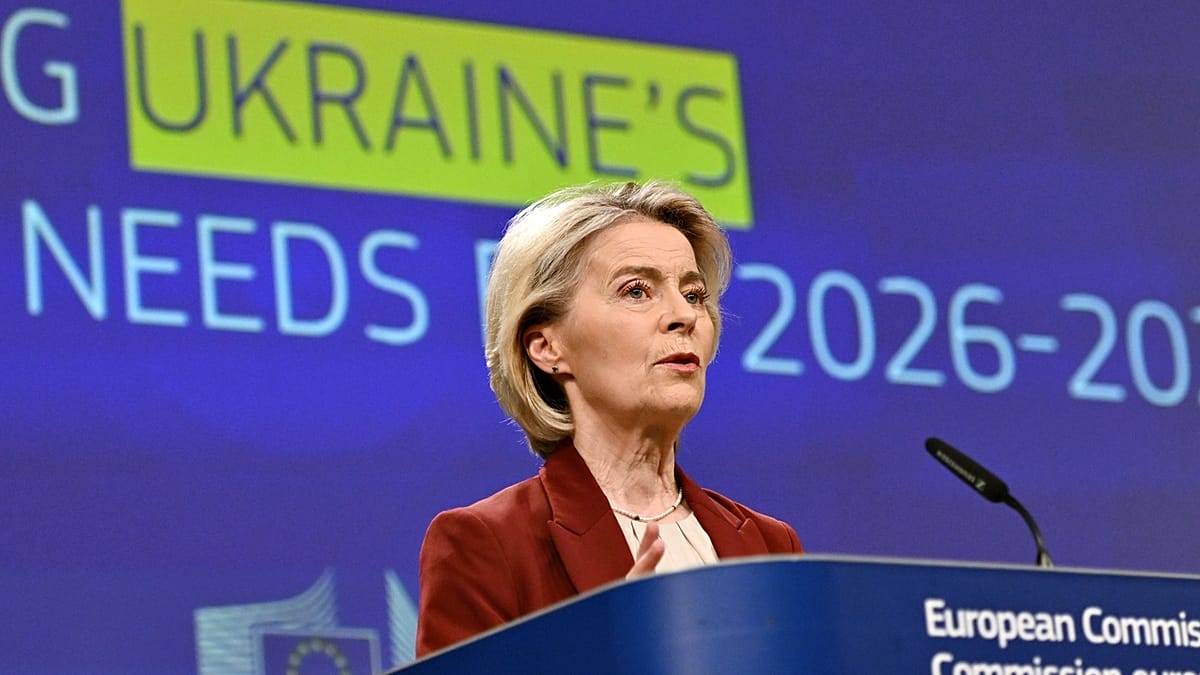
Ursula von der Leyen has finally spelt out her reparations loan for Ukraine.
Under the scheme, which has no precedent in history, the European Union intends to channel the immobilised assets of the Russian Central Bank into a zero-interest loan to support Ukraine’s financial and military needs for the years ahead.
Kyiv would be asked to repay the loan only after Moscow ceased its war and agreed to compensate for the damages – a virtually unthinkable scenario at this stage.
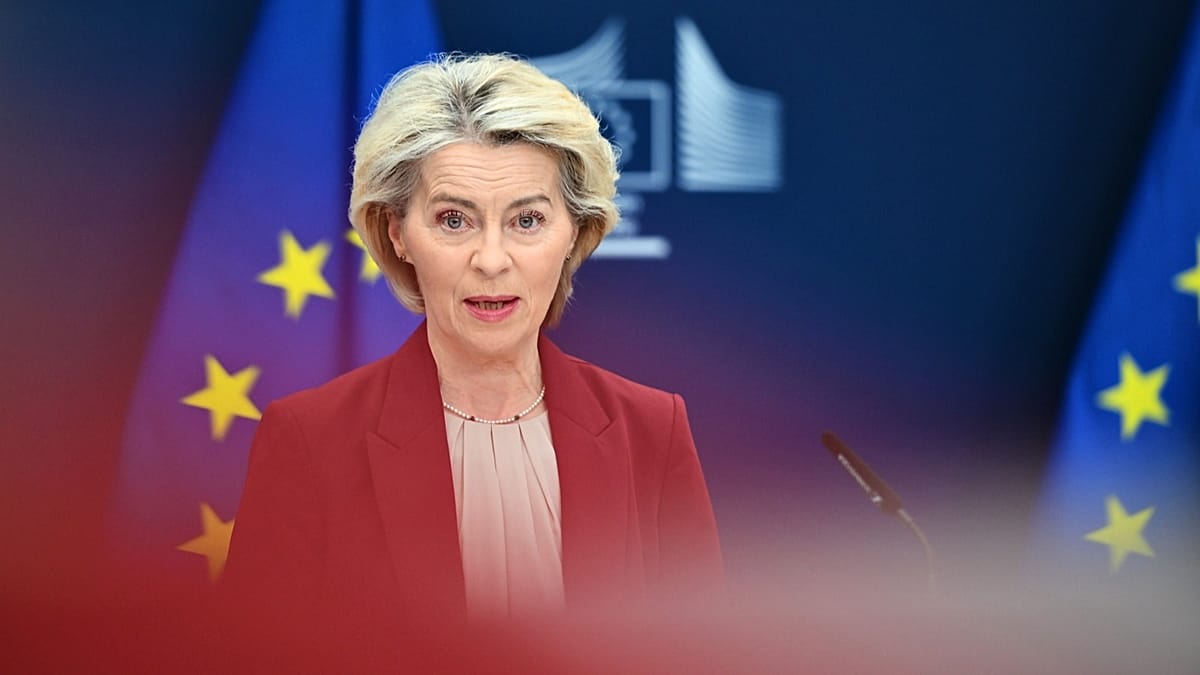
Until now, the project had been pitched in various speeches, letters and confidential documents, raising more questions than answers. But on Wednesday, the president of the European Commission went to the press room and formally unveiled the legal texts necessary to make the audacious idea a tangible reality.
“We all know that we can never match the sacrifice of the Ukrainian people, but what we can match is their stamina, their resolve, their staying power, and we can equip them with a means to defend themselves and to lead peace negotiations from a position of strength,” von der Leyen told reporters.
“Since pressure is the only language the Kremlin responds to, we can also dial it up.”
Here are the main takeaways from her presentation.
Guarantees for Belgium
The reparations loan cannot be understood without Belgium.
The country holds the bulk of the Russian sovereign assets, about €185 billion, at Euroclear, a central securities depository in Brussels. Since the start of discussions in September, Belgium has relentlessly demanded maximum legal certainty and solidarity among member states to shield itself against Moscow’s scorched-earth tactics.
The reservations were laid bare in a scathing letter that Prime Minister Bart De Wever sent to von der Leyen last week, in which he blasted the reparations loan as “fundamentally wrong” and ridden with “multifold dangers”.
De Wever’s shadow loomed heavily over Wednesday’s presentation.
Von der Leyen said her team had taken “almost” all the Belgian concerns into account and designed sweeping guarantees to protect both Belgium and Euroclear.
The proposal foresees an initial guarantee of €105 billion to cover the €90 billion that the EU is meant to send to Ukraine in the next two years. There could be a second guarantee of €105 billion after that period unless the next EU budget, which will come into force in 2028, assumes the responsibility on its own.
The guarantees will be distributed proportionally among member states according to their economic size and have an “inbuilt liquidity mechanism” to ensure that Euroclear has enough cash to repay the Russian Central Bank. This will be needed if the sanctions behind the assets are released prematurely before Moscow compensates Kyiv.
If the guarantees are triggered and one country fails to honour its financial duty, the Commission will step in and lend the necessary money.
“Either way, the money will be there for the EU to honour its obligation” with Euroclear, said a senior Commission official, speaking on condition of anonymity.
The guarantees will also be activated if a court rules in favour of Moscow and orders Belgium, or the EU as a whole, to pay damages.
Extra lines of defence
The Commission is confident that these guarantees will never need to be enforced.
Under current rules, judicial decisions issued anywhere in the EU against any member state in the context of the sanctions are automatically nullified. This decreases Russia’s chances of winning a legal challenge inside the bloc. Additionally, institutions like Euroclear can resort to the immobilised assets to offset losses outside the EU.
In his letter to von der Leyen, De Wever warned that European assets could be expropriated in “Russian-friendly jurisdictions” as part of Moscow’s retaliation. To avoid this scenario, the EU is proposing to establish a new sanctions regime to target people and entities, such as law firms, that facilitate this sort of expropriation.
And there is an extra line of defence.
The Commission wants to introduce a novel measure to prohibit the return of sovereign assets to Russia. The ban will be based on Article 122 of the EU treaties and require just a qualified majority to be approved. In practice, this will prevent a sudden removal of the sanctions, which depend on unanimity and are vulnerable to individual vetoes.
The use of Article 122 in the context of foreign policy is unheard of. The provision speaks about “measures appropriate to the economic situation, in particular if severe difficulties arise in the supply of certain products,” and has mostly been applied for defence and energy matters within the bloc.
Senior officials say it is “crystal clear” that Russia’s war has triggered economic disturbances for the entire bloc and therefore justifies Article 122.
The hidden assets
Another key request from Belgium has been solidarity. The country resents the fact that the political focus is exclusively on €185 billion held at Euroclear, even as an additional €25 billion is being kept in other institutions across numerous member states.
In her presentation, von der Leyen committed to channelling the entire pot of €210 billion of Russian sovereign assets into the reparations loan.
The other assets are kept in private banks in France, Sweden, Germany, Cyprus and, ironically, Belgium. It remains unclear if the Commission will manage to defy bank privacy and secrecy, two sacrosanct principles in the sector, to unlock all the available funds.
At any rate, out of the €210 billion, the EU is meant to channel €90 billion to Ukraine in the next two years. Meanwhile, €45 billion will be set aside to sustain an ongoing G7 line of credit, which relies on the windfall profits of the Russian assets.
Von der Leyen has also invited other G7 allies, like Canada, the UK and Japan, to mimic the initiative and employ the Russian assets kept under their respective jurisdictions.
Anti-corruption safeguards
The debate on the reparations loan coincides with a spiralling corruption scandal in Ukraine’s energy sector that has precipitated numerous resignations, including that of Andriy Yermak, President Volodymyr Zelensky’s powerful chief of staff.
Aware of this delicate backdrop, the Commission intends to add a “no rollback” clause to the loan that will link the financial assistance to the anti-corruption measures that the Ukraine must implement to advance in its EU accession bid.
If Kyiv takes a step back on the fight against corruption, as it briefly did in the summer when it undermined the independence of two anti-corruption agencies and prompted widespread protests, payments under the reparations loan will be suspended.
There will also be safeguards to strengthen oversight on how Ukraine allocates defence contracts, which have been a source of controversy in the past.
‘Made in Europe’
The reparations loan will be split into financial and military support for Ukraine. The former will be undesignated to allow greater flexibility in public spending, but the latter will be subject to “Made in Europe” criteria.
The loan, von der Leyen explained, will follow a “cascading principle” to “predominantly” favour weapons and ammunition produced in Ukraine, the EU or the associated countries: Iceland, Norway, Liechtenstein and Switzerland.
“If we have urgent needs that cannot be met by Ukraine or the European Union, then we allow purchasing outside,” she added.
The “Made In Europe” preference in the defence sector has long been advocated by France, which sees it as a question of strategic autonomy. Over time, it has been embraced by a majority of countries concerned about industrial stagnation.
Plan B: joint debt
If, after all these guarantees, safeguards and conditions, Belgium continues to resist the reparations loan, von der Leyen has a Plan B to keep the funding going.
As an alternative, the Commission will go to the markets and raise €90 billion on behalf of all countries to support Ukraine. The collective borrowing will avoid touching the Russian assets and the legal pitfalls that come with it.
Like the reparations loan, Ukraine will only be asked to repay the €90 billion if Russia agrees to compensate it for the damage its invasion has done. But in this case, member states themselves will have to shoulder the interest rates that the joint debt will generate each year.
This, in turn, will entail an immediate fiscal impact on national treasuries, a prospect that some capitals are keen to avoid at all costs.
Moreover, common borrowing for a non-EU country is not allowed under current rules. Amending the EU budget will require a unanimous agreement, a tall order given Hungary’s opposition to aiding Kyiv in any capacity.
As a middle ground, joint debt and the reparations loan could be deployed simultaneously to raise the necessary €90 billion.
“Of course, the options come with very different pros and cons, and different legislative processes,” said a senior official. “But it’s not impossible to combine the two options.”
Regardless of what option is chosen when leaders meet on 18 December, Ukraine’s needs will remain acute for the foreseeable future, even if a peace deal is achieved.