

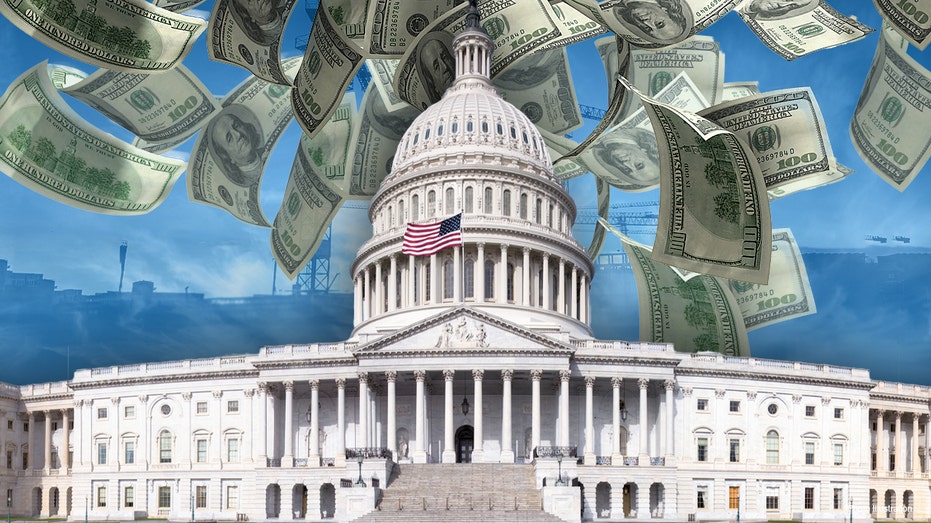
The U.S. national debt has now surpassed the size of the U.S. economy, a historic threshold that hasn’t been crossed since the conclusion of World War II.
Data released by the Bureau of Economic Analysis on Thursday showed that the national debt held by the public reached $31.27 trillion as of March 31, while nominal gross domestic product (GDP) was estimated at $31.22 trillion for the 12-month period ending in March.
That pushed the debt held by the public as a percentage of GDP above 100%, meaning that the public debt is now larger than the size of the U.S. economy. Public debt as a share of GDP is a measure preferred by economists in assessing a country’s government debt burden because it excludes debt held in government accounts.
With the latest data showing the public debt eclipsing the size of the U.S. economy, the federal government is quickly approaching the all-time record debt to GDP percentage of 106%, which was set in 1946 as the U.S. was in the process of demobilizing after the end of World War II.
US DEBT SET TO CRUSH WORLD WAR II RECORD AS ANNUAL DEFICITS EXPLODE TO $3T WITHIN DECADE
The nonpartisan Congressional Budget Office (CBO) released a 10-year budget and economic outlook earlier this year that projected the U.S. will break the post-WWII record in 2030 with the debt held by the public estimated at 108% that year. A decade from now, debt held by the public as a share of GDP is projected to reach 120%.
Making the budget picture even worse, the CBO estimates that the debt held by the public is expected to grow faster than U.S. GDP as projected in the years ahead, which could have far-reaching implications for the nation’s fiscal and economic outlook.
It said that dynamic could slow economic growth and reduce private investment, while hiking interest costs from servicing the debt.
US NATIONAL DEBT BREACHES $39 TRILLION MILESTONE FOR FIRST TIME AMID SPENDING SURGE
“With debt now above 100% of GDP, it’s only a matter of time until we pass the all-time record of 106% reached in the immediate aftermath of World War II,” said Maya MacGuineas, president of the nonpartisan Committee for a Responsible Federal Budget (CRFB).
“This time, the borrowing isn’t borne from a seismic global conflict, but rather a total bipartisan abdication of making hard choices.
“The higher we allow our debt to grow, the more we erode our own prosperity and that of future generations. Rising debt compromises affordability by slowing income growth, pushing up interest rates, and increasing inflationary pressures,” MacGuineas added.
“Debt squeezes our budgets with massive interest costs. It exposes us needlessly to challenges from geopolitical rivals. And without corrective action, rising debt could spark a devastating fiscal crisis.”
BUDGET DEFICIT HITS $1 TRILLION IN FIRST FIVE MONTHS OF FISCAL YEAR: CBO

MacGuineas added that lawmakers “need to stop the bleeding” to get the country’s fiscal outlook on a more sustainable path, urging them to reject new borrowing as well as offsetting new spending or tax cuts twice over to reduce budget deficits.
She also said that to stabilize and reduce the national debt as a share of the economy, the U.S. will need to go further and reduce budget deficits by about $10 trillion in the years ahead.
“One option among many is to follow the bipartisan momentum towards bringing deficits down to 3% of GDP, which would help bring the debt below 100% of GDP over time. What’s most important is turning this pattern of inaction around. There is no time to lose,” MacGuineas said.