

On 21 January, after 25 years of tense negotiations, the European Parliament voted to refer the Mercosur trade agreement to the European Court of Justice to determine if the deal aligns with the bloc’s rules.
It’s a move which could delay the ratification of the Mercosur agreement for a further two years and is a blow to supporters of the trade deal that would establish a free trade zone between the European Union and the Mercosur bloc (Argentina, Brazil, Paraguay and Uruguay).
On the European side, France, Poland, Austria, Ireland and Hungary are among the staunchest Mercosur critics, leading to conflicting claims about what the deal would bring to the EU in practice.
MEPs claim the deal will lead to ‘toxic’ imports
Concerns around the environmental impact of the deal, fair competition, and scepticism around the quality of products which will enter the European market are among the key issues stirring up opposition to the deal.
According to French MEP Manon Aubry, co-leader of the Left in the European Parliament, the agreement risks leading to the mass import of products treated with dangerous pesticides, a move which she said was “the worst free trade agreement ever negotiated by the European Union”.
“We export pesticides that are banned in the EU, only for them to return to our plates via imported food,” she said.
The European Union has some of the world’s most stringent rules when it comes to pesticides and food safety, meaning many harmful chemicals — that are banned for use in the EU — are instead shipped outside the continent, including to South America.
Critics argue that the Mercosur trade deal means that Europe will import food that is produced and grown with the very pesticides that are banned by the EU, but that are legal in many South American countries.
Ewa Zajączkowska-Hernik, a Polish MEP from the far-right Europe of Sovereign Nations Group, argues that the deal offers “no real protection mechanisms for farmers and consumers”, claiming that it will lead to the “importation of food containing toxic substances that are banned in the EU”.
Europe says it’s all good
Despite the frenzy around Mercosur, the EU already has trade deals with South American countries, with checks in place to ensure imported products comply with European standards.
For instance, in 2024, the European Commission carried out an audit in Brazil over the lack of traceability in beef exported to the EU. As a result, Brazil suspended exports of female beef.
The EU-Mercosur trade agreement aims to boost trade in goods and services between the EU and South American countries by significantly reducing tariffs on certain products.
Counteracting claims that the Mercosur agreement would mean importing a flood of unregulated products, the European Commission says it will ensure that existing food safety regulations remain in place under the Mercosur agreement.
In a statement shared in January 2026, the Commission reiterated that this means that genetically modified foods banned in the EU cannot be imported; that food must “comply with the maximum pesticide residue levels set by the European Union”; and that, as stipulated by a directive introduced in 1981, importing meat from animals who have been given growth hormones is banned.
Does the deal offer protection for consumers?
The European Commission announced that, under the terms of the deal, food safety checks will be operated on two levels.
Member states carry out inspections when products reach EU borders, while the European Commission oversees production systems in exporting countries to ensure compliance with EU standards before the goods leave their port of origin.
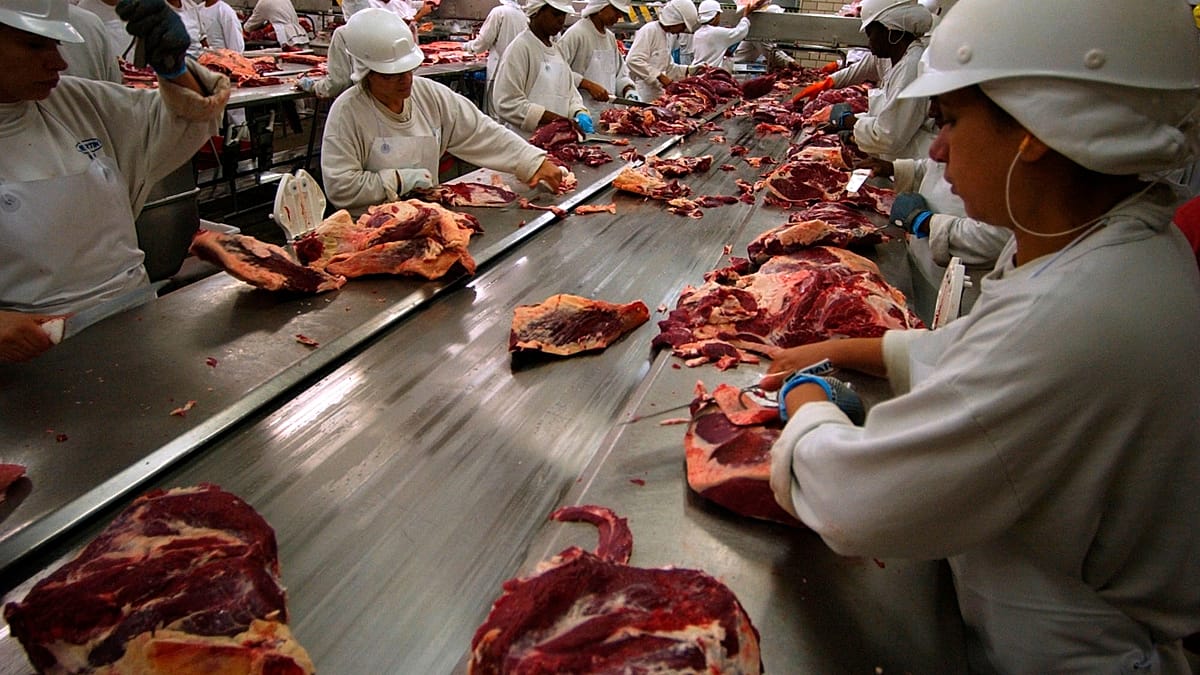
In practice, the EU already imports products from Mercosur countries, including beef, and border controls are in place.
But, the sticking point for Karine Jacquemart, general director at Foodwatch — a European advocacy group that focuses on protecting consumer rights on food quality — is that these checks are not implemented correctly as things stand.
For example, France urged Europe to introduce further measures to guarantee the quality of imported products.
The Commission did this through promising more scrupulous health checks in Europe, as well as on veterinary and phytosanitary audits of third countries to ensure compliance with the bloc’s rules.
Although France was among the EU member states which rejected Mercosur, President Emmanuel Macron praised the introduction of the measures, alongside the “establishment of a task force at the European Commission on the effectiveness of these checks”.
Critics, however, remain unconvinced. Jacquemart says the measures do not go far enough.
“Today, these rules are still not being properly enforced,” she said. “Border checks alone won’t stop the import of livestock treated with growth-promoting antibiotics — which are banned in the EU.”
“Foodwatch has found that current controls in member states are insufficient, and resources to enforce them are limited,” she added.
The authorities, however, assure that the current controls are indeed effective.
Speaking to Euronews’ fact-checking team, The Cube, Aline Van den Broeck, spokesperson for AFSCA — Belgium’s federal food safety agency — said that health-related checks at border inspection posts are being properly enforced.
She explained that the system is “designed to guarantee food safety, ensuring that imports from non-EU countries comply with European regulations and sanitary standards”.
The framework aims to maintain a consistent level of health protection across the EU, according to Van den Broeck.
“Belgium operates a four-step border control system, which includes temporarily intensified routine checks on consignments from certain countries or products, particularly where previous compliance issues have been identified,” she said.
Assurances from Brazil
Many of the health concerns surrounding the EU-Mercosur agreement stem from Mercosur countries’ use of chemicals that are banned in the EU.
However, speaking to The Cube, Brazil’s ambassador to the EU, Pedro Miguel da Costa e Silva, said that all meat currently exported to the EU comes exclusively from establishments audited and authorised by both EU and Brazilian authorities.
He also stressed that trade is already taking place regardless of the agreement, and that the deal would not change existing sanitary and phytosanitary standards.
“Trade is already taking place regardless of the agreement,” he said, adding that “the deal would not alter existing sanitary and phytosanitary standards.”
What do consumers say?
Consumer groups have also stressed the importance of maintaining food safety and animal welfare rules.
The Cube got in contact with the European Consumer Organisation, which represents European consumers and their rights.
It declined to respond to specific questions about allegations that “toxic” products could flood the European market.
Instead, a spokesperson told us that “while we understand the need for the EU to build long-standing partnerships with other regions in today’s world, we need to make sure the food that reaches consumers’ plates complies with EU food safety and animal welfare rules and that producers and governments do not give up on sustainability efforts.”