
While there are many ancient empires that have left their mark on history, in Europe, the Romans dominate the conversation.
ADVERTISEMENT

ADVERTISEMENT
Remnants are everywhere, from our use of the Latin alphabet and many law principles to the fact that men apparently think about the Roman Empire every single day, as revealed by a TikTok trend a few years back.
Roman buildings and archaeological sites continue to fascinate, with tourists flocking to the Colosseum in Rome, Hadrian’s Wall in the UK, and the Aqueduct of Segovia in Spain.
Yet not all of the remaining Roman wonders have made it into the mainstream, as I discovered on a recent visit to Plovdiv in Bulgaria.
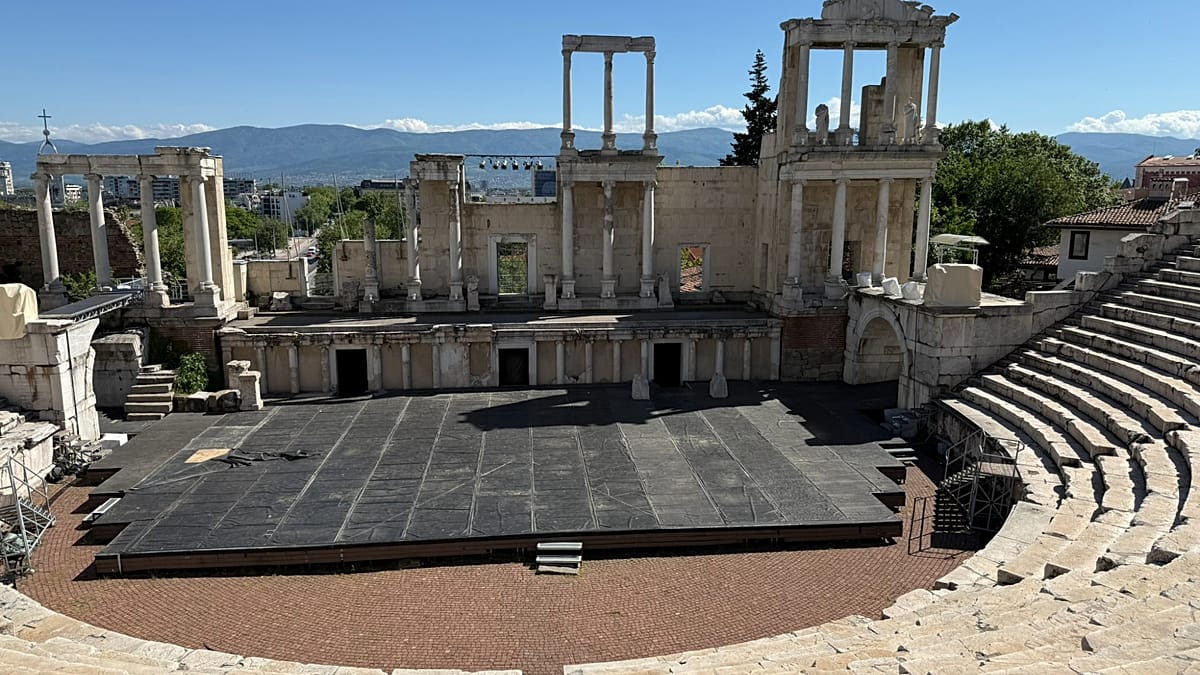
The Roman theatre of Philippopolis is among the best-preserved in the world – yet I had only a few other people, and a friendly cat, for company on my visit in mid-May.
In fact, Plovdiv’s history starts long before the Romans: Archaeologists have found evidence of human settlement here as far back as 6000 BC, making it the oldest continuously inhabited city in Europe.
Since then, the city has had various rulers, from the Thracians and Philip II of Macedon (aka Alexander the Great’s father) to the Bulgarians and the Ottomans.
With the city among those vying to host Eurovision in 2027, it won’t be long before the crowds descend. Visit now – and make use of our guide on what to see and do.
Things to see and do in Plovdiv
Admire the Stadium of Philippopolis
Plovdiv has had many names, but one you’ll hear a lot while visiting is Philippopolis.
Philip the Great, father of Alexander, founded it as a polis and lent it his name in 342 BC, with the city later going on to become the capital of the Roman province of Thracia.
One of the main sights dating back to the Roman era is the ancient stadium. Built in the 1st century AD, it had capacity for 30,000 spectators who would head here to watch athletic games and gladiator fights.
Only part of the stadium, at the end of the city’s main pedestrian street, is open to visitors as much of the remaining structure is underneath nearby shops.
Rub the knees of Milyo the Crazy
Another of Plovdiv’s most famous residents was Milyo Ludia.
Known for being a little, well, crazy, Milyo was a constant on the same street as the stadium, which is where you’ll find his statue today.
You’ll notice that Milyo’s knees are shinier than the rest of him – that’s because it’s said to bring good luck to your love life if you rub them both simultaneously.
You can ask a local exactly why that is…
Pay a visit to the Djumaya Mosque
Leaving the Romans behind, you can get a glimpse into Plovdiv’s Ottoman history with a visit to the Djumaya Mosque.
A mosque was built on this site shortly after the conquest of the city in 1363, although this structure was demolished and replaced by the current building in the 15th century.
Among the oldest Ottoman religious buildings in the Balkans, the structure was influenced by both Byzantine and Old Bulgarian architecture, with layers of brick and stone.
Dzhumaya is the city’s main mosque, and you will need to cover up if you want to go inside.
Explore Plovdiv’s Old Town
Plovdiv’s Old Town has been on UNESCO’s tentative list of World Heritage Sites since 2004, and it more than deserves its spot.
It’s here that you’ll find some of the city’s best ancient sites (more on that in a moment), but you’ll also be able to see houses built in the Bulgarian Revival style.
Stroll along the cobblestone streets and you’ll find numerous ones open to the public, like Nedkovich House, Stambolyan House and Balabanov House, but I settled on visiting Hindliyan House.
Built in 1834, the house has been remarkably well preserved, and you can see the décor and furnishings from that time inside.
Another option is the Ethnographic Museum, which covers things like clothing styles, musical instruments, and agriculture across the country.
Watch a concert at the Ancient Theatre of Philippopolis
The city’s theatre was in use from the 1st century until the 5th century, when it was destroyed by either a fire or an earthquake.
It was uncovered during archaeological excavations between 1968 and 1979 before being restored to its former glory in the 1980s, and now hosts concerts and performances once again.
You can wander the site as I did during the day, or you can experience it as intended by booking tickets for a show.
There are various concerts here during the year, but between June and September the theatre is the host of the Opera Open.
Climb up Nebet Tepe for sunset
The city of Plovdiv was built on seven syenite hills, three of which are in the Old Town. The northern hill, Nebet Tepe, is now an archaeological complex, with researchers finding traces of settlements dating back to 4000 BC here.
With its strategic location overlooking the area, Nebet Tepe was an obvious choice to build defensive fortifications. And as the city has changed hands many times over the thousands of years of its existence, there are many layers of history here, from the Thracian, Roman and early Byzantine to the Middle Ages and Ottoman period.
It’s free to visit, and the view is breathtaking at sunset. From here, you can also see Bunarjik Hill, another great option for seeing the sun go down.
Where to eat and drink in Plovdiv
Plovdiv’s selection as a European Capital of Culture in 2019 left a big impact on the city, particularly in the Kapana neighbourhood.
Once a hub for craftsmen (some of the streets are named for the shops you would have found here, like Blacksmith Street or Goldsmith Street), the area is now the home of the city’s creatives.
It’s also where you’ll find many of the city’s best restaurants and bars, like beer spot Cat and Mouse, and Mekitsa and Coffee, where you can try the traditional fried dough dish.
For something quick and tasty, we liked Fresh Pasta; be sure to head next door to sports bar The Turtle House for a pint after.
Next time I’ll visit Plovdiv for…
I didn’t get the chance to see a concert at the Ancient Theatre, so I’d definitely like to go back for the Opera Open later this summer.
Lots of people visit Plovdiv as a day trip from Sofia, but it’s definitely worth staying longer.
If I had more time, I would have liked to have visited the Buzludzha Monument, a futuristic abandoned building dating back to the communist era around a two-hour drive from the city.
How to get to Plovdiv
You can fly directly to Plovdiv on Wizz Air from London Luton and Bratislava, or with Ryanair from London Stansted and Milan.
You can reach Plovdiv from Bulgaria’s capital Sofia in around two hours and 15 minutes by bus, or just under three hours by train.
