


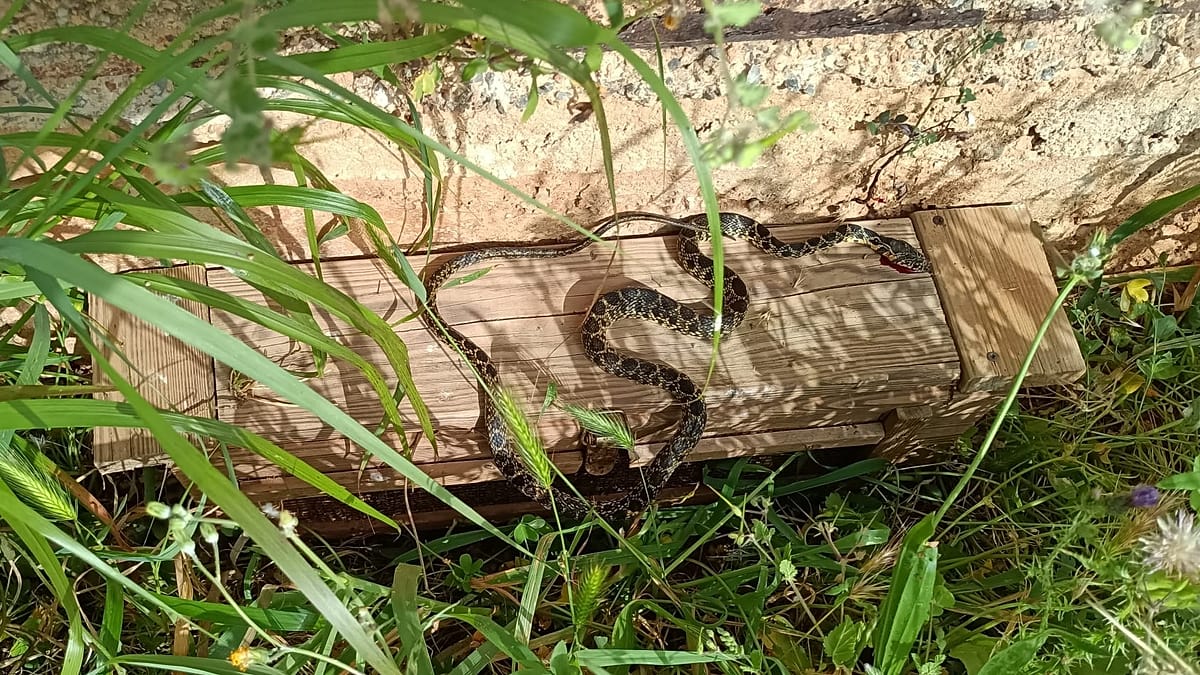
The spread of the horseshoe whip snake in the Balearic Islands has become one of the biggest threats to the islands’ biodiversity. Accidentally introduced from mainland Spain along with ornamental olive trees, this invasive snake has colonised much of Ibiza and Formentera and is driving a decline in native lizard populations, some of them unique to the archipelago.
ADVERTISEMENT

ADVERTISEMENT
Experts warn that the species behaves like an apex predator in an ecosystem where it has virtually no natural competitors. Its advance has been so swift that local extinctions of the Pityusan wall lizard have already been documented on several islets, and individuals have been recorded swimming between islands in search of new prey.
Yet the arrival of the horseshoe whip snake in the Balearics was no accident. Its story began more than two decades ago and, according to various studies, is closely linked to the trade in large ornamental olive trees from the mainland.
A silent invasion
It all began in 2003, with the sighting of the first horseshoe whip snake (“Hemorrhois hippocrepis”) on the island of Ibiza and anywhere in the Balearics, a species until then found only in the Maghreb, the Iberian Peninsula and parts of Sardinia.
But the Balearic government did not treat this ecological threat seriously until seven years later, when the first studies were published confirming that the snake had spread across much of the larger of the Pityusan Islands. In one of these studies (source in Spanish), by the time the invasive snake had already reached Mallorca in 2006 and Formentera in 2010, the islands’ biodiversity department was already pointing to a likely culprit:
“Residents of Capdepera (a town at the eastern tip of Mallorca) link the arrival of these Iberian olive trees to the introduction of the snakes, a possibility that appears plausible, since all three species are common in the area where the olive trees originate (…) Over the past 20 years there has been a considerable increase in the arrival of large specimens destined for landscaping,” the study notes.
In other words, instead of planting local olive trees and waiting for them to grow, estate owners – and the landscaping firms they hired – chose to bring in fully grown trees from the mainland, with reptiles on board.
This is not mere guesswork: the regional government explicitly singles out in the study a gardening company in Sant Llorenç de Balàfìa (Ibiza), where horseshoe whip snakes were recorded among its exports on two occasions. Nonetheless, some environmental organisations also criticise attempts by the authorities themselves to repopulate certain areas with imported tree species.
Since then this species, which should not be confused with the timid garriga snake (“Macroprotodon mauritanicus”), which is endemic to the islands, has chalked up a series of milestones in its conquest of the archipelago.
Ninety per cent of Ibiza is already colonised by horseshoe snakes, which are not dangerous to humans but are considered an apex predator for other species, as they face no competition in the Balearic food chain. They feed on small mammals and other snakes but particularly on Pityusan wall lizards, a species listed as “vulnerable” that lives only on Ibiza, Formentera and the surrounding islets.
And indeed, in 2024 a horseshoe whip snake was filmed for the first time swimming across the Balearic Sea in search of more food. According to scientists at the Centre for Ecological Research and Forestry Applications (CREAF), the extinction of “Podarcis pityusensis” has already been confirmed on around ten islets, including Santa Eulària, where they documented the snake swimming between islands (source in Spanish). Each islet also harbours its own subspecies with distinctive colours.
On top of that, the lizards known locally as sargantanas play a vital role in maintaining the islands’ ecological balance by keeping certain insect populations in check, dispersing seeds and even pollinating plants.
The measures adopted three years ago by the regional government to restrict certain tree imports during the time of year when snake eggs hatch have come far too late; efforts to catch them (around 12,000 snakes have been captured since 2016, according to official figures) are proving equally futile in the face of the spread of a species that seems to be here to stay in this corner of the Mediterranean, already well used to tourist invasions.
The horseshoe whip snake is not the only snake to have been introduced into the Mediterranean islands: along their coasts and mountain ranges live the ladder snake (“Zamenis scalaris”), the viperine snake (“Natrix maura”) and the Montpellier snake (“Malpolon monspessulanus”). Even so, the only snake species in Spain that are venomous to humans – the asp viper, the nose-horned viper and the Cantabrian viper – have not yet managed to reach Balearic shores.