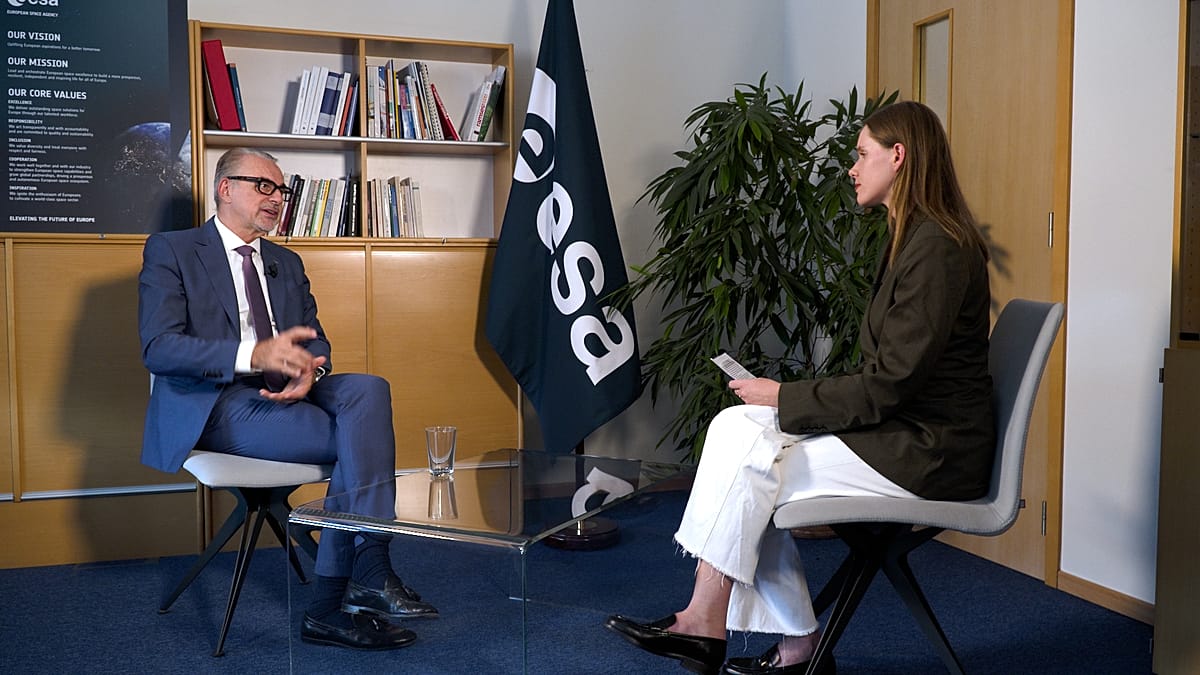
ESA’s Director General, Josef Aschbacher, was “saddened” and “concerned” by the images showing the explosion of a Blue Origin New Glenn rocket during an engine test at a Florida launch pad last week, saying the damage was “quite big.”
ADVERTISEMENT

ADVERTISEMENT
Amazon’s Jeff Bezos, who founded the space technology company, confirmed that no one was injured and that all personnel were accounted for, but the damage it caused is significant.
“It’s certainly a huge setback; this is not good for anyone in the space community,” Aschbacher said on Euronews’ interview programme 12 Minutes With.
The explosion has not only hampered Bezos’ hopes for Blue Origin to compete with rival Elon Musk’s SpaceX in the commercial space race. Last week’s setback could also complicate ESA’s American counterpart, NASA, in its lunar ambitions.
Aschbacher noted that such incidents are particularly devastating given “how much effort goes into developing a rocket, developing the engines, testing them, bringing them to orbit.”
“This was only one of the very first flights, so therefore it’s really in the ramp-up phase, and this is certainly something that concerns me,” Aschbacher said.
NASA hoped this type of rocket would be central to the multi-step Artemis programme to return astronauts to the surface of the Moon. In April this year, NASA launched the Artemis II mission, a historic 10-day crewed lunar flyby.
The next mission, Artemis III, involves a low-Earth orbit flight of two commercial lunar landers, built by SpaceX and Blue Origin, giving them time to test the launch systems needed for an eventual Moon landing. It was set to take place next year.
Until last week, Blue Origin was considered the more prepared of the two. However, the rocket explosion is now raising questions about whether landing on the Moon by 2028 — in what will be Artemis IV — and more recent plans to build a moon base are feasible.
“You have seen the explosion. The launcher base, I think, is pretty much destroyed, something that will take quite some time to rebuild, but also to investigate the reason why this explosion happened. And this, I know, takes quite a lot of time,” Aschbacher explained.
Science fiction?
Last week, NASA presented its plan for a permanent moon base, which would eventually be used to prepare humanity for missions to Mars. This would include full-time human habitation on the natural satellite by 2032.
“So that means infrastructure on the lunar surface. It may sound a bit science fiction to imagine that on the moon, astronauts will be walking, driving with rovers, and taking measurements. There will be other rovers extracting something from the soil on the surface. There will be factories producing bricks for making buildings and infrastructure,” Aschbacher said.
“But really, creating this infrastructure in this economy is quite a challenge. It will happen, but we are at the beginning of it.”
Asked about Europe’s role in these plans for a permanent moon base, he noted ESA is “very much part of it.”
“These days, I am very intensely negotiating with NASA on the various elements that we can provide in this larger context,” Aschbacher explained, adding that ESA has been in talks with its American counterpart on strengthened cooperation on such a project since 2022, when the European agency funded “very important projects.”
He cited Argonaut, ESA’s lunar lander programme, which will support Artemis missions and transport equipment from the Earth to the lunar surface, and its Moonlight programme, Europe’s first-ever constellation of lunar satellites dedicated to telecommunications and satellite navigation.
“The engine for the Orian capsule [the European Service Module] is provided by the European Space Agency. So yes, we are part of a very close and dense cooperation with NASA already,” Aschbacher said.
However, ESA’s future in the Artemis III mission was recently called into question. It was set to build the Lunar Gateway, a Moon-orbiting station for the Artemis III programme, but earlier this year, NASA paused the development of this base, at the expense of years of hard work and millions of euros invested by the European space sector.
European technology, in any case, will continue to be part of the Artemis mission. But what about the involvement of the continent’s astronauts?
“That is a big question. I wish I could answer it,” Aschbacher said.
“I hope before the end of the decade. We will, of course, partner with NASA, our partner for astronaut flights. This is not yet agreed; I just want to be very clear [on that]. But we are discussing with NASA very intensely to make this possible for Europeans as fast as possible.”
German ESA astronaut Alexander Gerst is considered a top candidate to become one of the first Europeans to fly to the Moon, possibly as part of the Artemis IV mission.
The crew for the Artemis III mission is scheduled to be revealed on 9 June.