Published on
Six European Union countries have raised renewed concerns over the bloc’s carbon market, saying that the costs it links to pollution could force industry to relocate production outside the EU to countries with weaker environmental rules.
ADVERTISEMENT

ADVERTISEMENT
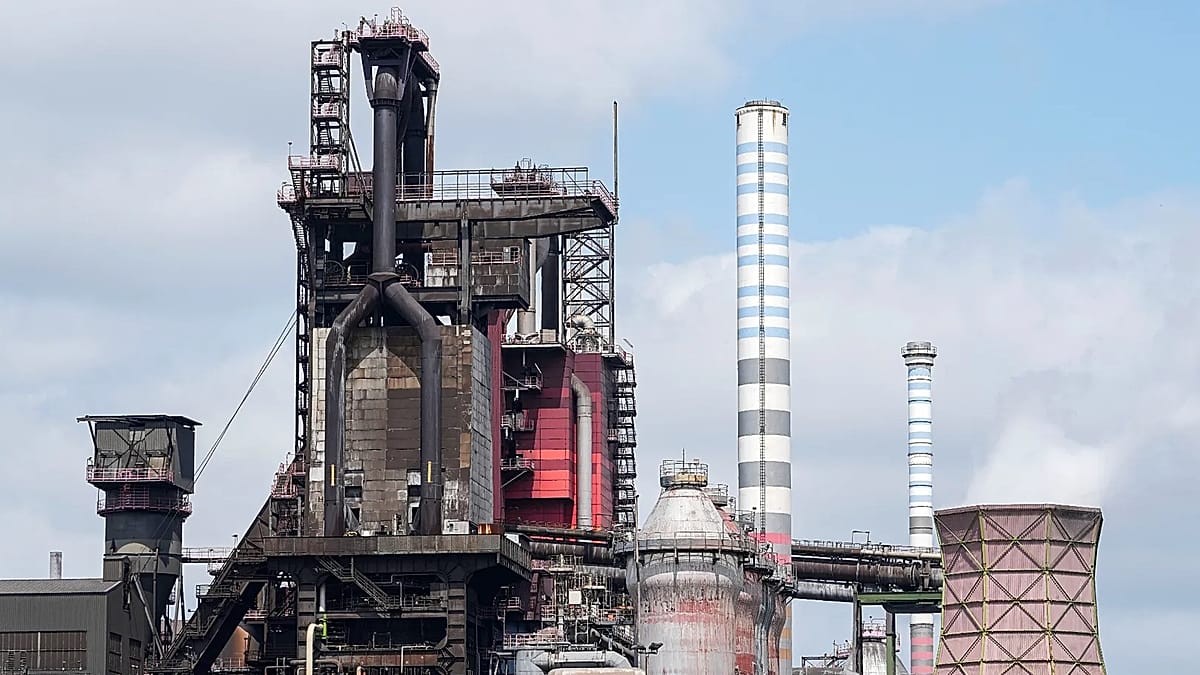
During a gathering of industry ministers in Brussels on Thursday, Bulgaria, the Czech Republic, Greece, Poland, Romania and Slovakia warned that their steelmakers, cement plants, aluminium smelters and chemical producers are being squeezed between soaring energy costs, geopolitical instability and tightening carbon rules under the EU Emissions Trading System (ETS), the bloc’s carbon market.
At the centre of the dispute lies the upcoming revision of how many free carbon allowances industries receive. Brussels intends to tighten free allowances sharply for 2026-2030, the European Commission announced on 11 May, in some cases cutting them by up to 50% compared with the previous decade.
The news was described as a “disappointment” by ministers on Thursday.
Italy and Austria strike back
Before the ministerial meeting, the six countries issued a document, seen by Euronews, stating their concerns.
In it, they argued that the EU is asking factories to decarbonise faster than technology currently allows, noting that many heavy industries still rely on fossil-fuel heat because affordable alternatives either do not exist at scale or remain commercially unviable.
The document drew support from Italy and Austria, who had been calling for the suspension of the ETS before the US-led war against Iran further exacerbated rising energy prices in Europe.
Italian Minister for Industry Adolfo Urso told his counterparts that the situation for industry in Italy was untenable even before the war in the Middle East, and urged the Commission to act in light of the latest geopolitical developments.
“It would have been necessary to do something before the war. We don’t know it’s going to end. It was necessary then, it’s even more necessary now to deal with the situation,” Urso said.
Similar worries were voiced by Austrian Federal Economy and Energy Minister Wolfgang Hattmannsdorfer, who noted that steel producers will need to invest between €1bn and €2bn in decarbonisation over the coming five years.
“The free (ETS) certificates need to be extended because the system is increasingly becoming a competitive disadvantage for our European industry,” Hattmannsdorfer said.
Rather than rejecting climate policy outright, the wary ministers propose a slower, more pragmatic transition, calling for a temporary freeze of benchmark values at current levels and redesigning the methodology to account for actual production capacity and realistic energy mixes.
Responding to the ministers’ concerns, Industry Commissioner Stephane Séjourné suggested that the Commission is inclined to propose tailoring free allocations to industry sectors as part of the upcoming revision of the ETS.
“We will also look into an adapted methodology that is more flexible as regards the reality of the sectors to avoid finding ourselves in the same situation in the future,” Séjourné said, pointing to the €30bn of funds financed by 400 million ETS quotas ready to support investment in industrial decarbonisation.