

The two Brazilian mainland cities closest to Europe are making the most of this geographic advantage to attract a growing number of international visitors, thanks to air links with capitals such as Madrid, Lisbon and Paris.
ADVERTISEMENT

ADVERTISEMENT
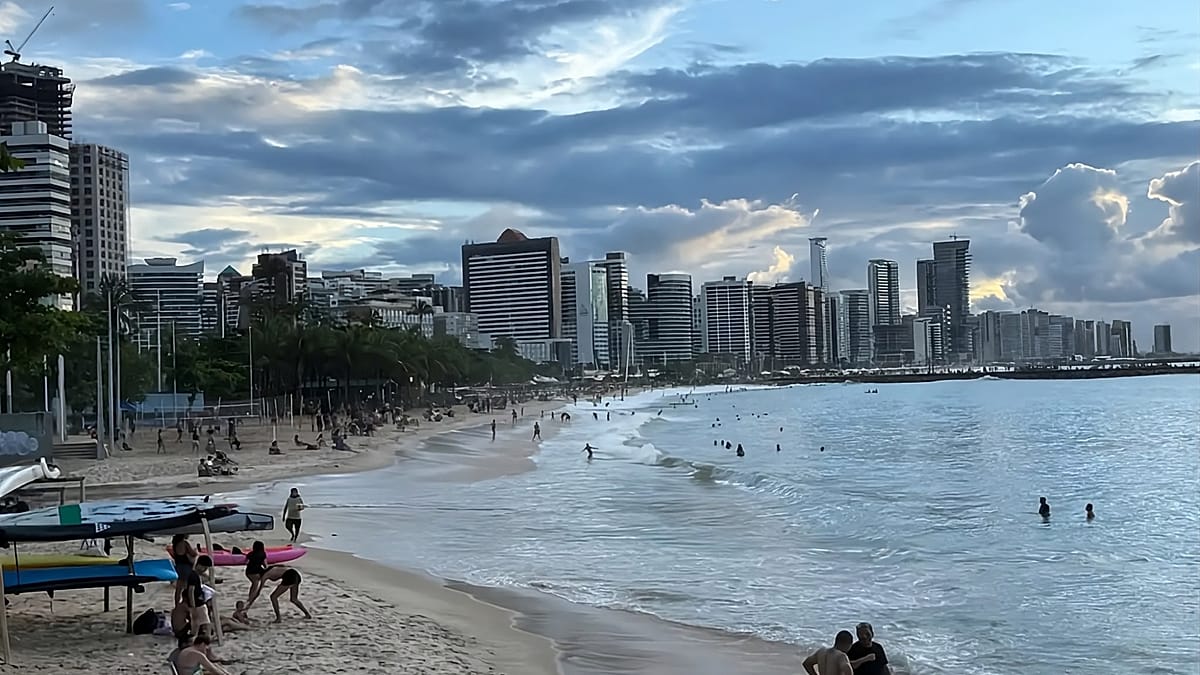
Less than eight hours from the Spanish capital, travellers can enjoy Fortaleza’s skyline of skyscrapers, which looks like a cross between Miami and Benidorm. The tall towers along the seafront give the city a modern urban profile that combines with the long coastal promenade (Beira Mar), in a tropical, holiday atmosphere that encourages you to make the most of the outdoors.
Fortaleza: 300 years of history
Fortaleza, with 2.57 million inhabitants, is one of Brazil’s five most populous cities and the capital of the state of Ceará, home to more than nine million people. Its history is tied to the colonial struggle between the Portuguese and the Dutch. In the 17th century, in 1649, the Dutch built Fort Schoonenborch, the origin of the modern city.
After the Portuguese reconquered it six years later, it was renamed Fortaleza de Nuestra Señora de la Asunción, Fortaleza of Our Lady of the Assumption. In 2026, the city is celebrating the 300th anniversary of its founding, an anniversary that can be felt in every corner of the city.
“This is a vibrant city with a rich blend of cultures that never sleeps. As early as three in the morning lots of people are already out on the streets doing sport, running; it’s a city with a great deal of movement,” explains tour guide Castalha. You can see it for yourself the following morning, first thing: dozens of amateur runners take to the Beira Mar promenade, pounding the pavement along some six kilometres of coastline that link three beaches – Iracema beach, with landmarks such as the Bridge of the English, Meireles, with its night-time craft market, and Mucuripe.
For those who like to combine sport and the sea, another option is canoeing in these more-than-mild Atlantic waters. A stroll afterwards through the Mercado dos Peixes makes it clear that this stretch of Mucuripe beach is ideal for near-artisanal fishing. Fishermen head out in what are known as jangadas, light sailing boats, to work the waters close to the shore. Fish and seafood are two staple ingredients of Ceará’s cuisine.
At night, the city never sleeps; music and dance take over. All across Fortaleza people dance forró, a cultural hallmark of north-eastern Brazil. It is danced in couples, very close together, with quick steps and simple turns that this reporter was unable to keep in time with the music.
The adventure of the falésias
Beyond the big city, the adventure begins, some 160 kilometres to the south-east, in Canoa Quebrada, in the municipality of Aracati. It is a small coastal village famous for its falésias (sand or rock cliffs), tinted red or white, and for its wind-sculpted dunes. It is one of the most distinctive landscapes in north-eastern Brazil and is explored by buggy, light open vehicles that race across the dunes, beaches and coastal tracks, allowing tourists to take stunning photos and videos with the crescent moon and star symbol carved into the falésias in the background, the emblem of Canoa Quebrada.
This place became famous in the 1970s among European backpackers and hippies, drawn by its unspoilt beaches, warm climate, dunes and laid-back, free-spirited atmosphere. One of the most authentic beaches in Ceará is Canto Verde beach, in the municipality of Beberibe, where travellers can enjoy a genuinely local experience that will not leave them indifferent. Here there is a community of some 200 artisanal fishers with whom you can head out to sea in their traditional boats, which, locals say, has attracted Swiss, Portuguese and American tourists.
It is total immersion in the local culture. “We make our living from artisanal fishing and we are promoting community-based tourism,” explains Roberto. The inhabitants of Canto Verde have fought against property speculation and mass-tourism projects in order to protect this area and create a sustainable reserve.
“This is another of this place’s attractions; it is a form of sustainable tourism that does not push out local people, but instead involves them and their traditions and customs,” notes Daniele Rocha, from Embratur, Brazil’s International Tourism Promotion Agency.
Recife, a defining symbol of Brazil
Just over an hour’s flight from Fortaleza, a completely different reality emerges in Recife, capital of the state of Pernambuco, with 1.5 million inhabitants. It is the other great metropolis of north-eastern Brazil and, in the past, was the country’s economic epicentre. Its strategic port and the sugar trade turned it into one of the most important cities in Portuguese America.
Its history is closely bound up with colonisation, Atlantic trade and Dutch occupation. Between 1630 and 1654 it was the capital of New Holland, the Dutch colony established in north-eastern Brazil. During that period bridges, canals and buildings were constructed that still form part of the city’s urban identity today.
Here the history of Brazil beats strongly, as it was the stage for major revolutions that left their mark on its cityscape: colonial churches, fortifications, old Portuguese streets, buildings influenced by Dutch architecture and the first synagogue in the Americas, the Kahal Zur Israel synagogue. With its rivers, bridges and urban islands, Recife has even earned the nickname “the Brazilian Venice”.
The city is also one of the country’s great cultural centres. The intense mixing of peoples that characterised Pernambuco, a crossroads for Europeans, Africans and Indigenous peoples, left a legacy in the form of frevo, a traditional music and dance style with jumps, acrobatics and spins reminiscent of capoeira. With their colourful umbrellas, frevo dancers, listed by UNESCO as Intangible Cultural Heritage of Humanity, embody the rhythm and soul of the city.
Frevo reaches its peak expression during Carnival, when the streets fill with troupes, musicians and millions of revellers. The most recognisable symbol of the festivities is the enormous decorated cockerel of the Galo da Madrugada, considerado uno de los mayores desfiles carnavalescos del mundo.
Olinda, the colonial gem
Just seven kilometres from Recife lies Olinda, one of Brazil’s most beautiful historic cities. Founded in 1535, it preserves a colonial urban ensemble that has been declared a UNESCO World Heritage Site. Walking its steep, cobbled streets takes you back to another era, with brightly coloured colonial houses and baroque churches.
From the viewpoints of Alto da Sé you can look out over the Atlantic, the colonial rooftops and, in the distance, the modern skyline of Recife. During Carnival, Olinda showcases another of its great calling cards: the Bonecos Gigantes, giant figures several metres high that represent historical figures, artists, athletes or politicians, and parade through the streets accompanied by thousands of people.
If Fortaleza is synonymous with beaches, nature and tourism, Recife embodies the country’s cultural and historical dimension. The first looks to the future from its skyscrapers on the Atlantic seafront; the second preserves the traces of some of the most decisive chapters in Brazil’s history.
With direct air links from Europe and an increasingly diverse offer, both cities are consolidating their position as two of the main gateways to a Brazil that still holds many surprises in store for international travellers.