

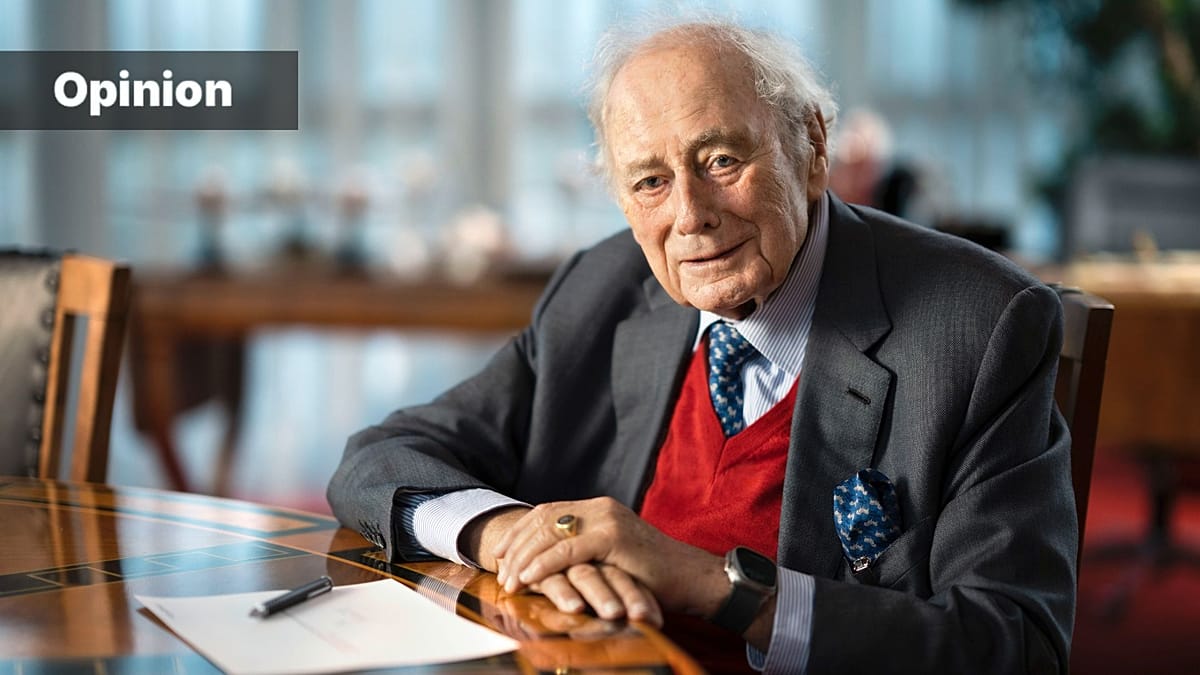
By Prof. Dr. h. c. mult. Reinhold Würth, Honorary Chairman of the Supervisory Board of the Würth Group
Published on
In April 2026, I celebrated my 91st birthday. At the end of World War II, I was 10 years old, which gave me the opportunity to experience the golden years of the German Federal Republic from day one. Future generations will refer to the period from 1945 to at least 2026 as Germany’s Golden 80 Years: a Germany at peace for 80 years, annual growth in prosperity, a functioning democracy.
ADVERTISEMENT


ADVERTISEMENT
I am grateful that I was born into this time in 1935. I was never a soldier. In my youth, I belonged to what was called the Silent Generation. This year, in 2026, I will have been married to my dear wife Carmen for 70 years.
Germany’s prosperity grew from year to year
My career and development can also be compared to the development of the Federal Republic. My father Adolf was able to establish the Würth company in Künzelsau a few days after the end of World War II, back then with the approval of the American military government.
In 1949, I joined this two-man business as an apprentice and, after the sudden passing of my father in 1954, had to continue managing the business at the age of nineteen, which turned out rather well. I worked on winning customers and recruiting new sta7. I considered it a happy hobby which ultimately resulted in 86,000 employees generating more than €20 billion in annual sales (2025) today.
On average, Würth’s sales grew by 19.3% every year. On the development of the Federal Republic of Germany, it can be said that this lost, destroyed country was rebuilt by the hard work of its citizens and the economy, by authorities and politicians. Prosperity grew year after year.
After buying a bicycle and a new car, many Germans were able to move into their own homes, while their new-found prosperity allowed them to start travelling ever greater distances to vacation spots around the world. So far, so good.
Children and grandchildren of baby boomers love convenience
Recapping this development, you could say that a majority of the population had achieved a secure existence and a certain degree of prosperity, which, in turn, diminished the interest of employees in making further steps in their professional careers.
Instead, people devoted their attention to their families and to preparing a mostly stress-free future for their children, which resulted in them pampering the younger generation to a certain degree.
Adding to this development was the launch of the constantly improving iPhone around the turn of the millennium: Quickly, the children taught their parents and teachers how to use the iPhone.
This led to a reorientation of an entire generation, leaving the stressful establishment of one’s own survival strategy behind and instead assuming that well-being would be guaranteed. Worries about war? None whatsoever. Stress at work? None whatsoever. Having the parents pay for a trip around the world after school? Yes, please! This more or less answers the question of how Germany is doing.
The children and grandchildren of the Baby Boomer generation love comfort and protest that Friday afternoons should not be part of their working lives, but rather part of the weekend. This used to be the Saturday afternoon!
2026: Germany’s immune system is no longer trained
Now that people have been roused from their quiet lives in 2026 by warnings of Germany’s economic decline, the threat of war, and fears of inflation, it turns out that Germany’s immune system is no longer trained and needs to be revitalised with infinite effort. The governments under Scholz and Merz reflect this situation, with the latter still having an opportunity to improve the situation.
It is a fact that most production companies in this national economy are no longer competitive due to the unreasonable wage demands of the trade unions: Unit production costs in other EU countries are up to 50% lower than in Germany.
As a result, products made in Germany are no longer competitive on the global market, while employees of production companies that close down in Germany are losing their jobs. Germany is caught in a downward spiral of deindustrialisation.
Take on the competition in electronics, IT and AI
In this context, I see only one chance to avert this disaster and that is starting to compete with US giants Google, Apple, etc. in the electronics, IT, and artificial intelligence sectors, building up domestic clouds, and innovating in the artificial intelligence segment like there is no tomorrow.
This is going to be immensely difficult considering the huge progress in the development of artificial intelligence in China. Apart from the purely economic aspects, we should not neglect the mood and emotions in Germany: 50% of macroeconomic success is simply emotion, the general mood, and the citizens’ opinions.
The prosperity-driven multitude of voices in this country, hate speech against everyone and everything is poisoning the country’s immune system.
One of the highlights in the 91 years of my life was 9 November 1989, when the Berlin Wall fell in the GDR and German reunification began. How elated Germans were back then, enthusiastic about the German reunification. Millions were moved to tears. This was one of the high points in the history of the Federal Republic of Germany.
And today? Morally narrow-minded and petty carnage (metaphorically speaking). Everyone against everyone, everyone against everything, does it have to be this way?? Against the threat of another World War, we as Germans should rearm –democratically, ideologically, and militarily – simply to deter our enemies and preserve the peace.
But this requires consensus, unity, a feeling of belonging, and not strikes for higher company pensions after retirement (Lufthansa). Now, in the 92nd year of my life, I know that I will pass away from this Earth and our country within a rather brief period of time.
The last words spoken by Claus Schenk Graf von Stauffenberg were “Long live Germany.” Allow me to add “Long live Germany in freedom and democracy.”