

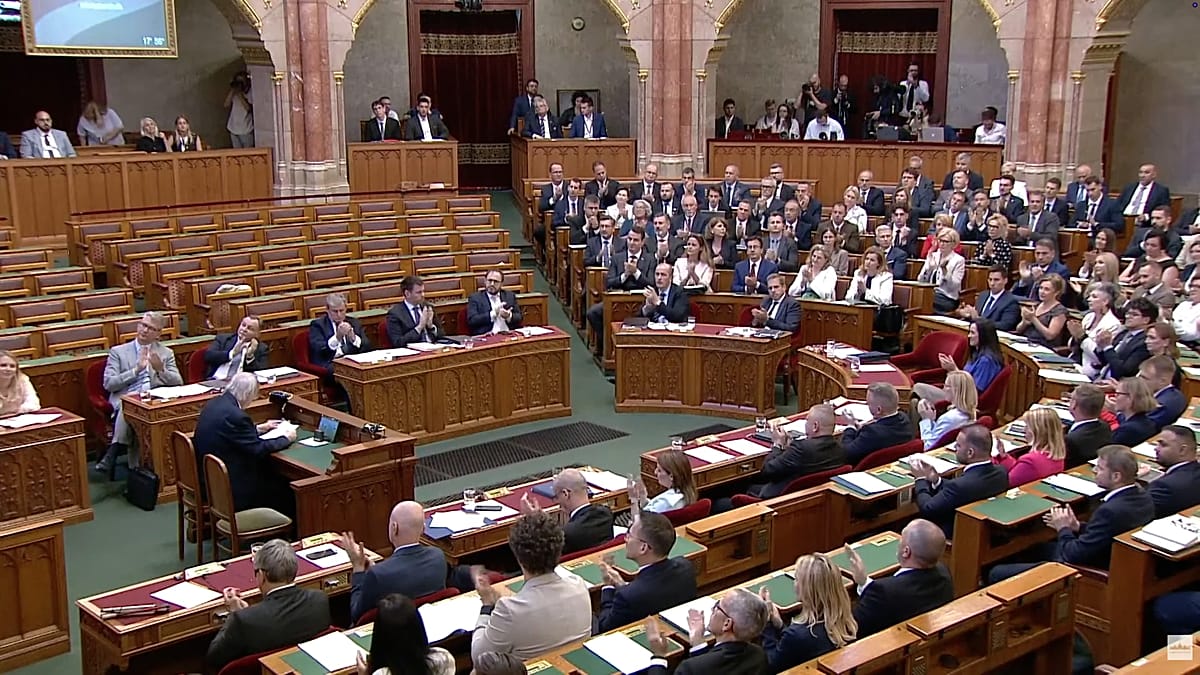
Parliament has adopted the 17th amendment to the constitution with 139 votes in favour and 6 against, thereby making it possible to remove the current President of the Republic, Tamás Sulyok. 54 MPs did not take part in the vote.
ADVERTISEMENT


ADVERTISEMENT
The constitutional amendment is primarily designed to remove the incumbent president, while also establishing a precedent that could enable similar removals in the future.
On the day after the amendment enters into force, Sulyok’s mandate will end, and thereafter Parliament will elect a head of state to serve until the new constitution takes effect, but for no more than five years.
In his speech before the start of the formal agenda, Prime Minister Péter Magyar said it would be a betrayal of the Hungarian nation not to touch the Fidesz-drafted constitution, which he described as “the founding document of the Hungarian Cosa Nostra built by Fidesz–KDNP.”
He added that, in his view, under the Orbán governments, everything had been subordinated to one man’s will and political survival.
Long list of cases failing to defend the constitution
He also recalled that when Péter Polt was chief prosecutor, no investigation was launched into the hundreds of billions that disappeared from the MNB, the central bank. As he put it, Polt was just as uninterested in that as in defending the constitution, which he should now be dealing with as president of the Constitutional Court.
“The constitutional task is to protect the country from external threats, Hungarian people from arbitrary power, common property from looting, the freedom of elections from interference by the state and the secret services, children entrusted to the care of the state from their abusers, and state institutions from being used by a party that has lost an election to preserve its own power,” the prime minister said.
To justify the removal of the president, he gave a long list of cases in which Tamás Sulyok had remained silent, including when it emerged that police proceedings and secret-service surveillance had been launched against IT experts from the Tisza Party on fabricated charges.
“He should have defended constitutionalism when one of its most important foundations was at risk: the principle that the secret services protect the Hungarian state and can never become the ruling party’s henchmen.”
Fidesz parliamentary group boycott
Last Tuesday, at the end of the general debate in Parliament on the seventeenth constitutional amendment, Fidesz MP Miklós Panyi announced that the Fidesz and KDNP parliamentary groups “will not take part in dismantling democracy”, and therefore would not be present either for the detailed debate or for the vote.
On the day of the vote, 13 July, they indeed stayed away from the chamber, and President Tamás Sulyok himself did not appear in Parliament.
Gulyás resigns as parliamentary group leader
Gergely Gulyás, leader of the Fidesz parliamentary group, said at a press conference held just before the vote that “from now on there is a political contest in Hungary in which at least half of MPs are excluded from competing.” The entire Fidesz group was present at the briefing.
“The removal of the head of state, the violent approach we have experienced in recent times, is unprecedented. […]The largest opposition group cannot have a leader who, in public-law terms, cannot in fact be its leader, and therefore I am resigning as head of the parliamentary group,” Gulyás announced.
Last Thursday, Fidesz organised a demonstration under the slogan ‘Stop arbitrary rule!’ outside the Sándor Palace, the official presidential residence.
Sulyok has five days
President Tamás Sulyok will have five days to sign the constitutional amendment. If he fails to do so, the Parliament will initiate removal proceedings against him.
Under the constitution, the head of state would then no longer be able to exercise his powers, and the Speaker of Parliament would be able to sign the law in his place.
Tamás Sulyok has previously voiced constitutional concerns several times about moves to remove him, seeking help from both the Constitutional Court and the Venice Commission.
The amendment drafted by Justice Minister Márta Görög aims to ensure the essential institutional conditions for the lawful functioning of the state until the new constitution enters into force, and to lay the foundations for the restoration of constitutional democracy.
The proposal includes, among other things, a 12-year (or three-term) limit for members of parliament, the termination of the current president’s mandate, the introduction of a 70-year age limit for constitutional judges, and the possibility for judges to initiate the recall of the presidents of the Curia and the National Judicial Office.
Magyar issues a warning
Before the vote, the prime minister wrote on his Facebook page that “on the basis of the democratic mandate of the Hungarian people, the replacement of Orbán’s political puppets can begin”.
According to Péter Magyar, the president cannot examine the content of an amendment to the constitution; he could only refer the text to the Constitutional Court for prior review if there were a public-law ground for invalidity.
“But it is obvious that no such situation exists. Tamás Sulyok knows this too, which is why, until the middle of last week, it seemed that, reluctantly, he would sign the adopted amendment and thus his own dismissal. However, around Wednesday, Fidesz swung into action and forbade the president from signing, in effect defying the constitution,” Magyar wrote.
Magyar also said that under the leadership of Gergely Gulyás, Fidesz had prewritten the submission to the Constitutional Court that the president would have to file, thereby blocking the amendment’s entry into force “and thus the breaking of the Orbán mafia”.
At the Constitutional Court, Viktor Orbán’s long-time henchman, Péter Polt, was already waiting for the presidential petition drafted by Fidesz so that he can consign the case to oblivion, potentially forever, he added.
“Let it be absolutely clear to everyone who takes part in this dark, unconstitutional manoeuvre and would thereby prevent the democratic will of the people from prevailing that they will have to bear responsibility for it later,” the prime minister warned.
Sulyok fell ‘because of his silence’
Health Minister Zsolt Hegedűs explained on his social media page before the vote why the head of state has to go.
“Over the past sixteen years, not only has a system of government been built, but also a deep state which, through long mandates, two-thirds rules, entrenched office-holders and power centres created from public funds, seeks to maintain the false, corrupt and hypocritical influence of the old order even after an election defeat,” he wrote.
According to the minister, this includes those who should have stood up for constitutionalism, human dignity and the unity of the nation, but did not do so – for example when “Hungarian citizens were called bugs, when judges, journalists and civic activists were stigmatised, or when the language of power became exclusionary and humiliating.”
In Zsolt Hegedűs’s view, Tamás Sulyok was brought down by his silence, his failure to take a stand and his avoidance of plain speaking as he did not stand up for judges under political attack and for judicial independence, nor for the journalists, civic activists and artists who were targeted, or for vulnerable and abused children.
“Time and again he failed to do what is the president’s most important moral duty: to draw a line in front of power, to defend human dignity, to guard the unity of the nation and to speak up also for those who have no institutional strength.”

