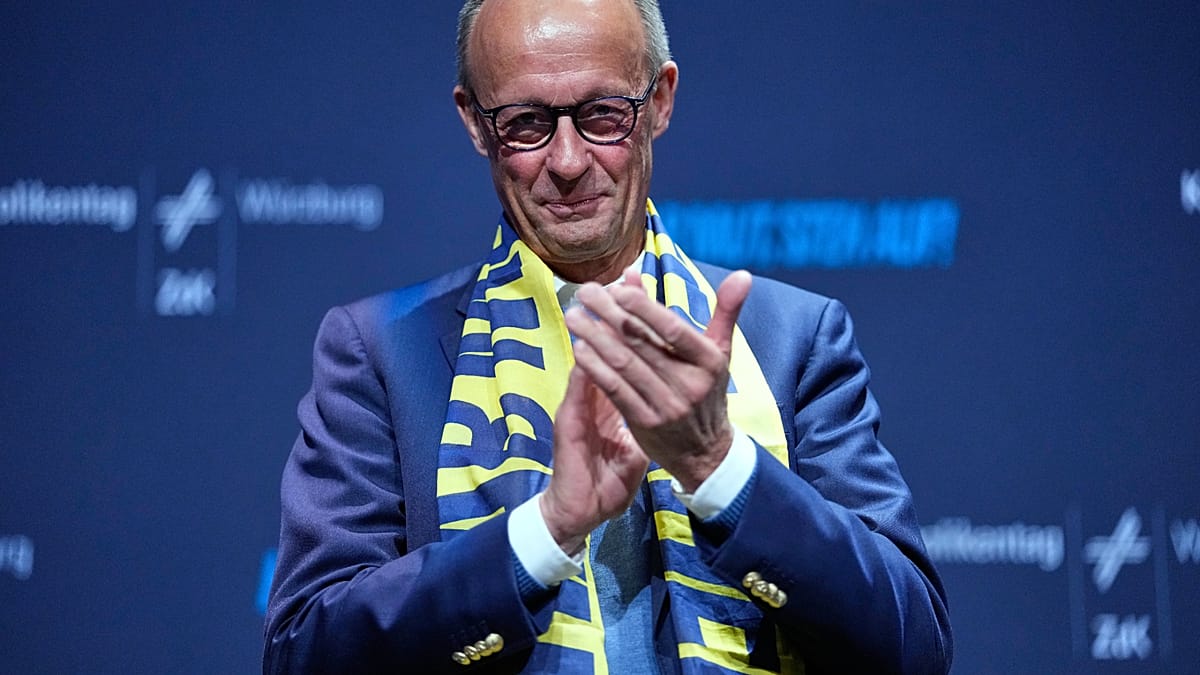
Federal Chancellor Friedrich Merz has acknowledged shortcomings in the conservative-Social Democrat coalition and announced that he intends to communicate his political course more clearly in future.
ADVERTISEMENT

ADVERTISEMENT
At the German Catholic Convention in Würzburg, the CDU leader said that while dispute is part of democracy, it has to lead to results. At present, he said, there may be too many arguments and too little being achieved.
The federal government is planning a reform package on tax, the labour market, pensions and cutting red tape before the summer recess. In recent weeks, however, there have been repeated conflicts within the conservative-Social Democrat coalition.
The chancellor also admitted to shortcomings in communication. He said he was increasingly grappling with the question of why he apparently was not succeeding sufficiently in convincing people of the federal government’s course. He knew he had to improve the way he communicates so that his messages are better understood, Merz said during a panel discussion at the Catholic Convention in Würzburg at which young people in particular asked questions.
According to last week’s ARD “Germany Trend” survey, only 13 percent of respondents are still satisfied with the government’s work one year after it took office. The chancellor’s own ratings have also fallen sharply in the first year of his term and now stand at just 16 percent.
Climate activists disrupted the panel discussion with Merz with heckling and whistling. The more than 1,000 members of the audience in the hall initially followed the situation patiently for a few minutes, but then called on the roughly four protesters to leave the room. Security staff escorted one woman out of the hall, while another activist left voluntarily. The event was then able to continue.
Merz stressed that many people in Germany already work very hard. At the same time, lifetime and annual working hours are lower than in many other industrialised countries. If existing prosperity is to be secured, everyone will have to make a greater effort and do more.
“Doing more”
He said he wanted to trigger a “collective push” to lead the country out of its current difficult situation.
Youth representatives called on the chancellor to involve young people more closely in political decision-making and not to label them as lazy. Merz replied that no one in his party had said that people in Germany were lazy. At the same time, he conceded once again that he needed to improve his communication.
He stressed that, in view of the major challenges, he wanted to convey optimism and build confidence that the problems can be solved, but that he would have to explain his positions even more clearly in future.
Fresh swipe at the US
Merz once again voiced criticism of the United States at the Catholic Convention, saying his admiration for the country was currently not increasing. He added that he would no longer advise his own children to go to the US: “I would not advise my children today to go to the United States, to be educated there and to work there. Quite simply because a particular social climate has suddenly developed there.”
Germany, he said, offers a social market economy rather than unfettered capitalism. Many young people, including highly qualified talent, are currently finding it difficult to secure a job in the US.
Later in the afternoon he posted on “X” that he had phoned US President Donald Trump.
He wrote: “I had a good phone call with Donald Trump on his return journey from China. We agree: Iran must now come to the negotiating table; it must open the Strait of Hormuz; Tehran must not have a nuclear weapon. We also spoke about a peace settlement for Ukraine and coordinated our positions ahead of the NATO summit in Ankara. The United States and Germany are strong partners in a strong NATO.”
It is unclear whether Trump was already aware of these remarks at the time of the call. When Merz last spoke about the US in front of young people, the US president reacted sharply, a move that triggered the recent cooling in relations between the two. Trump wrote at the time on his Truth Social platform that Merz did not know what he was talking about and that it was no surprise Germany was doing badly, both economically and overall.
Earlier, in April, Merz had told pupils at a school in North Rhine-Westphalia, in relation to the United States, that an entire nation was being humiliated by the Iranian leadership.