
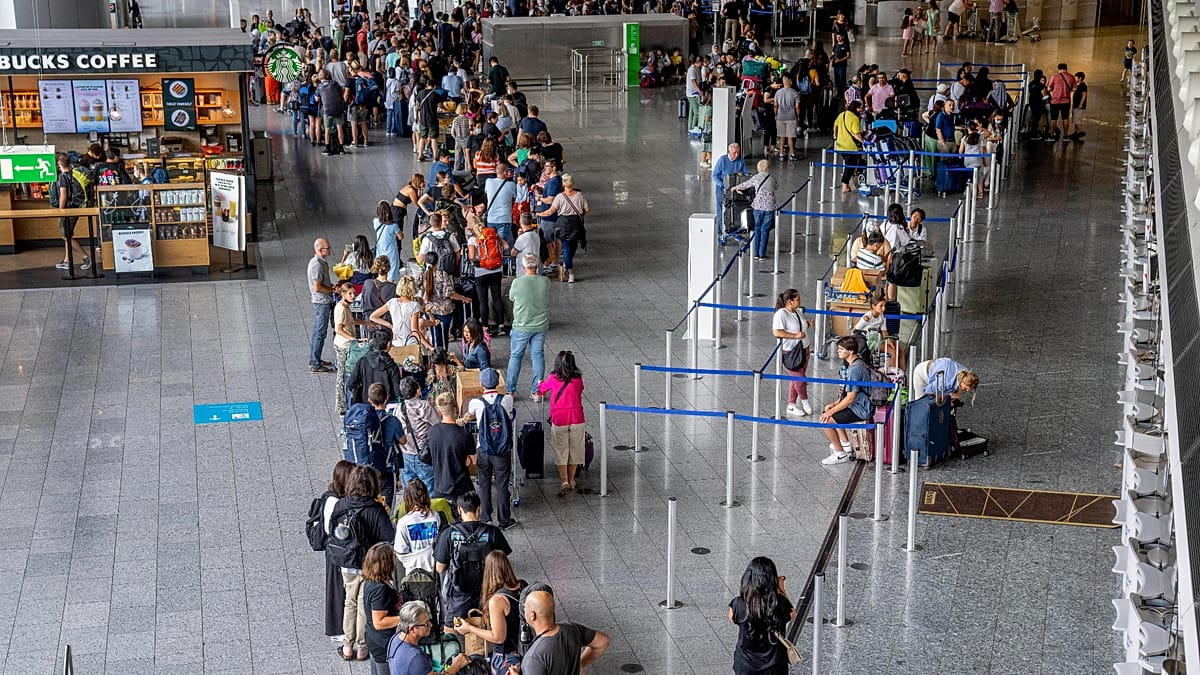
Nine European countries have urged the EU to extend the current temporary flexibility to suspend the new Entry/Exit System (EES) border checks, warning that the bloc isn’t ready to fully implement the controls.
ADVERTISEMENT

ADVERTISEMENT
In a joint letter, Belgium, France, Germany, Greece, Italy, Malta, the Netherlands, Portugal and Switzerland have requested the emergency safeguards remain in place after 6 September.
It comes as the chief executive of 14 Greek airports calls for the “unpleasant and dangerous” biometric checks to be overhauled, while easyJet’s boss brands the border queues “completely unacceptable”.
‘Source of serious and legitimate concern’
The letter from nine European countries warns that the initial months of the full EES rollout have exposed “significant difficulties” when the system is under pressure, which “should not be underestimated”.
While the ministers reiterate their support for the border checks, they are pushing for an extension of the flexibility currently in place.
“The scheduled end of the partial suspension mechanism on 6 September is a source of serious and legitimate concern, shared not only by several member states, irrespective of their level of preparedness, but also by the transport sector as a whole,” the signatories write.
“We consider it essential that, beyond 6 September, member states retain this [capability].”
The mechanism permits border authorities, in exceptional circumstances, to temporarily suspend the collection of travellers’ biometric data through fingerprints and facial scans to ease congestion.
According to news site POLITICO, European Commission spokesperson Markus Lammert said countries’ “explicit commitment” to the full implementation of the EES was welcomed.
He added that the Commission remains in “close and constructive contact” with the “few member states” experiencing difficulties at certain border crossing points.
‘The system needs to be overhauled’
The letter comes as airports and airlines join the chorus of criticism, once again warning of the disruption caused by the system.
EasyJet chief executive Kenton Jarvis has called the border queues in recent weeks “completely unacceptable”.
“Border authorities must make full use of the permitted flexibilities now, and if this cannot be done effectively, the system must be reviewed and those flexibilities extended beyond their September cliff edge, to ensure our customers do not continue being disrupted,” he added.
Earlier this month, Europe’s airports, airlines and aviation bodies wrote an open letter to the European Commission warning that border delays of up to five hours are disrupting passengers, flights and tourism.
Alexander Zinell, the chief executive of Fraport Greece, which operates 14 airports in the country, has condemned “fundamental flaws” in the border controls.
Zinell says airports have had to employ gazebos to shade queuing passengers from the sun as they wait for processing, while vulnerable travellers are being given priority at security to ensure their safety.
“It is very unpleasant for passengers, and even dangerous,” he told newspaper the Financial Times in an interview.
He added that the emergency suspension mechanisms were the only thing preventing the system from collapsing.
“These are just temporary fixes, the system needs to be overhauled,” he said. “It needs a new version, an update, and probably a reconfiguration in order to allow people to register before they fly, before they get on a plane, before they go to the airport.”
