
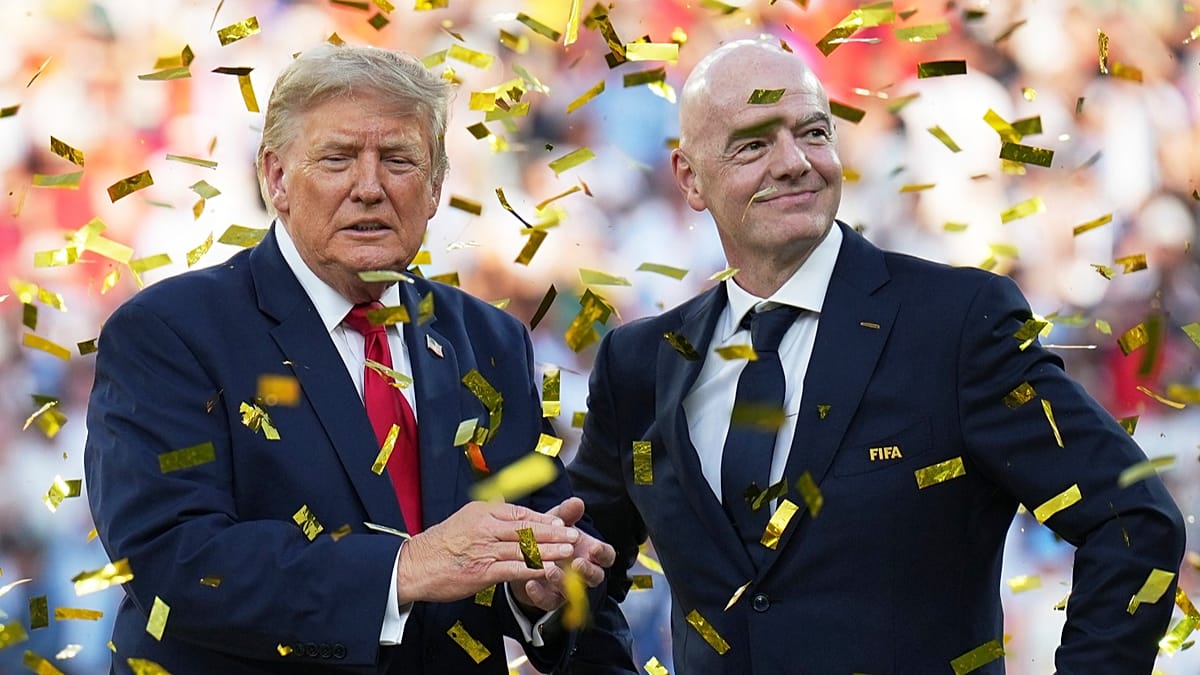
Gianni Infantino was supposed to be the man to detoxify the FIFA brand when he took over from his disgraced predecessor Sepp Blatter in 2016.
ADVERTISEMENT

ADVERTISEMENT
The Swiss-born administrator and former lawyer came with directives to stamp out corruption at the heart of football’s governing body and give the beautiful game its title back.
However, his time in charge of FIFA has been rife with controversy, making him one of the most divisive figures in football – culminating with his plans to sell a stake in the World Cup, a privatization proposal which has led Infantino to be accused of tarnishing the culture of football and the very soul of the beautiful game.
Here’s a chronological look at some of Infantino’s biggest controversies since he took over 10 years ago – leading to a very fraught 2026 for the head of FIFA.
2016: Ethics investigations
Following his rise through European football’s governing body UEFA – having moved up the ladder from the legal department to becoming deputy general secretary in 2007 and then secretary general in 2009 – Infantino was elected FIFA president in 2016 on a mandate to clean up the organisation’s stained reputation.
It didn’t take long for the first scandal to hit, as Infantino was subject to a probe by FIFA’s ethics committee – one focused on his decision to accept private jet flights. He was cleared but more controversies and investigations followed in 2016 and 2017.
These included being named in documents released as part of the Panama Papers and FIFA’s ethics committee looking into allegations that Infantino violated regulations in holding undisclosed meetings with Switzerland’s then-attorny general Michael Lauber, whose office was investigating corruption in international football.
Both Infantino and Lauber were unable to provide details of their meetings but denied any wrongdoing. FIFA’s ethics committee ended up clearing Infantino in 2020.
2018: “Russia has changed”
Infantino described the 2018 FIFA World Cup as the “best World Cup ever”, despite the controversial host selection of Russia – especially considering the Russo-Ukrainian war which began in 2014 and the treatment of members of the LGBTQ+ community and racial minorities.
Regardless, Infantino told “Western media” not to “try to paint with a dark paint everything that comes from the east – from Russia or the Arab world” in 2017.
He added that he felt like “a child in a toy shop” when visiting the Kremlin and accepted the Order of Friendship medal from Vladimir Putin in 2019, leading many critics to point out that Infantino was already showing a pattern of cozying up to autocratic leaders.
“This country, Russia, has changed,” he said. By the time the next World Cup arrived in 2022, Putin’s country had invaded Ukraine.
2022: The Qatar World Cup
When questioned about abuses suffered by migrant workers involved in preparations for the FIFA World Cup in Qatar, Infantino said that migrant workers were proud to contribute to constructing the stadiums. He also lashed out at Western countries for their perceived “hypocrisy” and for criticising Qatar on moral grounds in relation to issues regarding human rights related to migrant workers, LGBTQ+ individuals, and women.
“I’m European. For what we Europeans have been doing around the world in the last 3,000 years, we should be apologising for the next 3,000 years before starting to give moral lessons to people,” Infantino said.
His lengthy and now infamous press conference in Doha also included Infantino’s toe-curling words: “Today I have very strong feelings. Today I feel Qatari. Today I feel Arab. Today I feel African. Today I feel gay. Today I feel disabled. Today I feel a migrant worker. I feel like them because I know what it feels like to be discriminated, to be bullied as a foreigner in a country. At school I was bullied because I had red hair and freckles.”
This led many critics to call out Infantino for being flippant, out of touch, and insulting for comparing being ginger to being a member of violently oppressed and exploited groups.
2024: Saudi Arabia awarded 2034 World Cup
Infantino’s ties with Saudi Arabia, which has been the subject of allegations of human rights violations, have raised many eyebrows over the years.
The Gulf nation’s state-owned oil company Aramco agreed to a four-year global partnership with FIFA in 2024, and the announcement that year that Saudi Arabia will host the 2034 World Cup was met with uproar.
Worse, Infantino had already revealed the host nation a year earlier, on 31 October 2023, congratulating Saudi Arabia despite the host venue selection not yet reaching the voting process. Infantino had urged the AFC (Asian Football Confederation) to fully support the Saudi bid, and reportedly discouraged other AFC members from submitting their own bids.
The whole process was slammed by human-rights organisations and figures within football, with many noting that the host nation’s appointment coincided with Saudi-linked financing.
2025: The FIFA Peace Prize
In December 2025, Infantino provoked widespread scorn after his unilateral decision to award Donald Trump the inaugural FIFA Peace Prize. The timing was on-the-nose, considering the upcoming World Cup held in the US, Canada and Mexico, as well as Trump’s aggressive campaign to be awarded the Nobel Peace Prize.
Infantino had previously referred to Trump as “my great friend” at the global economic summit in Davos in 2020, and his ties with him grew during Trump’s second term.
He publicly congratulated Trump the day after he won the 2024 presidential election and visited Mar-a-Lago during the presidential transition. He then attended Trump’s inauguration, saying they “share a great friendship,” and even attended Trump’s Board of Peace meeting in Washington earlier this year.
In December 2025, human rights advocacy group Fair Square filed a complaint with FIFA’s ethics committee, accusing Infantino of repeated breaches of the governing body’s code regarding political neutrality, citing examples of his public support for the “actions and policies of the US President, Donald Trump.”
Add the fact that Infantino moved a FIFA office into Trump Tower in Manhattan and it seemed like his 2018 pledge that “it’s very clear that politics should stay out of football and football should stay out of politics” was a thing of the past.
2026: The failed handshake
In May, Infantino attempted to orchestrate a handshake between the Palestinian and Israeli delegates at the governing body’s congress. The whole thing backfired when the Palestinian Football Association’s president, Jibril Rajoub, refused to stand alongside the Israel FA’s vice-president, Basim Sheikh Suliman.
Asked what Rajoub said when he refused, the Palestinian FA’s vice-president, Susan Shalabi, told Reuters: “I cannot shake the hand of someone the Israelis have brought to whitewash their fascism and genocide. We are suffering.”
The whole endeavour came off as Infantino desperately seeking to portray himself as an international stateman prior to his FIFA re-election bid next year. Moreover, what was perceived as a tone-deaf photoshoot which failed to appreciate the complex geopolitical and humanitarian issues at play, showed that Infantino was living in his own world. Or as his predecessor Sepp Blatter described it, in a “different sphere”.
2026: The Platini accusation
In June, former UEFA president Michel Platini filed a criminal complaint in France against FIFA and Infantino, alleging that Infantino had orchestrated a campaign of false accusation to prevent Platini from succeeding Sepp Blatter as the head of FIFA.
The criminal complaint aims to force an investigation into a “criminal conspiracy to commit false accusation…influence peddling….and aiding and abetting influence peddling.”
Platini named Infantino, as well as former FIFA officials Marco Villiger and Domenico Scala, as targets of his suit. He also asked for the aforementioned Michael Lauber and other officials in that department to be investigated by their French counterparts.
“This complaint specifically targets the individuals who worked to eliminate Michel Platini from the race for the FIFA presidency.”
2026: The World Cup scandals
Where to begin, as the controversies are almost too numerous to tackle?
There were the exorbitant ticket prices which made the tournament look like an elitist shambles; concerns raised over FIFA’s supposed political neutrality due to Infantino cozying up with Trump; Infantino’s use of a private jet to attend two games per day, thereby adding to what the New Weather Institute described as “the most polluting event ever”…
Global outrage was ignited when Infantino was questioned about the exclusion of Somali referee Omar Artan – who was subjected to an 11-hour interrogation and deported from Miami, missing his chance to officiate at the World Cup. The FIFA president dismissed this by telling fans to “chill” over US border denials.
The there was Infantino’s rhetoric which many viewed as self-aggrandizing when he seemingly took credit for Iran’s participation in the World Cup; the controversial “hydration breaks” promoted by Infantino were seen as a money-grabbing scheme; and many accused Infantino and FIFA of showing preferential treatment to Argentinathrough some questionable referee decisions.
Then came that reversed red card, which was met with widespread furore from those who saw that politics and football were now inseparable thanks to Infantino’s close friendship with Trump, as USA star striker Folarin Balogun’s red card was overruled following a phone call from Trump to Infantino.
“Shame on you! When money calls the shots, the World Cup loses all credibility,” the Belgium Socialist party stated. “Adapting the rules to please Trump, trying to cheat to win – what a deplorable image for FIFA, for the soccer World Cup, and for the United States. Rules must be respected by everyone, in sports as in life.”
The reactions went viral and FIFA was given a new acronym: ‘Fix It For America’.
Following the end of the World Cup – which while marred in controversy made huge profits for the non-profit organisation FIFA, with a reported $15 billion in the bank – Infantino posted a 15-page Instagram meltdown in which he clapped back at his critics.
“Sorry that the matches are now over and sorry that you missed all that joy and togetherness. Sorry that you were so consumed by hate and criticism that you missed it all,” the 56-year-old man wrote – furthering accusations of lack of self-awareness and detachment from the serious issues plaguing his tenureship.
2026: The World Cup “sale”
Infantino’s latest and biggest controversy has seen him set up a new commercial vehicle, dubbed “FIFA Forward Enterprise” (FFE). The subsidiary valued at approximately $20 billion would handle commercial operations connected to the World Cup and other FIFA competitions. The aim? Sell stakes in the World Cup to private investors.
The stake to be sold would be around 20%, with investors including Thrive Capital, a company run by none other than Joshua Kushner, the brother of Trump’s son-in-law Jared Kushner.
The privatisation of football has drawn widespread resistance and condemnation, with critics describing it as an unabashed money-making scheme that would tarnish the culture of football.
Europe’s UEFA and North and Central America’s Concacaf confederations have rejected Infantino’s plans, while the Asian Football Confederation said it was “disappointed” it had not been consulted before the plans entered the public domain.
UEFA, which only accounts for a quarter of FIFA’s membership but does include some of the world’s most successful teams, stated it intends to boycott FIFA: “UEFA and its national associations will not participate in FIFA competitions.”
“UEFA and its 55 member associations stand as one. We unanimously and unequivocally reject FIFA’s proposal to transfer ownership interests in the World Cup and other FIFA competitions to private investors.”
“The World Cup cannot be treated as an investment product. It is one of football’s greatest sporting legacies. It has been built over generations by players, national teams and supporters across every continent. No part of it should ever be surrendered to private investors. The World Cup is not for sale.”
“Some things are simply too important to sell. The FIFA World Cup belongs to football. It always will,” the statement concluded. “And so long as Europe has a voice, it will never be for sale.”
Many, including UK prime minister Andy Burnham, blasted Infantino’s investment plan, with Burnham saying that “the World Cup is not a product” and was “never anyone’s to sell.”
Following the backlash, Infantino said he will “proceed with the consultation process” and that the proposal would need majority support from the 211 member associations and the FIFA council in order to be implemented. And for Infantino to take on the role as commissioner of the FFE – a role which reportedly entails a $64 million salary.
Infantino has written to FIFA members. He said that they will receive $40m if they back his controversial proposal. He has set a deadline of 19 September for federations to accept his plans if they want to access an initial $20m. He needs 106 votes in favour for the proposal to go through – one described by UEFA as an “act of coercion unworthy of an institution entrusted with the stewardship of the global game”.
Football fans, already dubious about Infantino’s Americanization of the game and plans to try to expand the World Cup tournament to 64 teams (following the 2026 competition expanding to 48), remain fearful regarding the future of football under Infantino.
It remains to be seen what happens next and if Infantino will have to back down due to mounting backlash. The latest blow for Infantino is the resignation of his senior advisor Carlos Cordeiro, who quit with immediate effect in protest and called Infantino’s plan “a bad deal for football”.
The next FIFA competition is the Women’s Under-20 World Cup, which is due to be held in Poland from 5 September – before the 19 September deadline. Should UEFA stick to its boycott, the line-up won’t be as impressive, to say the least.
What is certain is that Infantino has made an enemy of federations and fans, and that his plans have driven his global reputation to an all-time low. Whether or not he will face an opposing bid when it comes to FIFA re-election next year is an unknown, but with federations like UEFA accusing the governing body of “using our sport to enrich themselves and their friends”, many have lost faith in a man who may have grown too big for his football boots.
