

Should the European Union pick up the phone and call Vladimir Putin? It depends on who you ask.
The idea of re-engaging diplomatically with the Kremlin as part of the ongoing efforts to end the war in Ukraine has sharply divided the 27 member states, with some in favour, others against and most are on the sidelines, testing the temperature.
Though the debate is not entirely new, it has taken on a new salience after both French President Emmanuel Macron and Italian Prime Minister Giorgia Meloni endorsed the idea in back-to-back public statements last month.
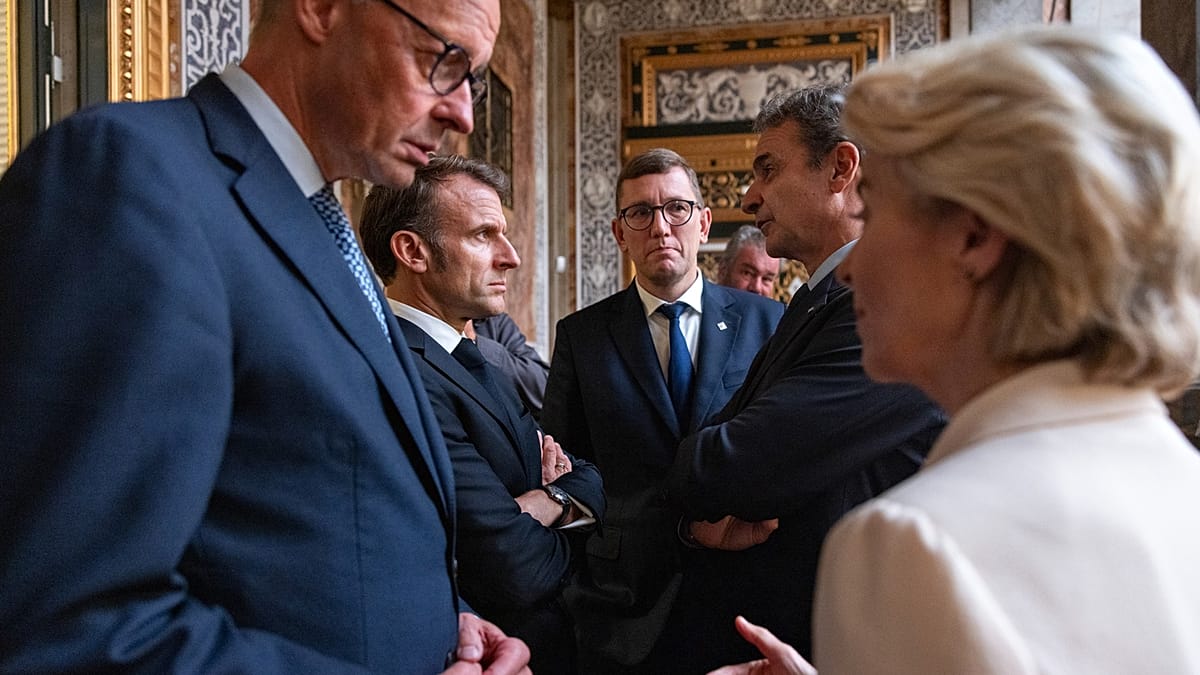
The two leaders, who have clashed in the past, agreed that as Ukraine’s largest donor, the EU needs to have a permanent seat at the negotiating table to shape the future of the continent’s security architecture without depending on the White House, which is today the main interlocutor with the Kremlin.
The security guarantees that Europeans and Americans are designing for the day after the war, including a legally binding commitment to aid Kyiv in the event of a future attack, make the case for re-engagement the more compelling.
“I believe the time has come for Europe to also speak with Russia,” Meloni told reporters days after attending a meeting of the “Coalition of the Willing” in Paris. “If Europe decides to take part in this phase of negotiations by talking only to one of the two sides, I fear that in the end the positive contribution it can make will be limited.”
Since then, the debate on whether the EU should reach out to the Kremlin has only intensified, with growing calls to appoint a special envoy that can represent all member states and avoid the scenario of “too many voices speaking”, as Meloni put it.
Austria, the Czech Republic and Luxembourg have expressed support for the idea.
“While Europe’s security is being discussed, Europe is not at the table,” Austria’s Foreign Minister Beate Meinl-Reisinger said in a statement. “Europe is strongest when it speaks with one voice. We need a single European line, not 27 national tracks.”
But not everybody agrees.
Germany, Estonia, Lithuania and Cyprus have voiced strong opposition, pointing to Putin’s maximalist demands and Russia’s continued bombardment of Ukrainian energy facilities and civilian areas during gruelling sub-zero temperatures, as evidence that Moscow is not willing to offer any concessions towards peace.
“We currently see no need to open additional channels of communication,” German Chancellor Friedrich Merz said last month when asked about the matter.
“Moscow must be willing to end the war. If Moscow isn’t, the price it has to pay for this war, including the economic price, will increase week by week,” he added.
Swedish Prime Minister Ulf Kristersson admitted Europe would reopen diplomatic channels “at some point”, but stressed such a decision should be based on Russia engaging in a “serious process” to conclude a peace settlement with Ukraine.
“The way this war ends will say a great deal about the possibilities for any long-term relations,” Kristersson said in an interview with Expressen, a Swedish newspaper.
“We can’t speak for others. Of course, there may be other countries that are prepared to open up trade links and the like with Russia, but our fundamental attitude is one of scepticism until proven otherwise, which I think is perfectly natural.”
An envoy for all seasons
The stark discrepancies have not gone unnoticed in Brussels, with the EU institutions keeping a close eye on the succession of public statements and treading carefully to avoid picking sides before the two sides reconcile.
Adding to the confusion is the fact that those who support re-engagement do not seem to share the same vision of what that re-engagement should look like.
Last week, Macron sent his top diplomatic adviser, Emmanuel Bonne, on a trip to Moscow. The journey, revealed after the fact by the French press, was made discreetly to prepare a phone call between Macron and Putin, who last spoke in July 2025.
The overture floundered. Bonne reportedly came back empty-handed, and Russia’s Foreign Ministry slammed the trip as “a kind of pathetic diplomacy”.
Macron later said the resumption of dialogue should take place without “too many interlocutors” and “with a given mandate”.
“My wish is to share this with my European partners and to have a well-organised European approach,” Macron said in an interview with several European newspapers. “Whether we like Russia or not, Russia will still be there tomorrow.”
If France envisions the re-engagement as one-on-one interactions between heads of state, other member states have a different take.
For Latvian Prime Minister Evika Siliņa, the special EU envoy would be employed to participate in trilateral talks brokered by the US between Russia and Ukraine, rather than Moscow alone, and economic sanctions should stay put.
“We have to be at the negotiation table because Ukrainians themselves have started to negotiate. So why should Europeans not negotiate?” Siliņa told Euronews.
Meanwhile, High Representative Kaja Kallas has suggested Europeans establish the political objectives that any envoy, or any phone call, should aim to accomplish before taking further steps. Kallas also questioned the usefulness of the outreach campaign given Russia’s tendency to demand the “absolute maximum” in negotiations.
“The point right now is not the person who does it, but more like how and what we want to get out of this,” High Representative Kaja Kallas told Euronews.
“If the Russians think they are getting their maximum goals from the Americans, why should they want to talk to the Europeans?” she added.
Privately, EU officials and diplomats say the debate has become serious, but warn that it is still unfolding at an abstract level, without a clear structure or direction. The sharp divide among capitals weighs heavily on the discussions behind the scenes.
There is no indication of when the hot-button issue might be properly discussed by the 27 leaders together. Their next formal summit is scheduled for 19 March.
Certain names are already being casually floated for the prospective special envoy position, such as Alexander Stubb, the president of Finland, and Margrethe Vestager, the former two-term European Commissioner for competition policy.
Another Nordic name making the rounds is Sauli Niinistö, the former president of Finland, who authored an EU report on civil and military preparedness. Niinistö has some proficiency in the Russian language and met with Putin several times while in office.
For some, re-engagement is now inevitable. Images of the trilateral US-Ukraine-Russia talks in Abu Dhabi without Europeans at the table did nothing but highlight the stakes at play. The €90 billion loan agreed by EU leaders to support Kyiv, which will require the issuance of joint debt, is seen as another reason to step up diplomacy.
Others urge caution, worried that a rushed move to engagement might risk going behind Ukraine’s back and derailing the common European front built over the past four years, which Hungary and Slovakia have flouted to foster closer ties with Moscow.
“We support any diplomatic efforts towards achieving a just and lasting peace in Ukraine, grounded in international law and the UN Charter,” said the Slovenian foreign ministry.
“On the EU side, political dialogue with Russia must be conducted on the basis of a unified position of the EU, agreed by all 27 member states.”
Shona Murray contributed reporting.