
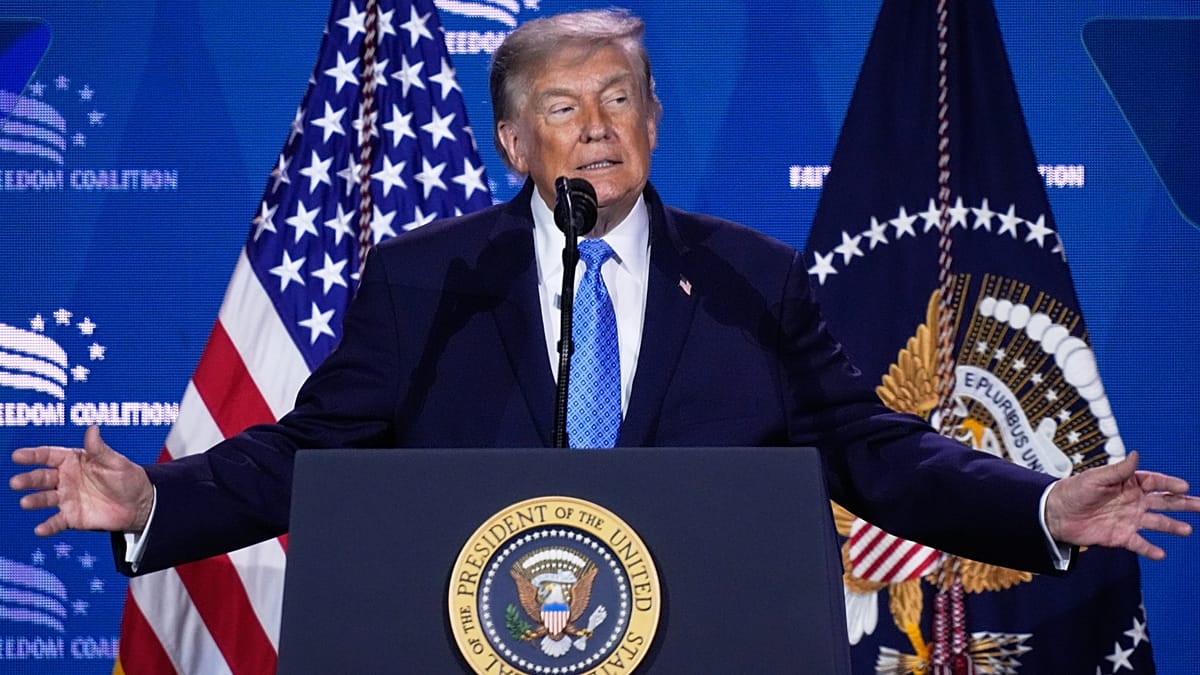
President Donald Trump on Friday threatened a 100% tariff on imports from any country that imposes a tax on digital services provided by United States companies.
ADVERTISEMENT

ADVERTISEMENT
In a social media post, Trump took aim at European countries, he said, that are discussing the “imminent” implementation of taxes on American companies.
The US president has repeatedly sought to use tariffs to deter such taxes, but many countries are seeking revenue as their economies increasingly operate in digital realms dominated by American companies.
“Please let this statement serve to represent that any Country that imposes such a Tax will immediately be met with a 100% tariff on any and all Goods sent to the United States of America,” Trump wrote.
He added that the new tax would supersede any previously negotiated trade deals. Trump said the penalty would apply to any country that moves forward with such a tax, but he singled out European nations in his post.
Trump has consistently opposed international attempts to tax or regulate American tech giants. Last year, he threatened fresh tariffs on any nation attempting to do so, writing in a post last August that digital taxes and regulations “are all designed to harm, or discriminate against, American Technology.”
The warning arrives just ahead of Trump’s 4 July deadline for the European Union and the US to begin implementing a trade agreement that caps most tariffs on EU exports at 15%.
The EU finalised that trade deal with the United States in May. It followed months of internal EU debate after European Commission chief Ursula von der Leyen initially reached a tentative agreement last year during a visit to Trump’s golf course in Scotland.
The issue of digital tax remained unresolved
Digital taxes were excluded from that pact and remain a primary source of friction between the US and the European bloc.
While the US government has previously launched Section 301 investigations into digital services taxes, it remains unclear how Trump intends to enforce his latest threat, or whether the tariffs would be applied globally or targeted at specific countries first.
Britain, having left the EU, has levied its own 2% digital services tax since 2020 on revenue generated by search engines, social media platforms and online marketplaces that “derive value” from UK users.
In a policy document released at the time, the British government argued that existing corporate tax rules for digital firms had “led to a misalignment between the place where profits are taxed and the place where value is created.”
The UK tax features specific thresholds, ensuring it is primarily paid by major multinational corporations. The policy was implemented to “ensure the large multinational businesses in-scope make a fair contribution to supporting vital public services,” the document noted.
