
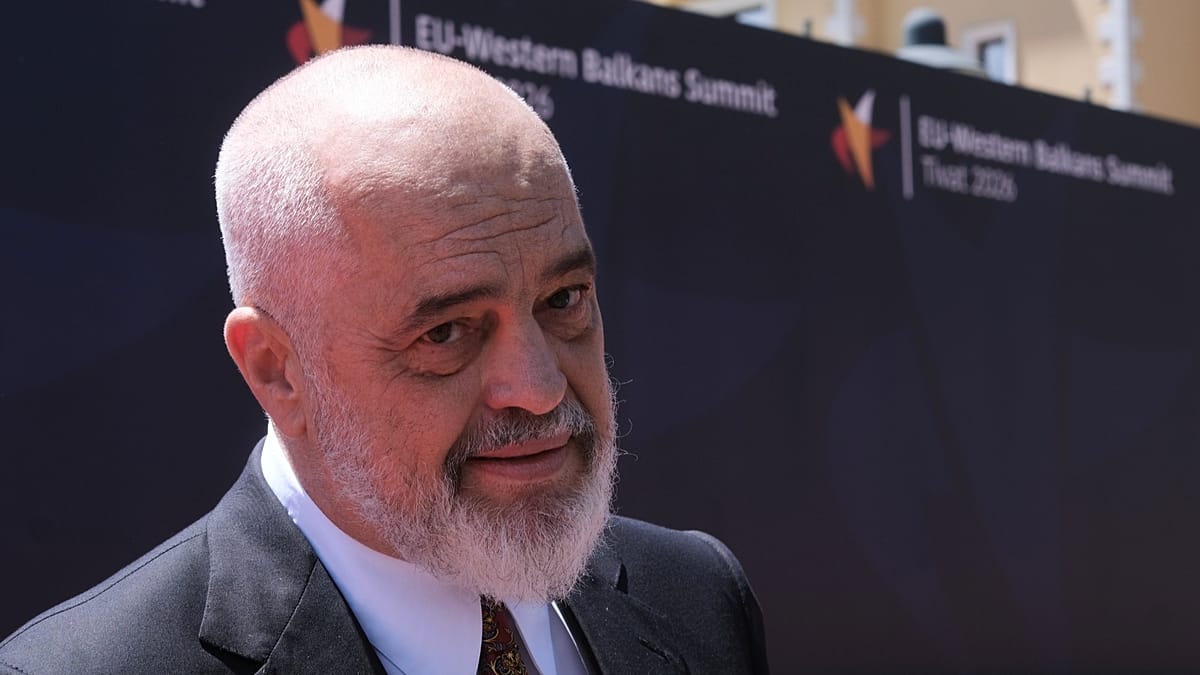
Albania’s Prime Minister Edi Rama believes accession to the European Union is the only path forward for his country.
ADVERTISEMENT

ADVERTISEMENT
“We are fanatics. We are not like the others. We are the fanatics of the EU faith,” Rama said on Euronews’ flagship programme The Europe Conversation, on the sidelines of the EU–Western Balkans summit in Tivat, Montenegro. “Whatever it takes, however it goes, we remain rooted in the EU faith. And so for us, there is no Plan B, there is no alternative, there’s nothing.”
Albania has been a candidate country since 2014 and opened negotiations to join the EU in 2020. However, the process still appears far from completion, and Rama said he has come to realise that the “old way” of accession no longer works in today’s world.
“We need to find a different approach. But, there is one. One piece of the puzzle missing yet, which I call the Helmut Kohl piece of the puzzle, meaning… politics first, and then the rest follows,” he said, referring to the former German Chancellor.
His comments come as France and Germany, ahead of the summit, called for a new process of “structured gradual integration” for EU candidate countries, aimed at granting them earlier benefits from closer integration with the bloc while maintaining the existing merit-based accession framework.
The paper has served as the basis for summit discussions and is seen as a way to renew momentum in the enlargement process, while also providing Western Balkan countries with additional incentives to remain engaged.
Rama’s path to EU accession
Rama’s “different approach” is not far from the Franco-German idea. He tabled it in a joint op-ed with the Serbian president, Aleksandar Vucic, last March, calling for the partial integration of their countries into the EU as an intermediate step to revive the enlargement process and strengthen stability in the region.
In the interview, the Albanian leader said it was crucial to “become part of the European Union family,” by sitting around the table with current member states, and taking part in the decision-making process step by step.
He rejected labels such as “associated membership” or “membership light,” instead insisting on the idea of a united family made up of both established and newer members.
He also credited EU Commission President Ursula von der Leyen for having re-engaged Europe with enlargement.
“Before her, the previous [Commission President] said there is no enlargement,” Rama said, carrying on with the same metaphor and comparing candidate countries to von der Leyen’s children.
“The kids are around the table. And then they have to go through exams, to go to school […] So it’s not them deciding anything around the table, but it’s them staying at the table. It’s them participating in the family life,” Rama said.
“You cannot say to the kids: ‘You have to stay somewhere in the neighbourhood and when you are ready, you will come in the family.”
Anti-EU forces in the Western Balkans
Rama also emphasised that in the Balkans there are “forces” and “third actors” seeking to promote the narrative that EU accession will never happen and that the EU will not allow candidate countries to become member states.
He did not directly mention Russian interference, but said it is crucial to counter the erosion of trust in the EU, which could ultimately benefit Moscow.
In his view, Moldova is an example of this dynamic, where delays in the accession process could fuel widespread distrust in the EU. He pointed to the country’s political situation as an illustration.
Moldova submitted its application to join the EU in 2022, following Russia’s full-scale invasion of Ukraine. It was granted candidate status later that same year and began accession talks with Brussels in 2024.
Moldova’s prime minister Maia Sandu has been a staunch supporter of the EU accession, which she considers a “matter of survival”, amid Russia’s attempt to destabilize the country and pull it away from Europe.
Pro-European sentiment is the majority view in the country and Sandu won the elections last September against the Patriotic Bloc (PSRM), a union of four parties widely considered very close to Russia.
The government has repeatedly denounced Moscow’s massive interference in domestic elections, and a referendum held in 2025 to include the EU path in the constitution passed by an extremely slim margin, showing how Moldovan public opinion could still shift.
“Maia Sandu is telling the Moldovans, ‘Come with me to Europe’. It’s not happening. She resisted two elections. The third election, maybe she will not resist anymore, because the Russians can say, ‘Are you crazy? It will never happen,” said Rama.
He explained that the right way to address the issue politically is to allow candidate countries partial integration into the bloc.
“It’s very important for you to close the political border and say: ‘This is a family. You have no room here to spread lies and to fuel the hatred against the EU and to tell the people [accession] will never happen.”
The EU should talk to Russia
Rama also made clear in the interview that European leaders should begin talks with Russia on ending the war in Ukraine, dismissing suggestions that meaningful progress has been made or that Europeans have shifted their mindset.
A diplomatic effort is needed, he said, to put an end to the conflict, despite Russia’s hostile attitude.
“I hope they start understanding each other on how this war can be stopped,” Rama said, considering that “every democratic country, every democratic soul should seek for peace no matter what.”
The prospects for a ceasefire appear to have increased after Ukrainian President Volodymyr Zelenskyy proposed a face-to-face meeting with Vladimir Putin in an open letter, saying he is ready for a “full ceasefire.”
Asked if Russia is an enemy to the EU and Europe, he said: “I don’t know what other name to put to a force that is killing people in another country every day. It has not been an enemy. It should not have become an enemy […] but nowadays it’s an enemy and should change.”