
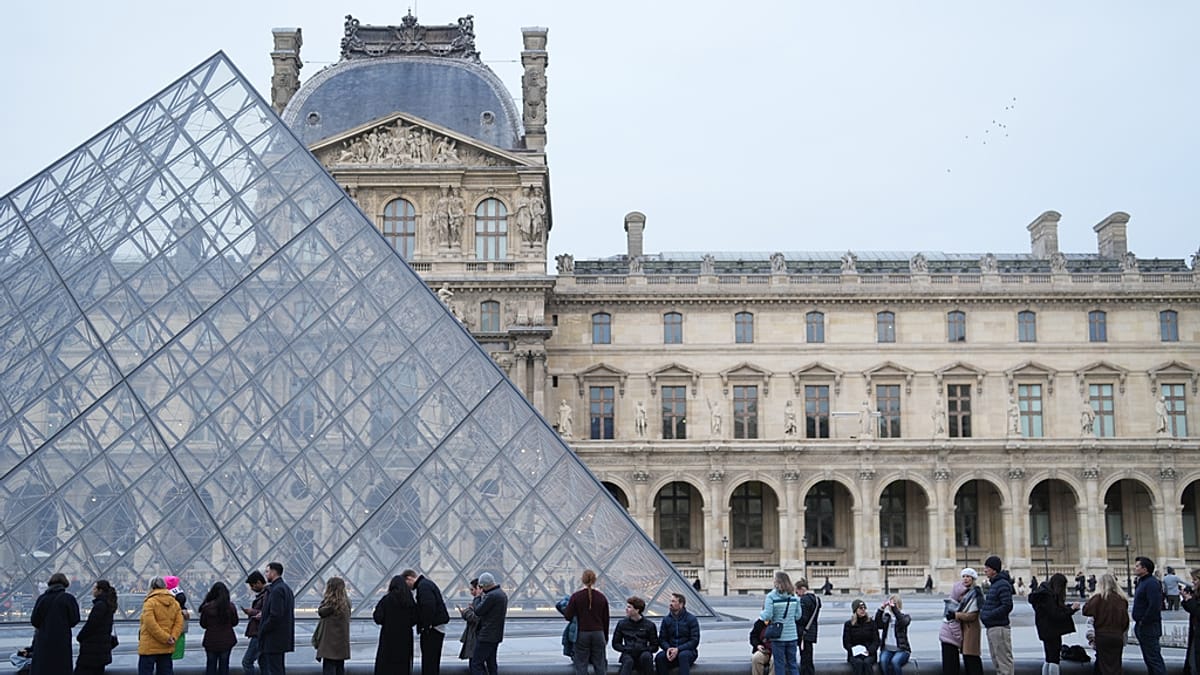
On Wednesday, the Louvre Museum in Paris raised admission prices for most non-European visitors by nearly half in an attempt to shore up its finances following repeated strikes, chronic overcrowding, and a brazen French Crown Jewels heist that shook the institution.
The museum said the 45 per cent price hike from €22 to €32 is part of a national “differentiated pricing” policy announced early last year, which is coming into force across major cultural sites, including the Versailles Palace, the Paris Opera and the Sainte-Chapelle.
But French worker unions have denounced the Louvre ticketing change, saying it undermines the universal mission of the world’s most visited museum.
Louvre hikes ticket prices for non-Europeans
The change affects visitors from most non-EU countries, including the United States, which typically accounts for the majority of the Louvre’s foreign tourists.
Under the new structure, visitors who are neither citizens nor residents of the EU, or Iceland, Liechtenstein and Norway, will pay the higher rate.
The new price applies to individual visitors outside Europe; guided groups will pay €28, with tours capped at 20 people “to maintain the quality of the visit,” the museum said.
Still, some tourists questioned the logic of charging visitors more. “In general, for tourists things should be a little bit cheaper than for local people because we have to travel to come all the way here,” said Darla Daniela Quiroz, visiting from Vancouver.
Even those not affected by the price hike had concerns.
“Culture should be open to everyone – yes – at the same price,” said Laurent Vallet, visiting Paris from Burgundy.
Others said they would pay anyway. “It’s one of the main attractions here in Paris … We’re still going to go,” said Allison Moore, a Canadian tourist from Newfoundland visiting with her mother. “Hopefully it’ll be all worth it in the end.”
The CGT Culture union has denounced the policy, arguing it turns access to culture into a “commercial product” and creates unequal access to national heritage.
Some categories remain eligible for free admission, though, including visitors under the age of 18.
The last price hike was in January 2024, when the standard entry fee rose from €17 to €22.
Major French attractions introduce dual pricing
The Louvre says it is not alone. Versailles and other flagship tourist attractions are adopting similar two-tier pricing this month.
At Versailles, the ‘Passport’ ticket will cost €35 in high season for visitors from outside the European Union, Iceland, Liechtenstein and Norway, compared to €32 for visitors who are citizens or residents of those countries.
At Sainte-Chapelle, the ticket rises to €22 for visitors from outside those countries, versus €16 for those within them, according to heritage officials.
Why are tourist sites around the world using dual pricing
Dual pricing is already in place for various tourist tickets or fees across Europe and the rest of the world.
Venice’s daytripper levy, which has been enforced on weekends and busy days for the last few years, costs as much as €10 for tourists.
However, residents of Venice or the surrounding Veneto region do not have to pay.
Authorities say the access fee system is key to easing the pressure that the throngs of tourists just visiting for a day put on the city’s services and infrastructure.
“It represents a useful tool for managing tourist flows and ensuring a better balance between residents and visitors,” says councillor Michele Zuin.
However, data shows the measure hasn’t yet curbed visitor numbers.
Throughout Italy, museums and attractions are often free for residents, including the Boboli Gardens in Florence and the Capitoline Museums in Rome, as well as the soon-to-be-introduced charge to get up close to the Trevi Fountain.
In Kenya, multi-tier pricing has long been used for safari park fees. On 1 October last year, the entry charge for non-resident, non-East African citizens increased to as much as $90 (€77) for some parks, compared to as little as 800 Kenyan shillings (€5) for East African citizens.
Authorities say the hiked prices will be used to “strengthen the financial sustainability of wildlife conservation” and improve visitor experiences.
On 1 January this year, President Donald Trump’s administration raised the entry fee for foreign tourists in US national parks by $100 (€86) as part of his ‘America First’ policy.
India’s Taj Mahal charges foreign visitors 1,300 Indian rupees (€12), which is roughly five times the domestic price.
Backlash over Japanese restaurants using two-tier pricing
Proponents of dual pricing argue that tax-paying citizens and residents should have facilitated access to cultural and natural treasures, especially in countries where the wealth divide between tourists and locals can be extreme.
But some instances of a ‘foreigner tax’ have been deemed unfair.
In Japan, dual pricing is in place at various tourist sites, including Okinawa’s new Junglia theme park and Niseko Ski Resorts in Hokkaido.
But its recent introduction at some restaurants has prompted criticism.
A seafood buffet restaurant in Tokyo’s Shibuya district was the subject of a backlash on Reddit and X last year after it started charging foreign tourists ¥1,100 (€6) more than Japanese nationals and residents for its all-you-can-eat deal.
Staff would check eligibility by asking customers to speak Japanese or show a residence card.
“Considering the rise in labour costs due to service costs and time used to serve [foreign customers], we have no other choice but to set the different prices,” Tamatebako’s owner told The Japan News.