


The damp air has seeped beneath my rain jacket and left me fully chilled, but ahead is my salvation – a wood-hewn table and benches under a little wooden roof.
ADVERTISEMENT

ADVERTISEMENT
Our shivering hiking group huddles beneath the structure, which does little to block the wind, but it’s not long before our mood is considerably brightened.
We’ve stopped at Popas la Cosma, which acts as a rest stop and accommodation for hikers, deep in the Eastern Carpathian mountains in Romania’s Bukovina region.
Shepherd Cosma Crăciuneac and his family are one of the roughly 500 hosts along the 1,600km-long Via Transilvanica trail that provide food or lodging for walkers.
Our group are warmed in no time by the hospitality of father and son wearing hats bedecked with a feather, who bring us as a priority some “afinata”, a liqueur made from wild blueberries, followed by a plate of homemade cheese and salami, lard, boiled eggs and plenty of bread.
After hot tea and homemade doughnuts, we’re given a quick tour of the house and the hay barn where hikers can sleep.
What is the Via Transilvanica?
Popas la Cosma is the perfect introduction to the Via Transilvanica, a trail running diagonally across Romania that was conceived and created by Tășuleasa Social.
The NGO realised this remarkable feat with no government or EU funding, just the core team, volunteers, sponsors and donations.
The hiking route was envisioned less as a tourist initiative and more as a social project which aligned with the association’s central aim to build stronger communities and protect the environment.
The idea of the Via Transilvanica was to bring life back to small villages and rural communities – of which it passes through some 400 in 20 different ethnic and cultural regions, hence its moniker ‘the path that unites’ – which are particularly affected by residents emigrating to cities or abroad.
Popas la Cosma, for example, welcomed around 1,500 hikers last season.
The route continues to be improved and extended. In 2026, the association is enhancing sections in the Bukovina region, including modifying some stages where the trail has been damaged by poor weather.
They have also rerouted some sections to make the trail more accessible and added a 200km extension to the historic town of Brașov in the Transylvania region.
“It was never a touristic project. It has always been about volunteering and young people, about doing something meaningful for the community,” Alin Ușeriu, president of Tășuleasa Social, tells us when we stop at the project headquarters.
Hikers are encouraged to visit the headquarters near Bistrița surrounded by mountain meadows, where they can have a hot meal, stay the night, and usually meet a few of the volunteers.
We eat mushroom and sour cream soup and a calorie-packed deep-fried dessert called “papanași” to fuel our next stage of the hike.
Hiking in the ‘Switzerland of the East’
Led by tour company Intrepid Travel, we are exploring some of the trail’s lesser-trod northern stages – but those which Tășuleasa volunteer Iulian Gabor, who was involved in the creation of the Via Transilvanica, considers some of the most beautiful.
Over three days winding through the Bukovina region – known as the “Switzerland of the East” – we are treated to deep forests of beech, oak and spruce trees, wide wildflower meadows drenched in sunlight and lots of meetings with bell-adorned cows.
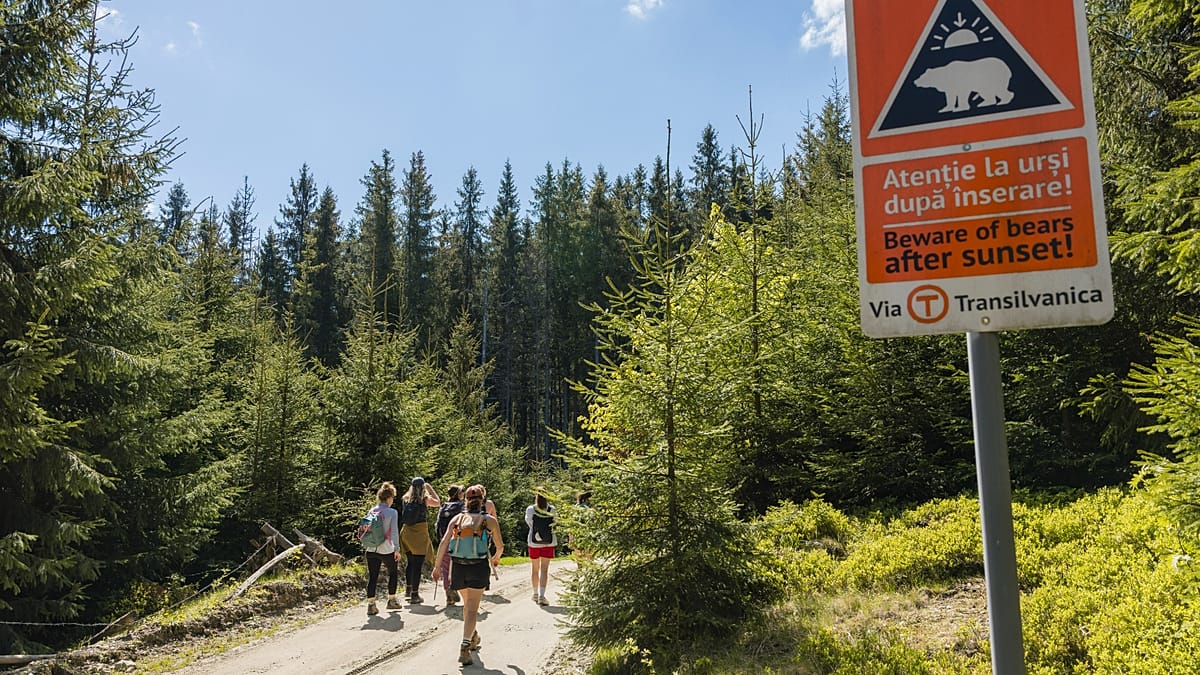
Alongside the orange T signposting the Via Transilvanica route, there were also frequent warnings about bears after sunset. Luckily, we don’t encounter any, but there are plenty of birds, butterflies, lizards and a couple of snakes on the way – plus a few horses pulling carts.
Each lunchtime, we forget about dull, rehydrated hiking meals and instead indulge in homemade delicacies like fresh cheese with paprika jam at Gigi Ursu Chalet and “sarmale” – cabbage rolls stuffed with minced meat – at La Moara Bucovina restaurant.
Part of the joy of these pauses is talking to the owners, seeing their pleasure at hosting hikers – and drinking a shot or two of afinata together.
These are also the places, along with guesthouses in the villages and towns, where hikers can receive their stamp in their travellers’ booklet – which they can pick up from more than 50 places on the trail such as shops, hosts and cultural attractions – for each stage they complete.
Painted monasteries and painted eggs
The Bukovina stretch of the Via Transilvanica is also perfect for those who want to learn about Romania’s cultural history.
We stop at two of Romania’s UNESCO-designated painted monasteries – Sucevița and Moldovița – where both the exteriors and the interiors are completely covered in intricate, intensely coloured religious scenes dating from the 16th and early 17th centuries.
In the town of Moldovița, we also learn about the tradition of painting eggs with equally exquisite designs at the house of Viorica Semeniuc.
Along the hiking trail itself, we also start looking forward to seeing what carving will be on the kilometre stone marker, each of which was sculpted by an artist featuring everything from Greek warriors and a Picasso-esque face to a frog with a crown and a majestic stag.
So, as Gabor summarises, the Via Transilvanica is a social initiative, a spectacular tourist experience, and probably the largest open-air art gallery in the world.
Rebecca Ann Hughes was hosted by Intrepid Travel, which launched its Hiking in Romania: Via Transilvanica itinerary in May, making it the only global tour operator that visits the northern section of the trail.
The 10-day package starts at £1,616pp (€1,872), which includes accommodation, ground transport, services of a local leader, guided hikes and some meals and other activities.
Tășuleasa Social is a new partner of The Intrepid Foundation, Intrepid’s not-for-profit, allowing customers to directly support the association and trail’s development.