
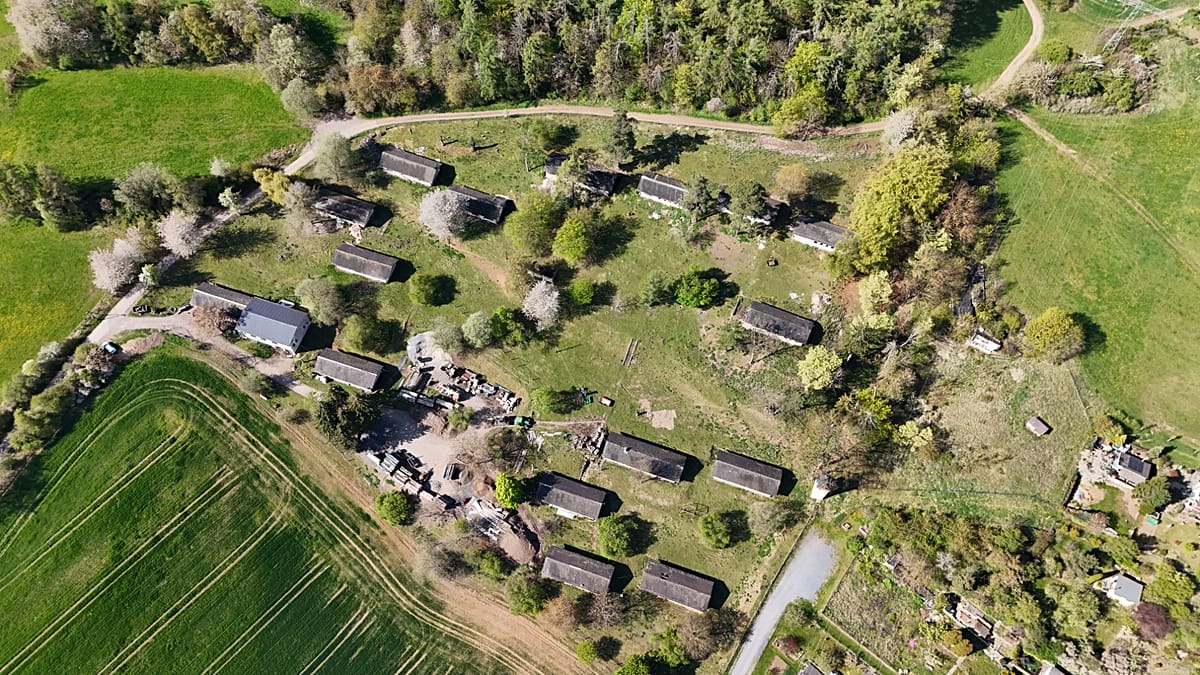
Anyone looking for an owner-occupied flat in a major German city will only get a handful of square metres for €390,000. In Kamsdorf, in the Thuringian district of Saalfeld-Rudolstadt, the same amount will buy an entire small village.
ADVERTISEMENT

ADVERTISEMENT
It includes 15 single-storey buildings, each with around 100 square metres of floor space, plus a central main building with a dining hall of more than 300 square metres. The site covers around 24,000 square metres, nestled between meadows, woodland and mature trees, just a few hundred metres from the Hohenwarte reservoir.
The complex is being sold via popular property platforms. The listing states that the seller is looking “not for a buyer of a plot of land, but for someone with a vision who recognises the potential to create something extraordinary here”.
The buildings have already been stripped back to the shell, electricity and mains water are connected, and wastewater is currently drained via a cesspit.
From GDR holiday camp to planning dispute
The site’s history goes back to the German Democratic Republic era. As owner Franz Eberitsch explained when contacted by Euronews, the complex was used from 1954 to 1990 – initially as a dormitory for apprentices at the Thuringia steelworks, and later as a holiday and recreation centre.
After German reunification, the site initially lay empty for ten years. From 2000 onwards, Eberitsch says, individual houses were once again used for residential purposes: “The residents were officially registered at this address and, to the best of my knowledge, state benefits such as housing benefit were even granted for this address.” This led him to believe that residential use was legally permitted.
What is the catch?
According to his own account, Eberitsch bought the site in 2014, after returning to Germany with his family from New Zealand. His vision at the time was “to create a place where people can live close to nature, experience community and build something new together”.
That hope has not been fulfilled. The problem lies in planning law: in planning terms, the plot is located in what is known as the “Außenbereich”, land outside the built-up area, even though it is only about 200 metres from the edge of the village. Because the complex was not used between 1990 and 2000, the authorities take the view that its original grandfathered status has lapsed.
Eberitsch confirms when asked: “When we later wanted to carry out more extensive refurbishment and further development of the site, the planning situation was reviewed again. We were informed that the registrations at the time did not change the planning status and that the grandfathering had already expired due to the long interruption in use.”
According to Eberitsch, the authorities currently view permanent residential use critically, as it “could constitute a so-called scattered settlement (Splittersiedlung) in the outer zone”.
Legal use would require a new local development plan or some other form of planning consent. German building and planning law is repeatedly criticised for its bureaucratic hurdles.
Between health village and scattered settlement
Despite the unresolved question of permits, Eberitsch sees great potential in the complex. He envisages a holistic health and regeneration village in which different therapy and prevention services could be brought together in one place – for example, houses for physiotherapy, osteopathy, naturopathy or yoga, supplemented by accommodation and a central community building for seminars and shared meals.
The listing also makes no secret of a commercial self-interest: it notes that all construction, fit-out and landscaping work could be “carried out directly by the owner’s associated construction company”.
A plea to politicians and to Elon Musk
For Eberitsch, the case is emblematic of a fundamental problem in Germany. He wonders “whether, in view of the housing shortage, the desire to use existing buildings sustainably and the need for new ways of living and housing, we should not adapt the legal framework more strongly so that existing structures can be brought back into use”. His conclusion: “Here you have a complete small village with existing buildings and infrastructure. From my point of view, it should be easier, under clear legal conditions, to return such existing complexes to meaningful use.”
Eberitsch would most like to realise the project himself, but says he lacks the initial capital. His idea is unusual and suddenly brings a controversial tech billionaire into play: “Perhaps it really does take someone like Elon Musk. […] If Elon Musk actually reads this article, I would be delighted with seed funding of around one million euros.”
In return, he is even offering the Tesla boss a break on his alpaca farm in nearby Unterwellenborn, “should Elon ever need to get his feet back on the ground instead of feeling weightless”, he writes to Euronews.
Bizarre property listings across Europe
The Thuringian village is just the latest in a whole series of unusual property deals. As recently as May, an abandoned island in the Baltic Sea was sold for 60,000 euros – likewise a relic of East Germany whose appeal lies, at best, in its remoteness.
An off-grid cabin on a Scottish island for €405,000 made headlines, and in Greece a private island with a guide price of €247,000 went up for auction. A recurring pattern is hard to miss: low prices meet remote locations, unclear usage rights or extensive refurbishment needs – the true value of such properties almost always lies in their as yet intangible potential.
Whether the former Thuringian youth village really becomes a “village of the future” will therefore depend not only on the buyer’s “vision” but also on the authorities and on how flexible Germany is prepared to be in dealing with unused stock.
