


Published on
MaiaSpace is assembling and testing Europe’s first reusable mini-launcher at its factory in Vernon, Normandy. Its project is currently the most advanced of its kind in Europe. The first flight is scheduled beginning of 2027. A subsidiary of ArianeGroup — the French industrial giant that manufactures Ariane heavy-lift launchers — MaiaSpace already has commercial contracts signed for several years.
ADVERTISEMENT

ADVERTISEMENT
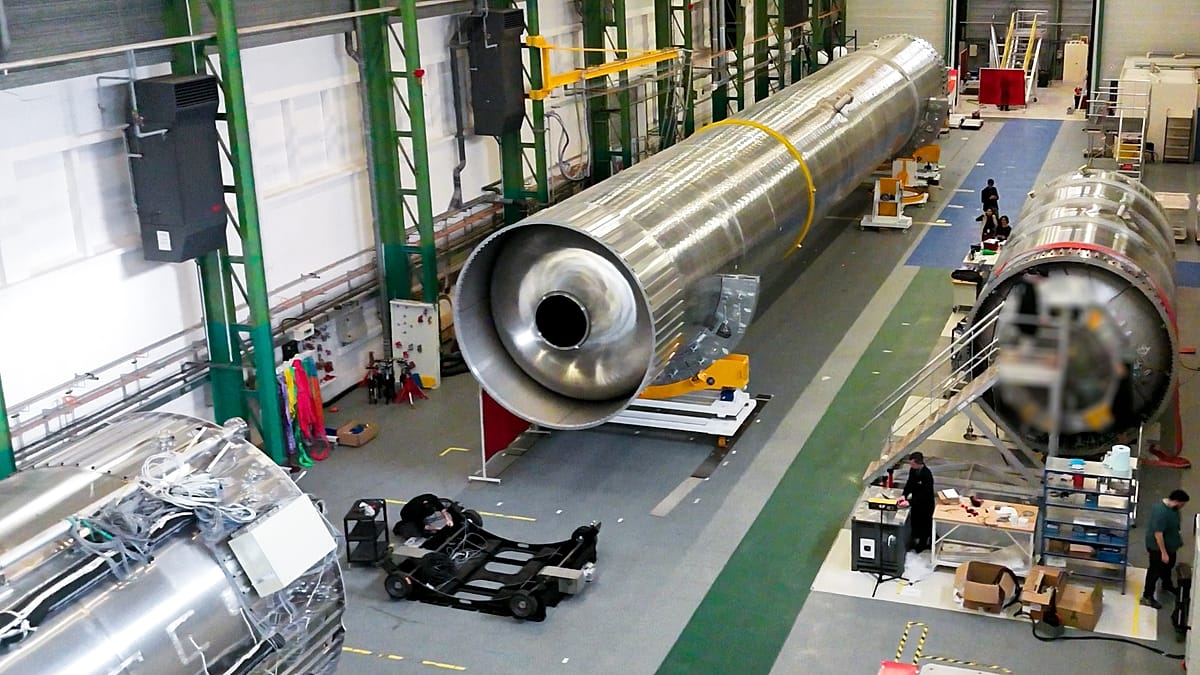
Raphaël Chevrier, spokesperson for MaiaSpace, takes us to the workshop where full-scale prototypes of the Maia launcher are assembled.
The model of the first stage alone is around thirty metres long. It’s this first stage that can be recovered, similar to what Elon Musk’s Space X has already been doing for around ten years. With Maia, Europe is trying to catch up this delay.
Europe does not currently have the technology to recover a first stage vertically. So this will be the first time that a company incorporates these technologies and it’s potentially also the forerunner in technologies that could be implemented on heavier European launchers.
Maia can be reused at least four times. Recovering the first stage will cut costs and lower satellite transport prices. The future rocket will be able to carry satellites weighing up to four tonnes into low orbit, a choice that responds to the booming market for small satellites, typically used for Earth observation and telecommunications.
Developing a European reusable mini launcher is not just a question of technology; it also involves revolutionising the European space industry’s economic model. This model is embodied by this start-up.
“The space industry,” explains Yohann Leroy, MaiaSpace CEO, “is undergoing a transformation driven by technological change, with the miniaturisation of a number of technologies and a very significant reduction in costs. This reduction in costs makes it possible to potentially transform niche markets into mass markets. To succeed in this market, we need to launch satellites at a fraction of the cost that was required just a few years ago”.
In 2015, the American company SpaceX became the first to break the mould in a sector that had previously been dominated by governments. We are moving from the space ‘programme’ to the space ‘product’. By focusing on reusable rockets and a high launch rate, its founder, Elon Musk, has accelerated New Space, an economic model driven by private players and agile industrial methods.
“Europe missed this opportunity due to an economic judgement that proved to be wrong,” explains Yohann Leroy, MaiaSpace CEO. Europe did not believe in the economic benefits that could be gained from recovering and reusing launchers. Europe is perfectly capable of developing these technologies, and that is what we have been working on for just over three years now. Our challenge, if we want to be competitive, is to approach the costs per kilogram of SpaceX’s Falcon 9.
To be competitive, MaiaSpace must move quickly. With the aim of achieving a sustained launch rate for institutional and private clients, the company is accelerating the development of its first rocket. From the Ariane 6 mega-rocket to MaiaSpace’s reusable mini-launchers, Europe is betting on complementary solutions to secure its presence in space.